
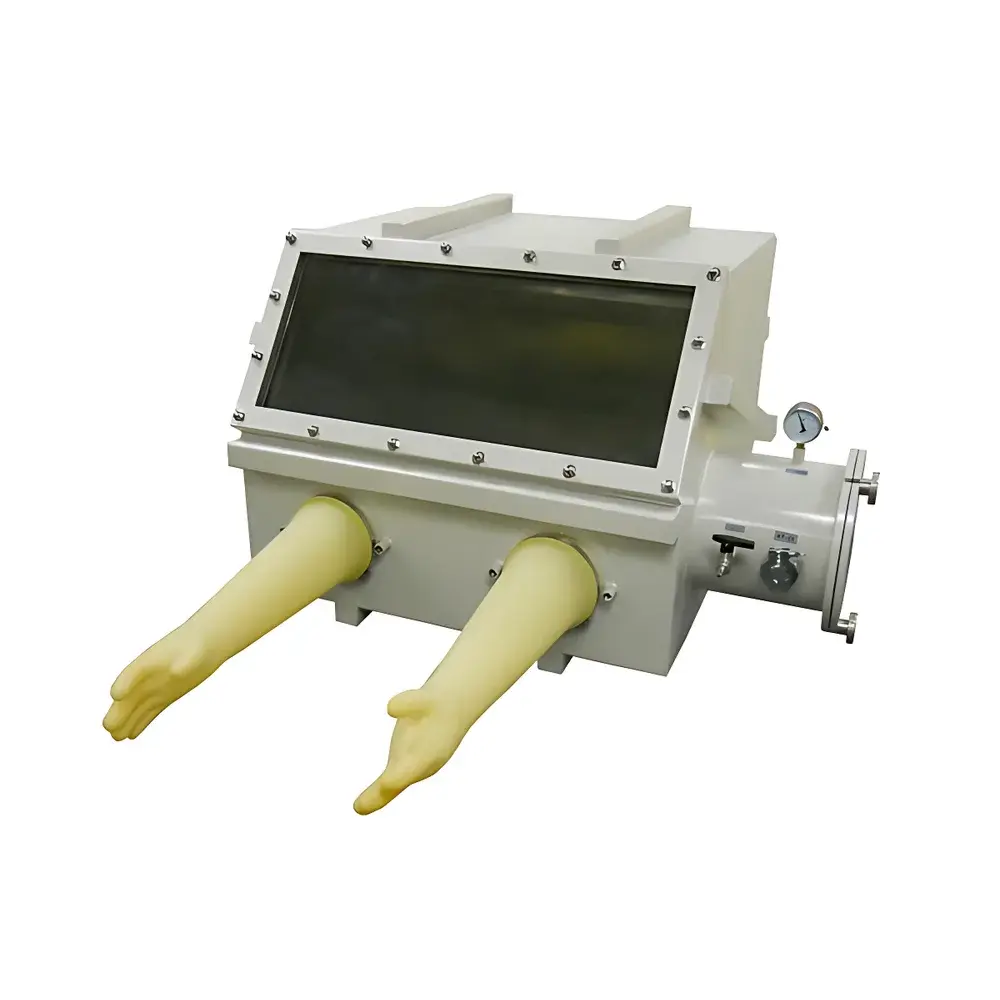
KJ GROUP VGB-1 Stainless Steel Vacuum Glovebox
| Brand | KJ GROUP |
|---|---|
| Origin | Liaoning, China |
| Manufacturer Type | Authorized Distributor |
| Country of Origin | China |
| Model | VGB-1 |
| Pricing | Available Upon Request |
| Chamber Dimensions | 560 mm × 430 mm × 410 mm |
| Front-Loading Antechamber Dimensions | Standard Integrated |
| Construction Material | 304 Stainless Steel (3 mm thickness) |
| Chamber Reinforcement | Internal Structural Ribs |
| Vacuum Performance (Main Chamber) | ≤0.5 torr (with mechanical pump) |
| Vacuum Performance (Antechamber) | ≤0.05 torr |
| Moisture Level (under inert purge) | <180 ppm H₂O |
| Oxygen Level (under inert purge) | <200 ppm O₂ |
| Leak Rate | 6 torr/h |
| Maximum Positive Pressure | 1.1 atm |
| Power Interface | 3-pin IEC C14 inlet (external) feeding internal 1500 W rated 3-outlet power strip |
| Certified | CE compliant |
| Net Weight | 95 kg |
| Overall Footprint | 940 mm × 480 mm × 490 mm |
| Standard Accessories | 2 pairs nitrile/rubber gloves (1 pair pre-installed) |
| Optional Accessories | Rotary vane vacuum pump, stainless steel bellows |
Overview
The KJ GROUP VGB-1 Stainless Steel Vacuum Glovebox is an entry-level, compact inert atmosphere workstation engineered for laboratories requiring reliable containment and controlled environmental conditions during air-sensitive material handling. Designed around the principle of dynamic gas exchange and vacuum-assisted purging, the system enables researchers to establish and maintain low-oxygen (<200 ppm) and low-moisture (<180 ppm) environments within its main chamber—critical for applications involving moisture- or oxygen-sensitive compounds such as lithium battery electrode materials, organometallic catalysts, perovskite precursors, and pyrophoric reagents. Its dual-chamber architecture—comprising a primary working chamber and a dedicated antechamber—allows safe sample transfer without compromising the integrity of the internal atmosphere. The unit operates on a robust vacuum-purge cycle: initial evacuation via external mechanical pump, followed by inert gas (typically argon or nitrogen) backfilling under controlled pressure differentials. This process ensures high reproducibility in atmospheric conditioning across repeated operational cycles.
Key Features
- Structurally reinforced 304 stainless steel chamber (3 mm wall thickness) with integrated internal ribs to prevent deformation under vacuum loads up to 0.5 torr.
- Dual independent vacuum zones: antechamber achieves ≤0.05 torr; main chamber reaches ≤0.5 torr using standard rotary vane pumping—enabling staged isolation and sequential sample loading.
- Integrated 1500 W internal power distribution strip (IEC C14 input), allowing direct operation of analytical instruments, microbalances, or electrochemical cells inside the glovebox without feedthrough complications.
- CE-certified design compliant with EN 61000-6-3 (EMC emission) and EN 61000-6-2 (immunity), confirming suitability for general laboratory deployment within EU-regulated facilities.
- Vacuum-tight construction validated by leak rate specification of ≤6 torr/h, ensuring long-term stability of inert conditions between maintenance intervals.
- Front-access antechamber with quick-release vacuum flange facilitates rapid sample introduction while minimizing exposure of the main chamber to ambient air.
Sample Compatibility & Compliance
The VGB-1 supports handling of solid powders, thin films, coin-cell assemblies, and small-scale reaction vessels—provided dimensions remain within the internal cavity envelope (560 × 430 × 410 mm). Its stainless steel construction resists corrosion from common inert gases and mild chemical vapors encountered in battery R&D or catalysis workflows. While not rated for Class I explosion-proof use or ISO Class 4 cleanroom certification, the glovebox meets baseline requirements for GLP-aligned research environments where documentation of environmental parameters (e.g., O₂/H₂O levels, pressure history) is maintained manually. It serves as a foundational platform compatible with downstream integration into GMP-adjacent processes when paired with validated monitoring accessories (e.g., residual gas analyzers, dew point sensors).
Software & Data Management
The VGB-1 operates as a manually controlled, hardware-centric platform with no embedded microcontroller or digital interface. All vacuum sequencing, gas flow regulation, and pressure monitoring rely on analog instrumentation—including mechanical compound gauges for rough vacuum measurement and calibrated needle valves for inert gas metering. Users are expected to log operational parameters (e.g., pump-down time, final vacuum level, purge duration) in laboratory notebooks or LIMS-compatible spreadsheets. For labs requiring audit trails, the system may be retrofitted with third-party USB-connected pressure transducers and data loggers conforming to FDA 21 CFR Part 11 requirements—though such configurations fall outside standard delivery scope.
Applications
- Lithium-ion and solid-state battery electrode fabrication and testing, including slurry casting, coin-cell assembly, and post-cycling disassembly.
- Synthesis and characterization of air-sensitive metal–organic frameworks (MOFs), single-source precursors, and Grignard reagents.
- Handling of alkali metals (e.g., Li, Na), phosphides, and hydride-based hydrogen storage materials.
- Controlled-atmosphere microscopy sample preparation and TEM grid loading.
- Calibration and validation of reference standards for trace moisture/oxygen analyzers.
FAQ
What vacuum pump is recommended for optimal performance?
A two-stage rotary vane pump with ultimate vacuum ≤1 × 10⁻³ torr and pumping speed ≥4 m³/h is recommended to achieve the specified antechamber (0.05 torr) and main chamber (0.5 torr) performance.
Can the VGB-1 operate under positive pressure only, without vacuum cycling?
Yes—the system supports continuous positive pressure operation (up to 1.1 atm gauge) using regulated inert gas supply; however, initial chamber conditioning still requires vacuum-purge cycles to reduce baseline O₂/H₂O.
Are glove ports compatible with alternative glove materials (e.g., Viton®, Butyl)?
Standard ports accept industry-standard 8-inch diameter gloves; users may replace supplied nitrile gloves with chemically resistant alternatives, provided flange sealing geometry and clamping force are preserved.
Is the internal power strip grounded and surge-protected?
The 3-pin internal outlet strip shares grounding continuity with the chassis and external IEC inlet; no built-in surge suppression is included—lab-grade upstream protection is advised for sensitive instrumentation.
Does the CE marking cover electromagnetic compatibility and safety directives?
Yes—the CE mark affirms conformity with the Low Voltage Directive (2014/35/EU) and Electromagnetic Compatibility Directive (2014/30/EU), verified through third-party testing at accredited EU Notified Bodies.



