
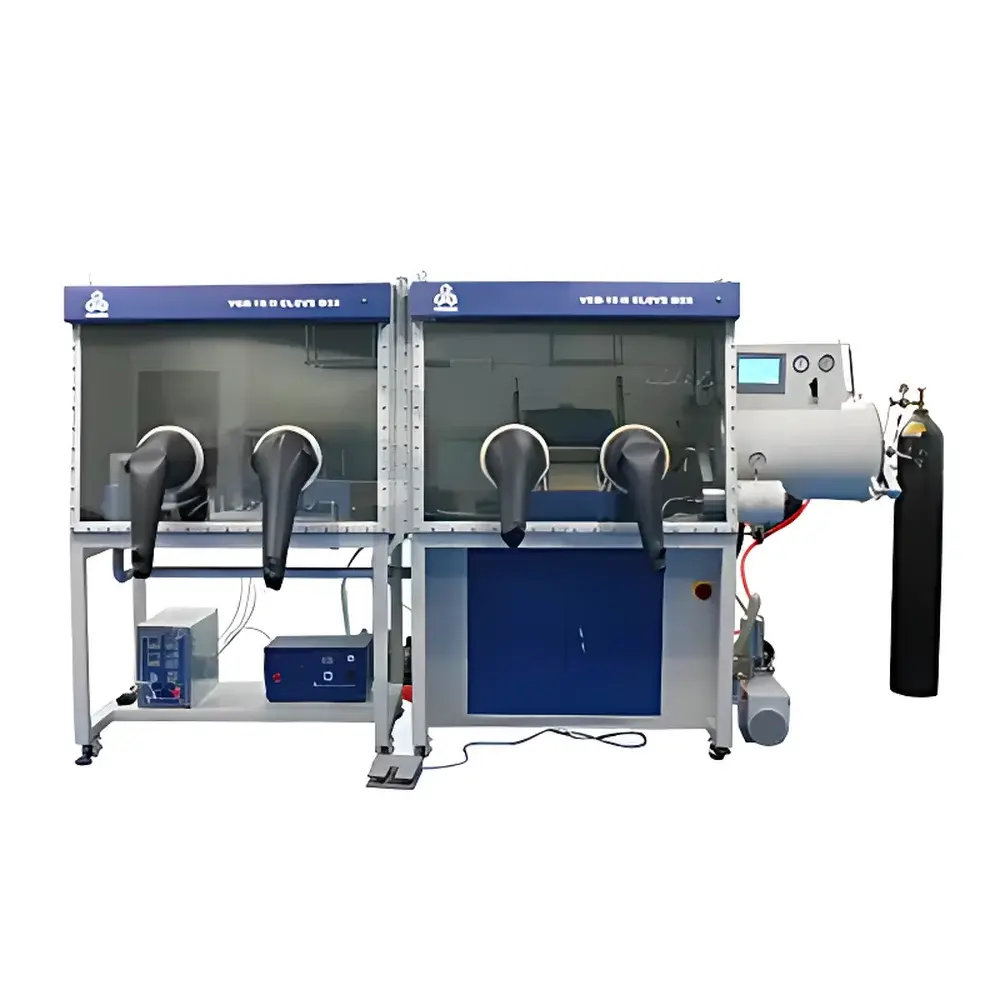
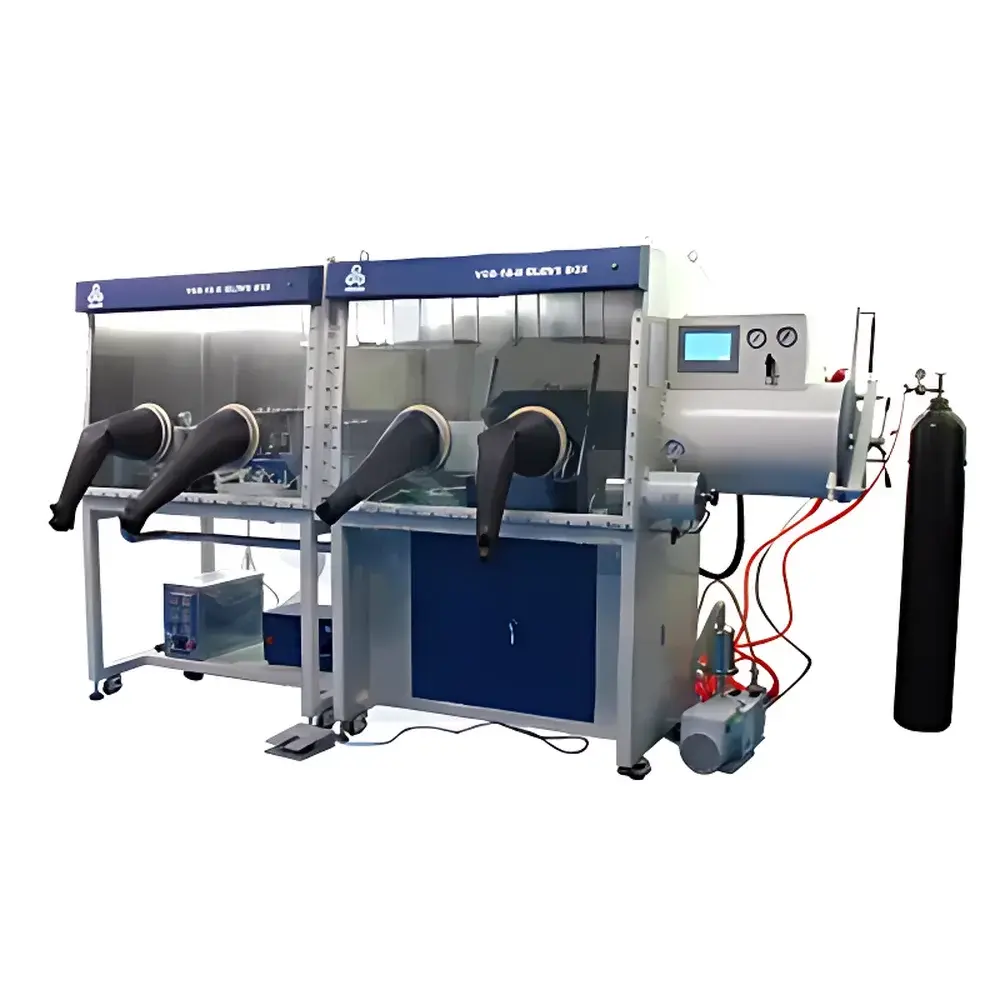
KJ GROUP VGB-10-II Dual-Station Stainless Steel Glovebox
| Brand | KJ GROUP |
|---|---|
| Origin | Liaoning, China |
| Manufacturer Type | Authorized Distributor |
| Origin Category | Domestic |
| Model | VGB-10-II |
| Pricing | Upon Request |
| Power Supply | AC 220 V, 50 Hz |
| Max. Power Consumption | ~3000 W |
| Main Chamber Dimensions | 2400 mm × 800 mm × 930 mm (W×D×H) |
| Overall Footprint | 3115 mm × 830 mm × 1830 mm (W×D×H) |
| Standard Transfer Chamber | 385 mm × 588 mm |
| Tool Transfer Chamber | Ø150 mm × 300 mm |
| Viewing Window | 12 mm thick laminated tempered safety glass with corrosion-resistant film |
| Lighting | Philips fluorescent tubes |
| HEPA Filter | ISO Class 5 compliant, 0.3 µm particle retention efficiency ≥99.999% |
| Organic Solvent Filtration | Integrated activated carbon + HEPA dual-stage filter |
| Moisture Sensor | GE probe, 0–1000 ppm, resolution 0.1 ppm, touchscreen display |
| Oxygen Sensor | AII probe, 0–1000 ppm, resolution 0.1 ppm, touchscreen display |
| Pressure Transducer | Setra, −2500 to +2500 Pa, accuracy ±1 Pa, touchscreen display |
| Vacuum Pump | Edwards, pumping speed 8.4–12 m³/h |
| Gas Purification System | BASF oxygen scavenger + UOP molecular sieve desiccant, auto-regeneration cycle |
| Leak Rate | ≤0.05 vol%/h (measured via O₂ ingress) |
| Transfer Chamber Vacuum Rating | ≤100 Pa |
| Compatible Process Gases | N₂, Ar, He |
| Reductive Gas Compatibility | H₂/N₂ or H₂/Ar mixtures |
| Control Interface | 6-inch color touchscreen, PLC-based, bilingual (English/Chinese) |
| Glove Material | North-brand synthetic elastomer |
| Optional Accessory | 304 stainless steel universal feedthrough plate with KF40 flanges |
Overview
The KJ GROUP VGB-10-II Dual-Station Stainless Steel Glovebox is an engineered inert-atmosphere containment system designed for reproducible, long-term operation under ultra-high-purity conditions. It employs a closed-loop recirculation architecture with continuous gas purification—utilizing catalytic oxygen removal (BASF OXISORB®) and deep desiccation (UOP 3A/4A molecular sieves)—to maintain internal H₂O and O₂ concentrations at ≤1 ppm (v/v) under standard ambient conditions (20 °C, 101.3 kPa). This performance level meets the stringent environmental requirements for handling air-sensitive compounds, including alkali metal anodes, solid-state electrolytes, organometallic precursors, and moisture-sensitive catalysts. The system operates on a dual-station configuration: one main chamber for primary manipulation and two independent transfer chambers—one standard (385 × 588 mm) for bulk sample introduction and one cylindrical tool chamber (Ø150 × 300 mm) for rapid instrument or probe insertion—enabling uninterrupted workflow while preserving chamber integrity.
Key Features
- PLC-controlled dual-mode operation: fully automatic purification cycles with manual override capability for pressure regulation, purge sequencing, and regeneration initiation.
- Real-time multi-parameter monitoring via 6-inch industrial touchscreen: simultaneous visualization of H₂O (GE sensor), O₂ (AII sensor), differential pressure (Setra transducer), and system status alarms.
- Redundant safety architecture: mechanical vacuum/pressure gauges provide independent verification; leak rate ≤0.05 vol%/h ensures compliance with ISO 10648-2 Class 1 containment standards.
- Corrosion-resistant construction: 304 stainless steel main chamber body with electropolished interior surfaces; double-laminated 12 mm tempered safety glass viewport featuring chemically resistant film lamination.
- Integrated dual-stage filtration: upstream HEPA (0.3 µm, ≥99.999% efficiency) and downstream activated carbon sorbent for organic vapor abatement—critical for battery slurry processing and solvent-based synthesis.
- Modular utility interface: KF40 vacuum flange ports and optional 304 stainless steel universal feedthrough plate support in-chamber integration of electrical feeds, pneumatic lines, and vacuum manifolds without compromising seal integrity.
Sample Compatibility & Compliance
The VGB-10-II accommodates a broad spectrum of sensitive materials requiring inert, dry, and oxygen-free environments—including lithium metal foils, sodium-ion cathode precursors (e.g., layered oxides), perovskite quantum dots, Grignard reagents, metal–organic frameworks (MOFs), and pyrophoric transition metal complexes. Its validated ≤1 ppm O₂/H₂O stability supports ASTM D6984-22 (moisture-sensitive material handling), ISO 8573-1 Class 1 compressed air purity equivalency, and GLP-compliant documentation protocols. All sensors meet NIST-traceable calibration requirements; data logging adheres to ALCOA+ principles (Attributable, Legible, Contemporaneous, Original, Accurate, Complete, Consistent, Enduring, Available) for audit readiness.
Software & Data Management
The embedded PLC firmware records all operational parameters—including timestamped sensor readings, valve actuation events, regeneration cycle logs, and alarm triggers—at user-defined intervals (1 s to 60 min). Exportable CSV files support traceability per FDA 21 CFR Part 11 Annex 11 expectations when paired with networked time servers and role-based access control (via optional Ethernet module). No cloud dependency: local storage on industrial-grade SD card ensures data sovereignty and uninterrupted logging during network outages.
Applications
- Battery R&D: Electrode slurry casting, coin-cell assembly, solid-electrolyte interface (SEI) characterization, and post-cycling disassembly of Li-metal and Na-ion cells.
- Materials Synthesis: Controlled atmosphere CVD precursor handling, MOF crystallization, and air-sensitive nanoparticle ligand exchange.
- Catalysis: Preparation and activation of Pd/C, Ni/Raney, and Ziegler–Natta systems under defined reducing atmospheres (H₂/N₂).
- Pharmaceutical Development: Handling of hygroscopic active pharmaceutical ingredients (APIs) and oxygen-labile intermediates per ICH Q5C guidelines.
- Electronics Fabrication: Thin-film deposition pre-treatment, photolithography mask storage, and GaAs/InP wafer handling prior to epitaxial growth.
FAQ
What inert gases are compatible with the VGB-10-II?
N₂, Ar, and He are fully supported as primary working gases. H₂/N₂ or H₂/Ar mixtures may be introduced for in-situ reduction cycles, provided appropriate explosion-proof fittings and O₂ sensor cross-calibration are implemented.
Can the glovebox operate continuously for extended periods without maintenance?
Yes—the BASF/UOP purification system enables >6 months of uninterrupted operation at ≤1 ppm H₂O/O₂ under typical lab usage (≤4 h/day operator access); regeneration cycles are fully automated and require only periodic desiccant/oxygen-scavenger replacement every 12–18 months.
Is the system compliant with international cleanroom or laboratory safety standards?
It conforms to ISO 10648-2 (leak integrity), EN 61000-6-2/6-4 (EMC), and IEC 61010-1 (electrical safety); optional ATEX-certified components available for H₂-rich environments.
How is data integrity ensured during power interruption?
Non-volatile memory retains all configuration settings and the last 72 hours of sensor history; critical alarms trigger audible/visual alerts and initiate safe-state shutdown (valve closure, pump coast-down) within <500 ms.
What validation documentation is supplied with the system?
Factory acceptance test (FAT) report, as-built drawings, sensor calibration certificates (GE, AII, Setra), and material traceability for all wetted parts (304 SS mill test reports) are included. IQ/OQ protocol templates are provided for user-executed qualification.
Related Products



