
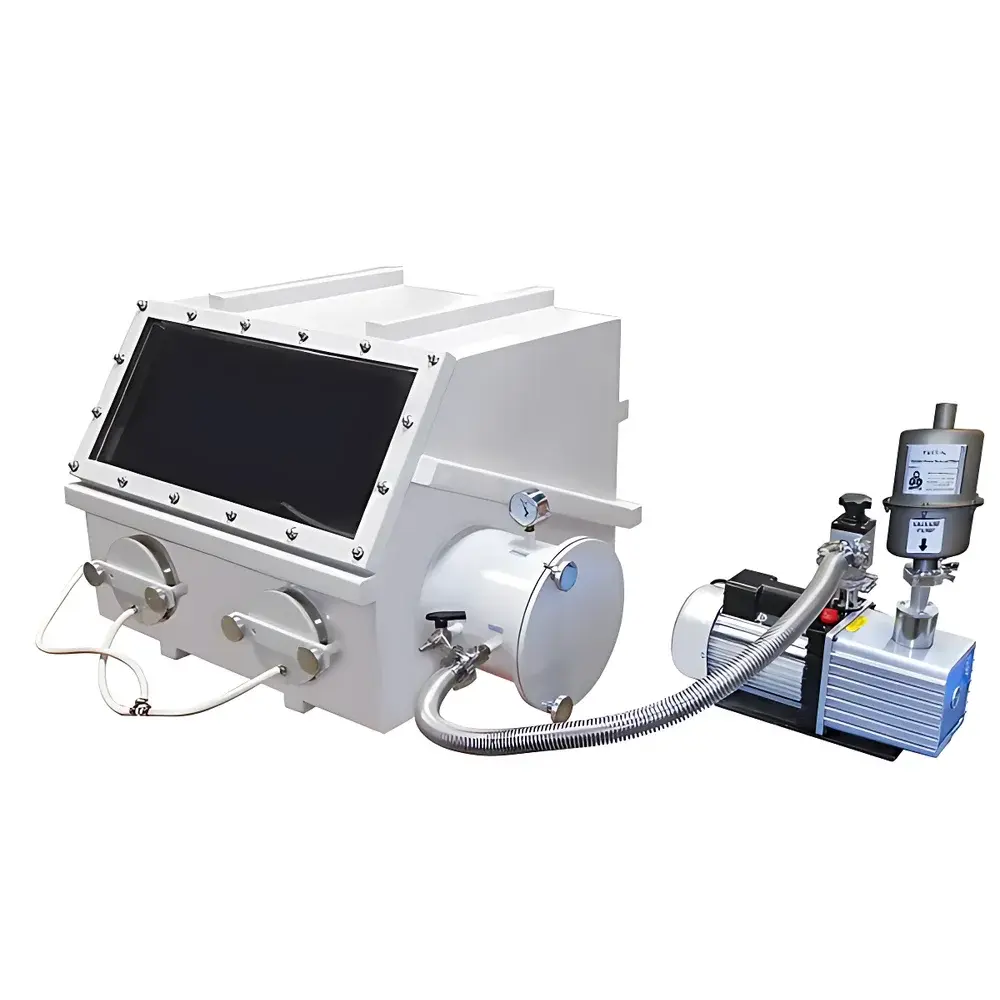
KJ GROUP VGB-3 Stainless Steel Vacuum Glove Box
| Brand | KJ GROUP |
|---|---|
| Origin | Liaoning, China |
| Manufacturer Type | Authorized Distributor |
| Country of Origin | China |
| Model | VGB-3 |
| Pricing | Available Upon Request |
| Construction Material | 304 Stainless Steel (3 mm thickness) |
| Main Chamber Dimensions | 780 × 700 × 650 mm (31" × 28" × 26") |
| Antechamber Dimensions | Not Specified |
| Vacuum Level (Antechamber) | 0.05 Torr (0.067 mbar) |
| Vacuum Level (Main Chamber) | 0.5 Torr (0.67 mbar) |
| Leak Rate | < 6 Torr/hour |
| Inert Gas Retention Time | > 12 hours |
| Maximum Positive Pressure | 1.1 atm (≈ 810 Torr) |
| Internal Power Outlet | 1500 W rated strip with external 3-pin IEC C14 inlet |
| Standard Accessories | Two 6" elastomeric gloves (one installed, one spare) |
| Net Weight | 520 lbs (236 kg) |
| Structural Reinforcement | Integrated stiffening ribs |
| Port Configuration | Two KF25 vacuum ports + three ball valves (main chamber) |
| Operating Limitation | Not designed for high-vacuum applications (< 10⁻³ Torr) |
Overview
The KJ GROUP VGB-3 Stainless Steel Vacuum Glove Box is an engineered inert-atmosphere workstation designed for controlled-material handling in research and development environments where oxygen and moisture sensitivity are critical concerns. Unlike ultra-high-vacuum systems, the VGB-3 operates within a defined low-vacuum regime—optimized for efficient degassing of internal atmosphere prior to inert gas purging—rather than sustained high-vacuum operation. Its core function is to establish and maintain an oxygen- and moisture-controlled environment (typically < 1 ppm O₂ and < 1 ppm H₂O after proper conditioning) through sequential vacuum-purge cycles using argon or nitrogen. The unit employs a robust 304 stainless steel construction (3 mm wall thickness), reinforced with structural ribs to prevent deformation under differential pressure conditions up to ±0.1 atm. This architecture ensures dimensional stability during repeated evacuation and pressurization cycles, supporting long-term operational integrity in academic laboratories, battery R&D facilities, and air-sensitive synthesis workflows.
Key Features
- Monolithic 304 stainless steel chamber fabricated to ASME BPE-equivalent fabrication standards, with full weld seam inspection and passivation treatment for corrosion resistance.
- Main chamber volume of 358 L (780 × 700 × 650 mm), configured with dual 6″ elastomeric glove ports mounted on ISO-KF flanged interfaces—designed to retain seal integrity at both sub-atmospheric (down to 0.5 Torr) and modest overpressure (up to 1.1 atm) conditions.
- Dedicated antechamber equipped with mechanical Bourdon-tube pressure gauge (0–1000 Torr range), single KF25 vacuum port, and isolation ball valve—enabling safe sample transfer without compromising main chamber integrity.
- Main chamber rear panel features two KF25 vacuum ports and three manually operated stainless steel ball valves, permitting flexible integration with external vacuum pumps, gas manifolds, or analytical feedthroughs.
- Internally mounted 1500 W power distribution strip (120/240 V AC, 15 A), accessible via external IEC C14 inlet—compliant with UL 61010-1 and IEC 61010-1 safety requirements for laboratory equipment.
- Leak rate verified at < 6 Torr/hour under static vacuum hold test—meeting ASTM E493 Class III criteria for moderate-seal integrity in glove box applications.
Sample Compatibility & Compliance
The VGB-3 accommodates solid, powder, and small-component samples typical in solid-state battery electrode fabrication, organometallic synthesis, and air-sensitive catalyst handling. Its design supports GLP-compliant documentation of atmospheric conditioning cycles when paired with external data loggers. While not certified to ISO 14644 cleanroom classifications, its sealed architecture enables stable inert environments suitable for processes requiring adherence to USP analytical instrument qualification guidelines for environmental control. The unit complies with CE machinery directive 2006/42/EC for mechanical safety and meets RoHS 2011/65/EU material restrictions. Note: Final system validation—including O₂/H₂O residual concentration measurement—requires user-installed sensors (e.g., Systech or MBRAUN trace analyzers) and is outside the scope of factory certification.
Software & Data Management
The VGB-3 is a manually operated, non-automated platform with no embedded controller or digital interface. All process steps—including vacuum initiation, purge gas flow regulation, and pressure monitoring—are executed via mechanical valves and analog gauges. This architecture eliminates firmware dependencies, ensuring deterministic behavior and compatibility with electromagnetic-sensitive environments (e.g., nearby NMR or TEM facilities). For audit-trail compliance in regulated settings, users may integrate third-party pressure and gas purity loggers connected to validated PC-based acquisition software (e.g., LabVIEW or MATLAB) that conforms to FDA 21 CFR Part 11 requirements for electronic records and signatures.
Applications
- Lithium-ion and solid-state battery electrode slurry preparation and coin-cell assembly under argon atmosphere.
- Handling of pyrophoric reagents (e.g., alkyl lithium compounds, white phosphorus) and moisture-sensitive precursors (e.g., metal halides, MOFs).
- Encapsulation and testing of perovskite photovoltaic devices prior to encapsulation.
- Controlled-atmosphere metallurgical sample mounting and sectioning for electron microscopy specimen preparation.
- Long-duration storage of hygroscopic reference standards used in quantitative XRD or TGA calibration protocols.
FAQ
Can the VGB-3 achieve high vacuum (e.g., 10⁻⁶ Torr)?
No. The VGB-3 is structurally and functionally optimized for low-vacuum degassing (≤ 0.5 Torr). Attempting higher vacuum levels risks permanent deformation of the 3 mm stainless steel chamber due to lack of internal bracing for ultra-high-vacuum stress profiles.
Is it safe to operate the gloves under vacuum?
No. Rubber gloves must never be manipulated while the chamber is under vacuum. Vacuum application serves only to evacuate ambient air and adsorbed moisture from interior surfaces prior to inert gas backfilling.
What is the maximum allowable positive pressure?
The system is rated for a maximum differential pressure of +0.1 atm (≈ 810 Torr absolute). Exceeding this limit may compromise glove seal integrity or cause flange gasket extrusion.
Does the unit include a vacuum pump?
No. Vacuum pumping hardware—including scroll, diaphragm, or turbomolecular pumps and associated KF25-compatible piping—is sold separately and must be selected based on required ultimate pressure and pumping speed for the user’s specific gas load.
How is inert gas purity maintained over time?
Gas retention exceeds 12 hours under static conditions; however, continuous purity depends on leak rate, operator discipline during transfers, and frequency of antechamber cycling. Best practice includes periodic verification using trace O₂/H₂O analyzers calibrated per ISO 8573-1 Class 2 specifications.



