
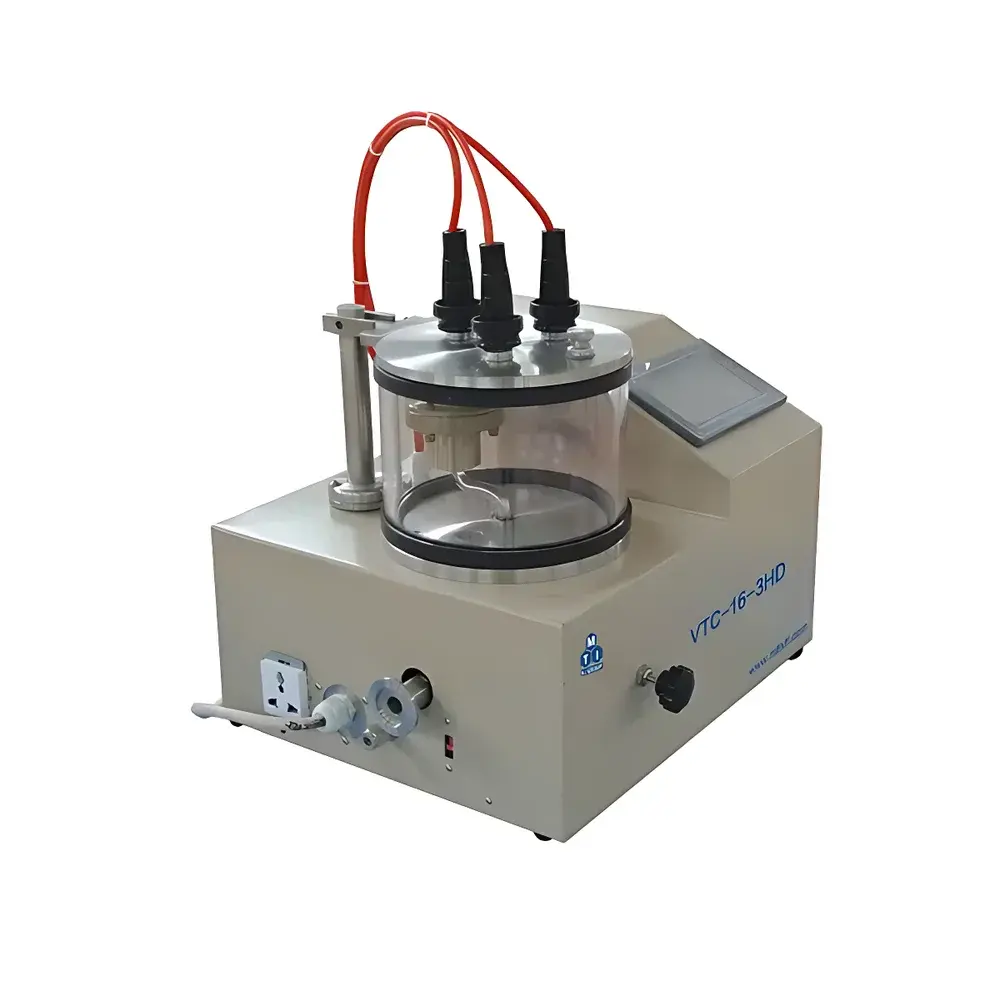
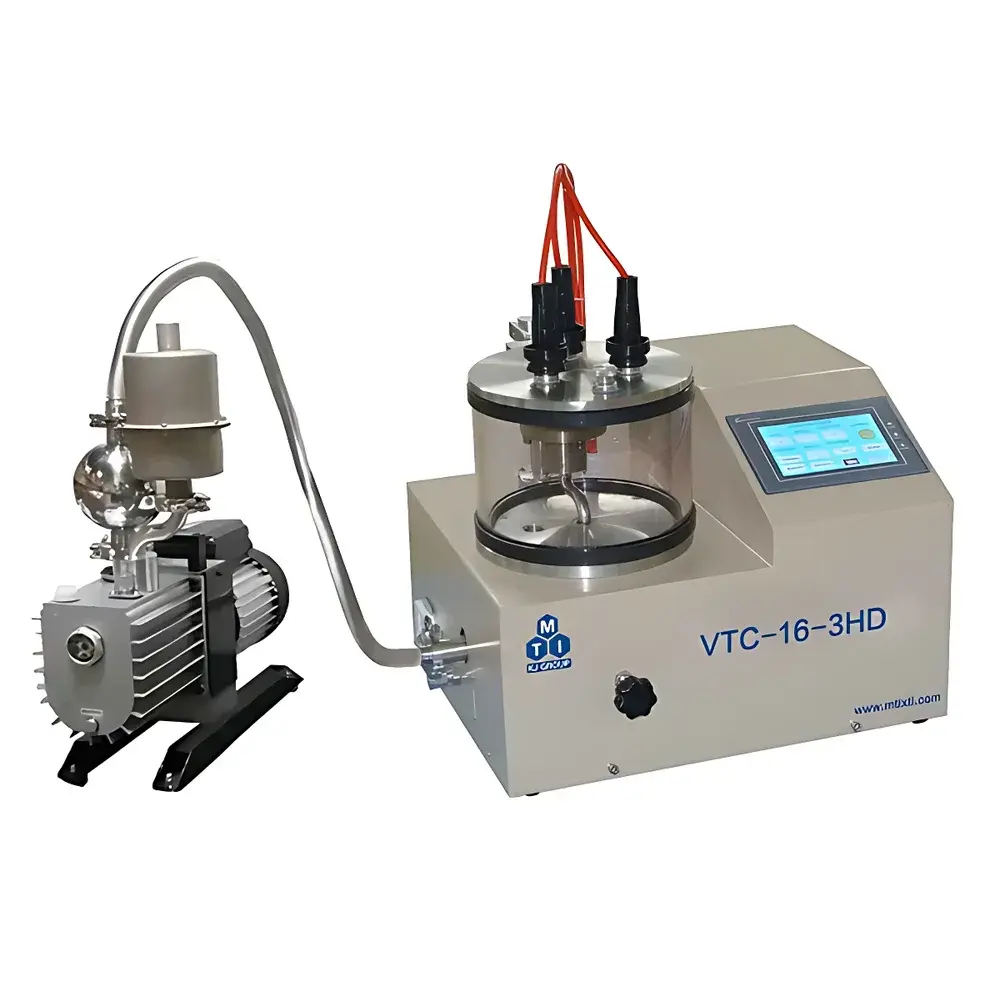
KJ GROUP VTC-16-3HD Triple-Target DC Magnetron Sputtering Coater
| Brand | KJ GROUP |
|---|---|
| Origin | Liaoning, China |
| Model | VTC-16-3HD |
| Input Power | 2000 W (universal 110/220 V, 50 Hz) |
| Max DC Output | 1600 V / 50 mA |
| Sample Stage Diameter | 50 mm |
| Max Heating Temperature | 500 °C |
| Quartz Chamber Dimensions | Ø160 mm × 120 mm |
| Vacuum Pump | 120 L/min Rotary Vane Pump |
| Gas Inlet | Precision Adjustable Needle Valve for Argon (≥99.99% purity) |
| Target Size | Ø47 mm, Thickness 0.1–3 mm |
| Compatible Targets | Au, Ag, Pt, Cr, Ni |
| Excluded Materials | Oxides, Semiconductors, Al, Zn, C, Mg, Ti, Si |
| Footprint | 360 mm × 350 mm × 360 mm |
| Weight | 50 kg |
Overview
The KJ GROUP VTC-16-3HD Triple-Target DC Magnetron Sputtering Coater is a compact, benchtop-scale physical vapor deposition (PVD) system engineered for precise, repeatable thin-film fabrication in academic and industrial research laboratories. It operates on the principle of direct-current magnetron sputtering—where a high-voltage DC discharge ionizes argon gas within a low-pressure chamber, accelerating Ar⁺ ions toward conductive metallic targets. Momentum transfer from these ions ejects target atoms, which subsequently condense as uniform nanoscale films onto substrates mounted on a rotating sample stage. Designed for simplicity without compromising process control, the VTC-16-3HD integrates a PLC-based automation architecture with a 4.3″ color touch interface, enabling intuitive operation by users with minimal vacuum or thin-film training. Its modular vacuum train—comprising a 120 L/min rotary vane pump, KF25-compatible flanges, stainless-steel bellows, and precision needle-valve gas regulation—supports base pressures down to ≤5 × 10⁻³ mbar, sufficient for high-quality metal film deposition (e.g., Au, Ag, Pt) with thickness control at the sub-10 nm level via time-based sputtering protocols.
Key Features
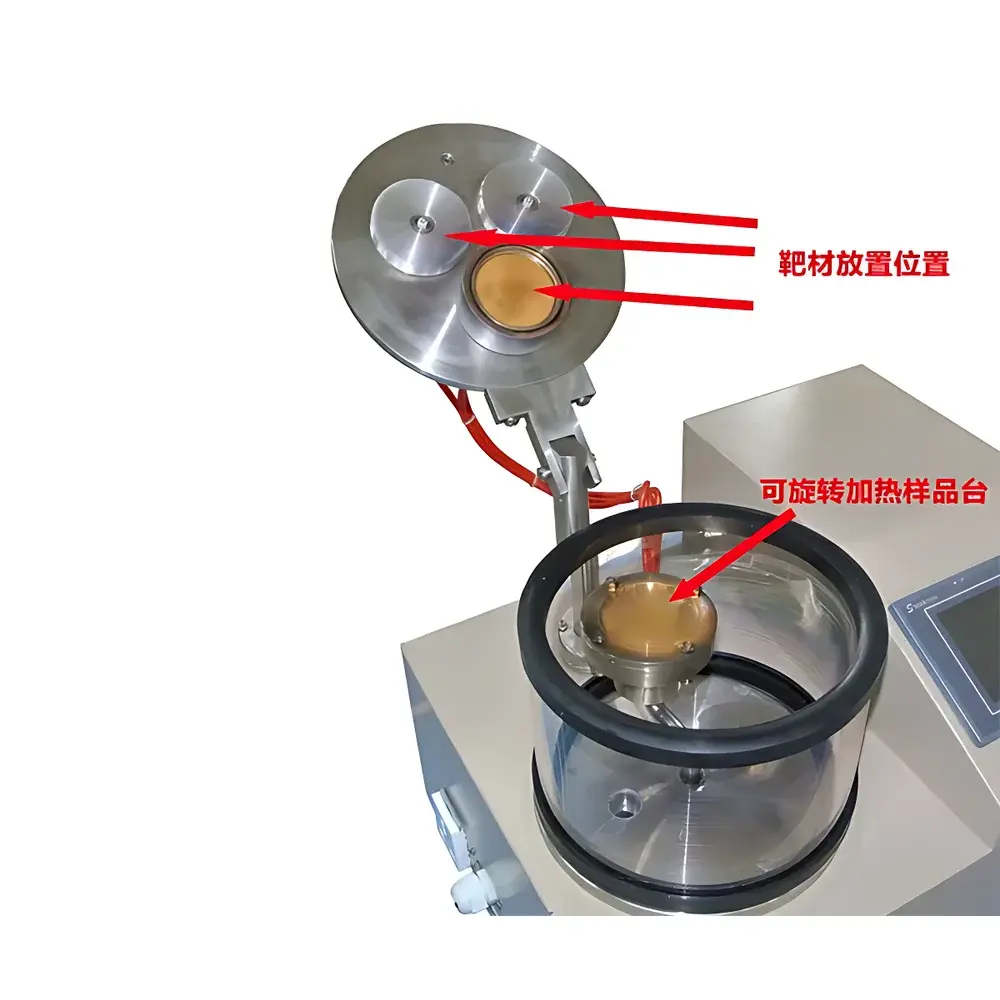
- Triple independent DC magnetron targets (Ø47 mm), manually positionable for sequential or co-sputtering configurations
- Motorized rotating sample stage (Ø50 mm) enabling uniform multi-layer deposition on a single substrate without realignment
- PID-controlled resistive heating stage (optional upgrade), calibrated up to 500 °C for thermally activated adhesion or interfacial diffusion studies
- Integrated 4.3″ HMI touchscreen with PLC logic—providing real-time monitoring and adjustment of sputtering current (0–50 mA), chamber pressure (via analog Pirani gauge), argon flow rate, and stage temperature
- CE-compliant electrical architecture with reinforced grounding, overcurrent protection, and interlocked chamber door safety circuitry
- Compact footprint (360 × 350 × 360 mm) optimized for shared lab environments; no external water cooling or exhaust ducting required
Sample Compatibility & Compliance
The VTC-16-3HD accommodates substrates up to 2-inch (50.8 mm) diameter, with standard mounting on a flat, electrically isolated copper stage. Compatible substrates include silicon wafers, glass slides, TEM grids, ceramic chips, and polymer films—provided surface cleanliness meets standard solvent-rinse protocols (e.g., acetone/isopropanol ultrasonication). As a DC sputtering system, it is inherently limited to electrically conductive targets: high-purity Au, Ag, Pt, Cr, and Ni are routinely deposited with reproducible sheet resistance and morphology. Non-conductive materials—including metal oxides (e.g., ITO, TiO₂), semiconductors (e.g., Si, Ge), and light metals (Al, Mg, Ti) —are incompatible due to arcing risk and charge buildup. The system complies with EU Machinery Directive 2006/42/EC and Electromagnetic Compatibility Directive 2014/30/EU, bearing full CE marking documentation traceable to ISO/IEC 17065-accredited certification bodies. While not GLP/GMP-validated out-of-the-box, its parameter logging capability supports internal audit readiness per ISO/IEC 17025 requirements.
Software & Data Management
The VTC-16-3HD employs embedded PLC firmware (no PC dependency) with non-volatile memory storing up to 20 user-defined process recipes. Each recipe retains setpoints for voltage, current, pressure, gas flow, stage temperature, and sputtering duration—enabling rapid recall and cross-lab protocol replication. All operational events (start/stop timestamps, fault codes, manual overrides) are timestamped and logged locally to internal flash storage, exportable via USB to CSV for integration into LIMS or ELN platforms. Though lacking native FDA 21 CFR Part 11 compliance (e.g., electronic signatures, audit trails), the system supports procedural adherence through documented SOPs and manual logbook supplementation—a common practice in university core facilities operating under institutional QA frameworks.
Applications
- Preparation of conductive coatings for SEM/TEM sample mounting and charge dissipation
- Rapid prototyping of electrode layers in microelectrode arrays and biosensor development
- Deposition of reference metallization for XRD calibration standards and AFM tip coating
- Multi-target layer stacking (e.g., Cr/Au, Ni/Pt) for ohmic contact studies in semiconductor device fabrication
- In situ thermal annealing experiments using the heated stage to investigate interdiffusion kinetics in bilayer systems
- Teaching labs: Demonstrating PVD fundamentals, plasma characteristics, and vacuum science principles
FAQ
What vacuum level can the VTC-16-3HD achieve?
With the included 120 L/min rotary vane pump and proper leak-tight assembly, the system reaches a base pressure of ≤5 × 10⁻³ mbar after 20–30 minutes of pump-down.
Can I use reactive gases like oxygen or nitrogen?
No—the power supply and chamber design are configured exclusively for inert argon sputtering. Reactive sputtering requires RF or pulsed-DC sources and corrosion-resistant components not present in this model.
Is remote operation or computer control possible?
The unit operates autonomously via its integrated PLC and touchscreen. RS232 or Ethernet interfaces are not provided; however, analog voltage outputs (0–10 V) for pressure and current are accessible at the rear I/O terminal block for third-party DAQ integration.
What maintenance does the vacuum pump require?
The rotary vane pump requires oil replacement every 200 hours of cumulative operation and periodic inspection of the gas ballast valve and exhaust filter—per manufacturer guidelines supplied with the pump.
Does the system support film thickness monitoring?
No quartz crystal microbalance (QCM) or optical monitor is integrated. Thickness estimation relies on empirical calibration curves (nm/min vs. current/time) established during initial process validation using profilometry or ellipsometry.



