
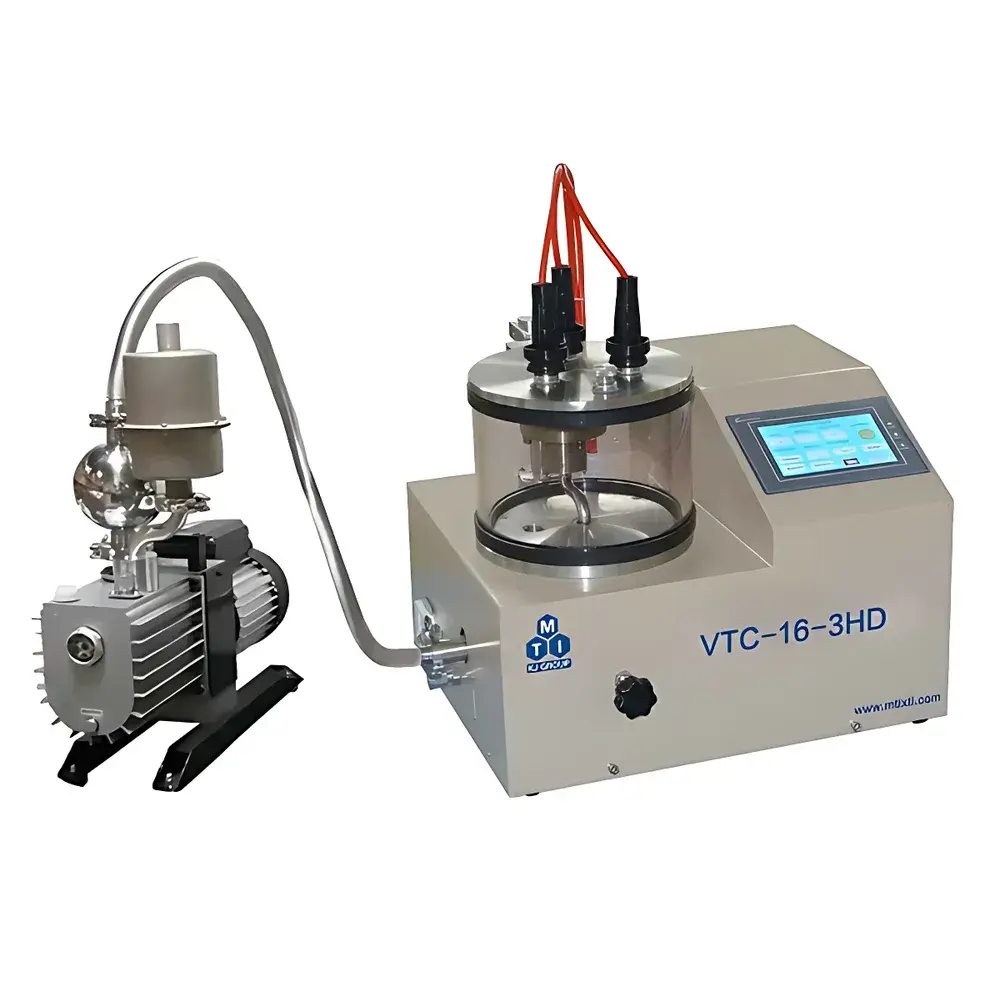
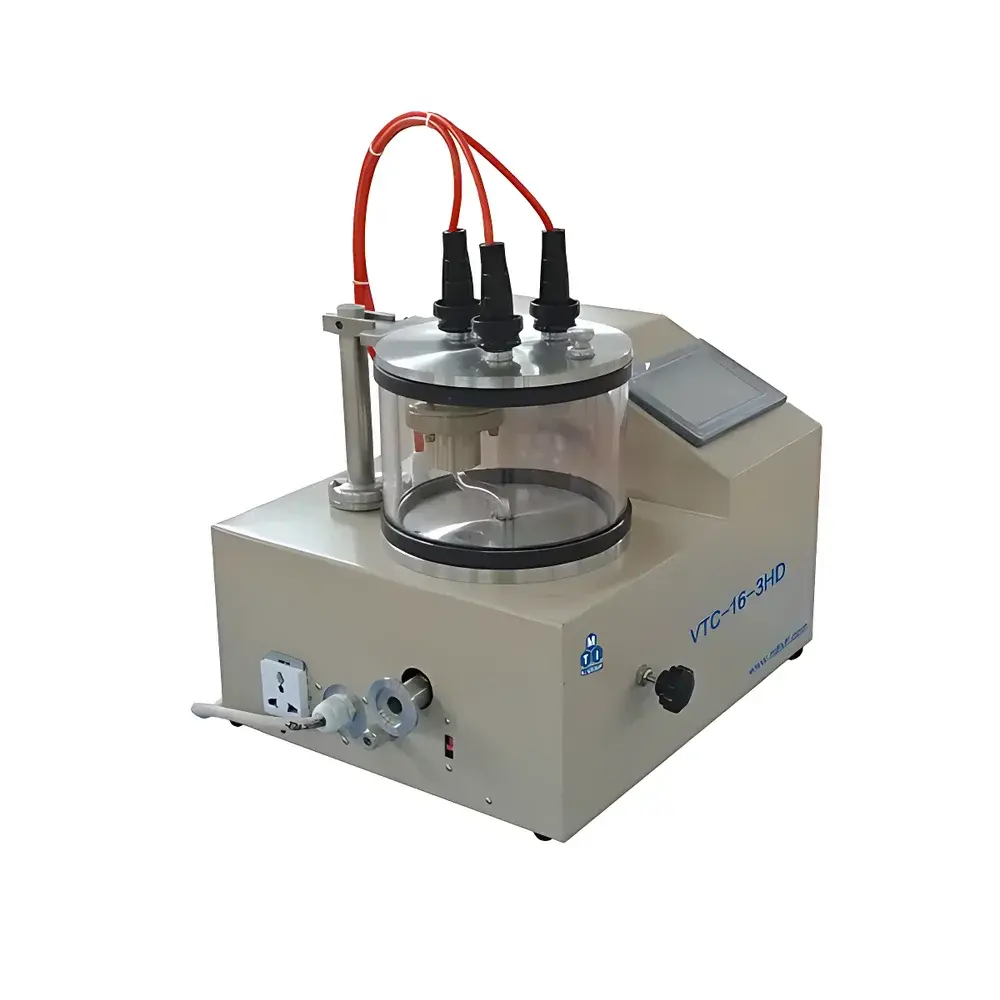
KJ GROUP VTC-16-3HD Triple-Target DC Magnetron Sputtering System
| Brand | KJ GROUP |
|---|---|
| Origin | Liaoning, China |
| Model | VTC-16-3HD |
| Input Power | 2000 W (universal 110/220 V, 50 Hz) |
| Max DC Output | 1600 V / 50 mA |
| Sample Stage Diameter | Ø50 mm |
| Max Heating Temperature | 500 °C |
| Sputtering Chamber Quartz Shield | Ø160 mm × 120 mm |
| Vacuum Pump | 120 L/min Rotary Vane Pump |
| Argon Purity Requirement | ≥99.99% |
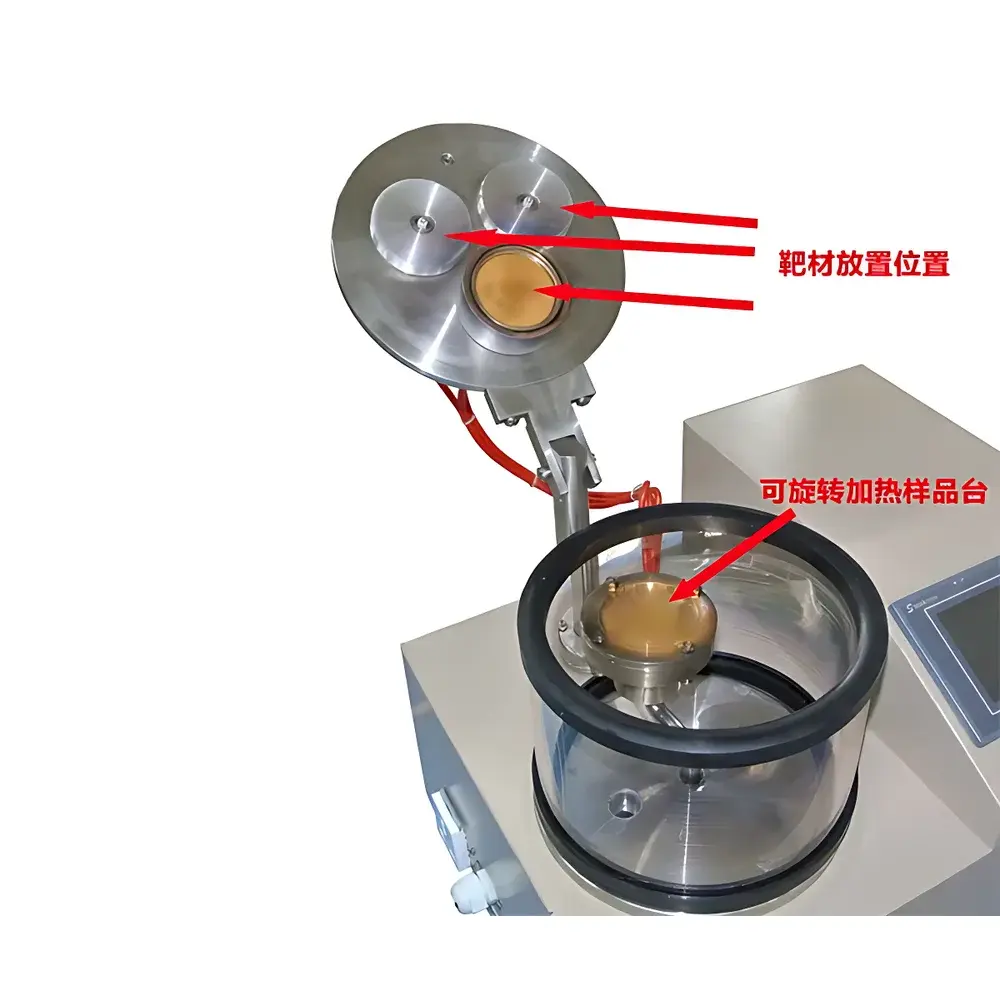
| Target Dimensions | Ø47 mm, thickness 0.1–3 mm |
| Compatible Target Materials | Au, Ag, Pt, Cr, Ni |
| Excluded Materials | Al, Zn, C, oxides, semiconductors, light metals |
| Dimensions (W×D×H) | 360 mm × 350 mm × 360 mm |
| Weight | 50 kg |
Overview
The KJ GROUP VTC-16-3HD Triple-Target DC Magnetron Sputtering System is a compact, benchtop-scale physical vapor deposition (PVD) instrument engineered for precise, reproducible thin-film fabrication in academic and industrial research laboratories. It operates on the principle of direct-current (DC) magnetron sputtering—where energetic argon ions, accelerated in a low-pressure plasma environment (typically 1–20 mTorr), bombard conductive target materials, ejecting atoms that subsequently condense onto a substrate to form uniform metallic thin films. Designed with three independently positionable sputter targets, the system enables sequential or co-deposition of up to three distinct metallic layers on a single substrate without breaking vacuum—critical for fabricating multilayer structures such as electrical contacts, seed layers, or model catalytic interfaces. Its integrated PID-controlled heating stage (up to 500 °C), PLC-based automation, and intuitive 4.3″ touchscreen interface ensure consistent thermal management and process repeatability across experimental runs.
Key Features
- Triple-target configuration with manual azimuthal rotation for sequential layer deposition on a single Ø50 mm substrate
- PLC-controlled operation with real-time monitoring and adjustment of vacuum level, DC current, target positioning, and stage temperature
- PID-regulated heated sample stage (optional upgrade), capable of stable operation from ambient to 500 °C with ±2 °C thermal uniformity over the central 30 mm diameter
- Integrated quartz viewing shield (Ø160 mm × 120 mm) for visual process observation and plasma monitoring
- High-precision adjustable needle valve for controlled argon gas flow regulation, enabling fine-tuned pressure stabilization between 0.5–30 mTorr
- CE-certified design compliant with EN 61000-6-2 (immunity) and EN 61000-6-4 (emission) standards; built-in safety interlocks for door-open shutdown and overtemperature protection
- Modular vacuum architecture compatible with KF25 flanged components—including stainless-steel bellows, quick-release clamps, and optional 120 L/min rotary vane pump
Sample Compatibility & Compliance
The VTC-16-3HD accommodates substrates up to 2 inches (Ø50 mm) in diameter, including silicon wafers, glass slides, TEM grids, ceramic coupons, and flexible polymer films mounted on rigid carriers. Substrate heating is supported only for thermally stable materials (e.g., SiO₂/Si, alumina, fused quartz); prolonged exposure above 400 °C is not recommended for organic or low-melting-point substrates. The system is restricted to DC-sputterable conductive targets: high-purity Au, Ag, Pt, Cr, and Ni (≥99.95% purity). Oxides, nitrides, semiconductors (e.g., Si, Ge), and reactive light metals (Al, Mg, Ti, Zn) are incompatible due to arcing risk and lack of RF capability. All operational parameters—including vacuum ramp rate, sputter time (≤5 min per layer), and power delivery—are documented in accordance with GLP-aligned lab record-keeping practices. While not inherently 21 CFR Part 11 compliant, audit trails can be maintained externally via timestamped operator logs and saved parameter sets.
Software & Data Management
The VTC-16-3HD employs an embedded PLC controller with non-volatile memory for storing up to 20 user-defined process recipes. Each recipe retains vacuum setpoint, argon flow rate, target selection sequence, DC voltage/current limits, heating profile (ramp/soak/cool), and total sputter duration. Parameter changes during operation are logged with timestamps and operator ID (via touchscreen login). No proprietary PC software is required; however, RS-232 or USB-to-serial adapters allow integration with third-party data acquisition systems for long-term trending of chamber pressure, power delivery, and thermal response. Exported log files follow CSV format for compatibility with MATLAB, Python (pandas), or LabVIEW analysis pipelines. Firmware updates are performed via microSD card, ensuring traceability under internal quality control protocols.
Applications
- Preparation of conductive electrodes for scanning electron microscopy (SEM) and energy-dispersive X-ray spectroscopy (EDS) sample coating
- Deposition of adhesion-promoting Cr or Ni layers prior to Au or Pt metallization in microfabrication workflows
- Controlled synthesis of bilayer or trilayer model catalysts (e.g., Pt/Cr/SiO₂) for surface science studies
- Rapid prototyping of resistive heater elements or thermocouple junctions on MEMS substrates
- Thin-film calibration standards for X-ray reflectivity (XRR) and ellipsometry validation
- Teaching laboratory demonstrations of plasma physics, thin-film nucleation, and solid-state diffusion phenomena
FAQ
What vacuum level can the VTC-16-3HD achieve with the included pump?
With the standard 120 L/min rotary vane pump and clean, dry chamber conditions, base pressure reaches ≤5 × 10⁻³ mTorr after 30 minutes of pumping. Process pressure is actively regulated between 1–20 mTorr using the integrated needle valve.
Can I use reactive gases like oxygen or nitrogen with this system?
No. The VTC-16-3HD is configured exclusively for inert-gas (Ar) DC sputtering. Reactive sputtering requires RF power supplies, gas mixing manifolds, and process controllers not present in this model.
Is the heating stage programmable for ramp-and-soak cycles?
Yes—the PID controller supports multi-step thermal profiles, including ramp rates (1–10 °C/min), dwell times (1–60 min), and cooling pauses, all definable within stored recipes.
What maintenance is required for long-term reliability?
Recommended quarterly tasks include cleaning the chamber interior with IPA-wiped lint-free wipes, inspecting O-rings for compression set, verifying argon line filter integrity, and calibrating the thermocouple input using a certified reference source.
Does the system support automatic layer thickness estimation?
No. Thickness must be inferred post-deposition via profilometry, SEM cross-section, or quartz crystal microbalance (QCM) if integrated separately. The VTC-16-3HD provides no in-situ thickness monitoring capability.



