
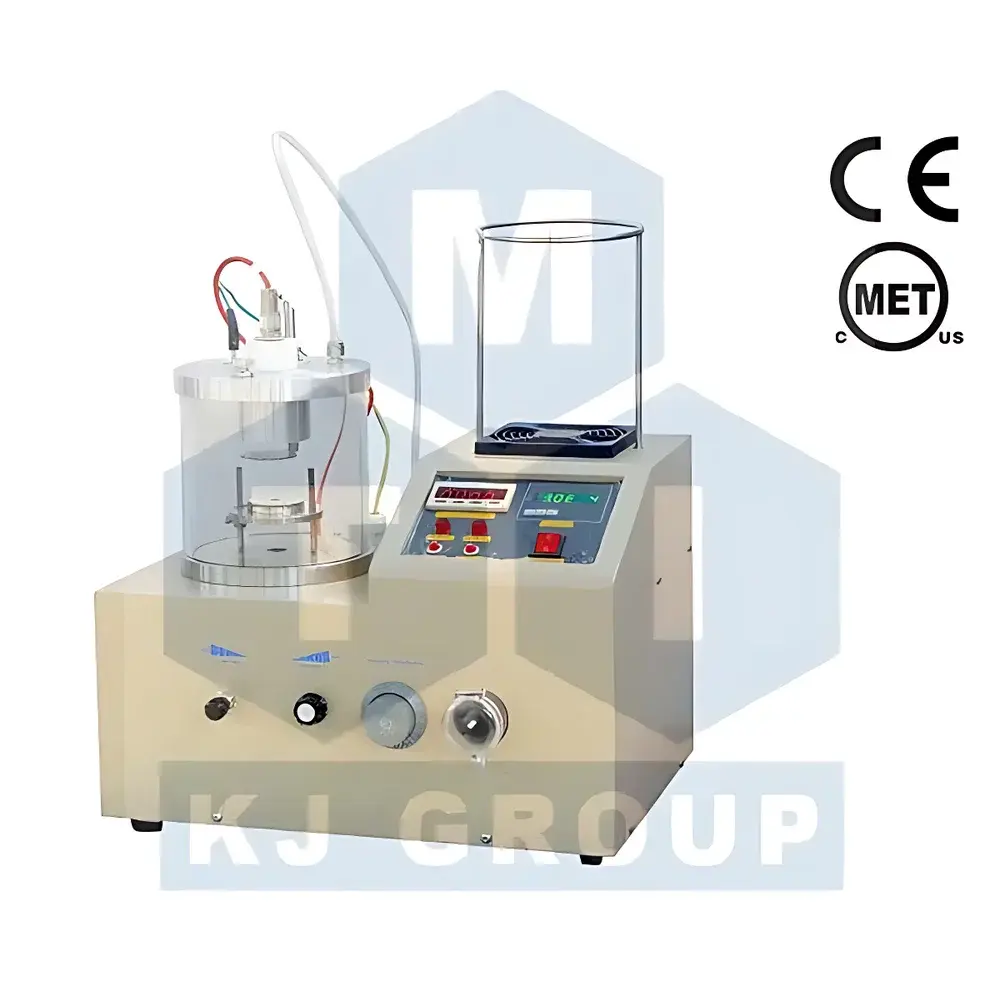
KJ GROUP VTC-16-D Benchtop DC Magnetron Sputtering Coater
| Brand | KJ GROUP |
|---|---|
| Origin | Liaoning, China |
| Manufacturer Type | Authorized Distributor |
| Country of Origin | China |
| Model | VTC-16-D |
| Power Input | 220 V AC, 50/60 Hz |
| Max. Output | 500 VDC, 0–50 mA adjustable |
| Sputtering Time | 1–120 s adjustable |
| Chamber | Quartz tube, Ø166 mm OD × Ø150 mm ID × 150 mm H |
| Sealing | Stainless steel flat flange with Viton O-ring |
| Target Mount | 2-inch (Ø50 mm) magnetron cathode, target thickness 0.1–2.5 mm |
| Substrate Stage | Ø50 mm stainless steel, height adjustable from 30–80 mm |
| Max. Coating Area | Ø100 mm (4-inch equivalent) |
| Vacuum Performance | <1.0×10⁻² Torr (mechanical pump), <1.0×10⁻⁵ Torr (turbo-molecular pump optional) |
| Vacuum Interface | KF25 |
| Pressure Gauge | Digital vacuum gauge (Pa range) |
| Gas Inlet | 1/4" NPT port with front-panel flow control valve |
| Standard Target | Copper (Cu), ≥99.99% purity |
| Optional | Heated stage (up to 500 °C), additional sputtering targets (Au, Ag, Pt, Cr, Ti, etc.), in-situ film thickness monitor, Ar/N₂ gas compatibility |
| Dimensions | 460 × 330 × 540 mm (L×W×H) |
| Net Weight | 20 kg (excl. pump) |
| Certification | CE compliant |
| Warranty | 12 months parts & labor, lifetime technical support |
Overview
The KJ GROUP VTC-16-D is a compact, benchtop-scale DC magnetron sputtering coater engineered for reproducible deposition of conductive metallic thin films—primarily intended for electron microscopy sample preparation, prototyping of functional electrodes, and small-area metallization in materials science laboratories. It operates on the principle of plasma-assisted physical vapor deposition (PVD): argon ions, accelerated by a DC electric field between cathode (target) and anode (chamber wall), bombard a solid metal target, ejecting atoms via momentum transfer (sputtering). These neutralized atoms travel ballistically across the low-pressure chamber and condense onto substrates mounted on a precisely positioned stage. Unlike RF or pulsed-DC systems, this instrument employs a simple, robust DC configuration optimized for high-conductivity metals (e.g., Au, Ag, Pt, Cu, Cr), delivering uniform, low-stress, and adherent nanoscale coatings with minimal substrate heating. Its quartz chamber enables direct visual monitoring of plasma ignition and target erosion, while the manually operated shutter permits pre-sputtering to clean target surfaces and stabilize plasma conditions prior to deposition.
Key Features
- Benchtop footprint (460 × 330 × 540 mm) designed for integration into gloveboxes or standard lab benches without dedicated floor space.
- 2-inch (Ø50 mm) magnetron cathode with adjustable source-to-substrate distance (30–80 mm), enabling precise control over film thickness uniformity and deposition rate.
- Digital vacuum gauge with Pa-range readout and KF25 vacuum interface compatible with standard rotary vane pumps or optional turbo-molecular pumping stations.
- Front-panel gas flow regulator and 1/4″ NPT inlet facilitate controlled introduction of high-purity argon (≥5N) or nitrogen for reactive sputtering.
- Stainless steel substrate stage (Ø50 mm), optionally upgradeable to a resistively heated version (max. 500 °C) for in-situ annealing or improved adhesion of refractory layers.
- Integrated manual shutter for pre-sputtering and process repeatability; supports multi-step protocols including buffer-layer deposition (e.g., 5 nm Ti or Cr adhesion layers).
- CE-certified electrical architecture with insulated high-voltage (500 VDC) feedthroughs and interlocked safety circuitry compliant with IEC 61010-1 for laboratory use.
Sample Compatibility & Compliance
The VTC-16-D accommodates rigid, flat substrates up to Ø100 mm (4-inch equivalent), including silicon wafers, TEM grids, glass slides, ceramic chips, and polished metal coupons. Substrate compatibility is governed by thermal stability (<500 °C for heated stage option), electrical conductivity (required for DC sputtering), and surface cleanliness—users are advised to implement standardized pre-treatment protocols: sequential ultrasonic cleaning in acetone and isopropanol, nitrogen blow-drying, and vacuum baking (≤120 °C, 2 h) to remove physisorbed contaminants. For enhanced interfacial adhesion, a 2–5 nm transition layer (e.g., Ti, Cr, or Mo) may be deposited prior to noble-metal top layers. The system complies with CE marking requirements for electromagnetic compatibility (EMC Directive 2014/30/EU) and low-voltage safety (LVD Directive 2014/35/EU). While not validated for GMP or ISO 13485 environments, its design supports GLP-aligned documentation practices—including operator logs, parameter traceability, and maintenance records—for academic and industrial R&D applications.
Software & Data Management
The VTC-16-D operates via fully manual, analog controls—no embedded microprocessor or software interface is included. All operational parameters (voltage, current, time, gas flow) are set using calibrated front-panel dials and digital displays, ensuring deterministic repeatability without firmware dependencies or cybersecurity vulnerabilities. This architecture aligns with laboratories requiring audit-ready, lock-down instrumentation where parameter changes must be physically logged and verified. Optional accessories—including external film thickness monitors (quartz crystal microbalance or optical reflectance units)—provide analog voltage outputs compatible with standard data acquisition systems (e.g., National Instruments DAQ, LabVIEW) for real-time thickness tracking and endpoint detection. Vacuum pressure data can be recorded via the built-in digital gauge’s RS232 output (optional adapter). No cloud connectivity, remote access, or FDA 21 CFR Part 11 compliance is provided; users implementing electronic recordkeeping must validate their own data capture workflows per ALCOA+ principles.
Applications
- Preparation of conductive coatings on non-conductive SEM/TEM specimens (e.g., polymers, biological tissues, ceramics) to mitigate charging artifacts during imaging.
- Rapid prototyping of electrode architectures for electrochemical sensors, microbatteries, and flexible electronics.
- Deposition of reference metal layers for XRD calibration, XPS depth profiling, or sheet resistance mapping.
- Fabrication of seed layers for subsequent electroplating or CVD processes.
- Research into sputter yield, ion energy distribution, and film microstructure evolution as a function of pressure, power, and target-substrate geometry.
- Teaching laboratory demonstrations of plasma physics, thin-film nucleation, and PVD process fundamentals.
FAQ
What metals can be sputtered with the VTC-16-D?
The system is optimized for DC sputtering of electrically conductive targets, including Au, Ag, Pt, Cu, Cr, Ti, Ni, and Al (with caution—see limitations below). Non-conductive or semi-conductive targets (e.g., oxides, nitrides) require RF or pulsed-DC sources and are not supported.
Why is aluminum sputtering discouraged on this model?
Al has low sputter yield under DC conditions and forms insulating native oxides that cause arcing and unstable plasma. For Al, Mg, Zn, or other reactive metals, KJ GROUP recommends its RF magnetron or thermal evaporation systems.
Can the VTC-16-D operate inside a nitrogen or argon glovebox?
Yes—the unit’s compact dimensions and external gas inlet allow safe integration into inert-atmosphere gloveboxes (O₂/H₂O < 0.1 ppm), enabling oxygen-sensitive depositions without breaking vacuum cycles.
Is the quartz chamber resistant to reactive gases like O₂ or NH₃?
No. Quartz is susceptible to etching by halogens, fluorine-containing compounds, and strong oxidizers. Only high-purity argon or nitrogen is recommended. Use of corrosive gases voids warranty and risks chamber degradation.
What vacuum level is required before initiating sputtering?
Base pressure should reach ≤1.0×10⁻² Torr with a mechanical pump. For lower contamination and higher film purity (e.g., for TEM grids), a turbo-molecular pump achieving ≤1.0×10⁻⁵ Torr is strongly advised prior to gas introduction.



