
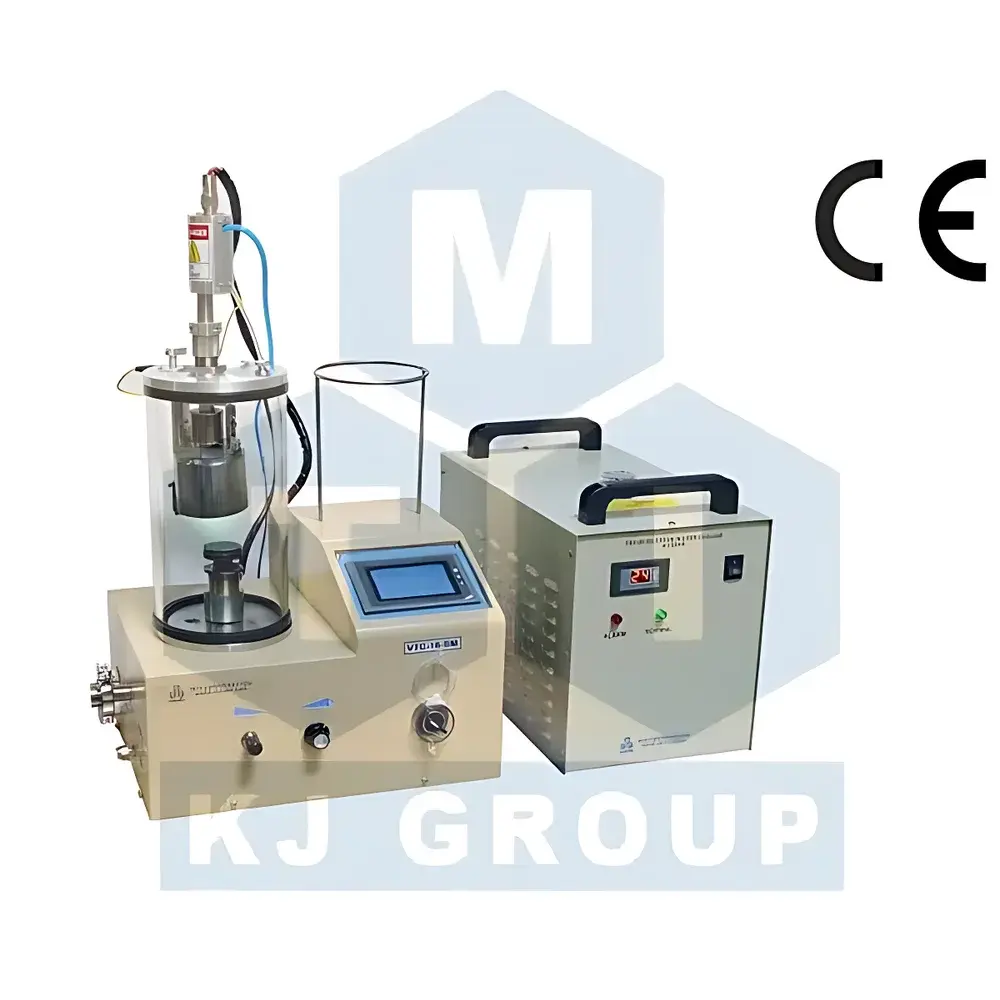
KJ GROUP VTC-16-SM Benchtop High-Energy DC Magnetron Sputtering System
| Brand | KJ GROUP |
|---|---|
| Origin | Liaoning, China |
| Manufacturer Type | Authorized Distributor |
| Origin Category | Domestic (China) |
| Model | VTC-16-SM |
| Price | Upon Request |
| Input Power | 220 VAC, 50/60 Hz |
| Max Sputtering Current | 0–150 mA |
| Max Output Voltage | 1600 VDC |
| Max Power Consumption | <2 kW |
| Chamber | Quartz, Ø166 mm OD × Ø150 mm ID × 290 mm H |
| Sealing | Viton O-ring |
| Target | 2-inch water-cooled magnetron (1-inch optional) |
| Substrate Holder | Ø50 mm stainless steel, rotatable (0–5 RPM) |
| Target-to-Substrate Distance | Adjustable, 30–80 mm |
| Base Pressure (Mechanical Pump) | <1.0×10⁻² Torr |
| Base Pressure (Turbo-Molecular Pump) | <1.0×10⁻⁵ Torr |
| Vacuum Interface | KF25 |
| Pressure Gauge | Digital vacuum gauge (Pa range) |
| Process Gas | Argon (external cylinder with regulator required) |
| Gas Control | Manual needle valve + vent valve |
| Max Sputtering Area | 4-inch equivalent |
| Target Dimensions | Ø50 mm × 0.1–2.5 mm thickness |
| Compatible Materials | Au, Ag, Cu, Al, Ti, and other conductive metals |
| Control Panel | 6″ PLC-integrated touchscreen HMI |
| External Cooling | Recirculating chiller required (not included) |
| Dimensions (L×W×H) | 460 × 330 × 520 mm |
| Net Weight | 20 kg (pump & chiller excluded) |
Overview
The KJ GROUP VTC-16-SM is a compact, benchtop-scale DC magnetron sputtering system engineered for reproducible thin-film deposition of conductive materials in academic research laboratories, materials science teaching facilities, and early-stage R&D environments. It operates on the principle of plasma-assisted physical vapor deposition (PVD), where argon ions—accelerated by a high-voltage DC field—bombard a conductive target surface, ejecting atoms that subsequently condense onto a substrate to form a uniform metallic film. The system integrates a water-cooled 2-inch magnetron cathode to dissipate thermal load during sustained sputtering, minimizing target arcing and enabling stable operation at up to 150 mA current. Its quartz vacuum chamber provides optical transparency for process observation and excellent chemical inertness against reactive sputtering byproducts. Designed for rapid pump-down and straightforward operation, the VTC-16-SM delivers high-energy sputtering performance without requiring cleanroom infrastructure or dedicated utility lines.
Key Features
- Benchtop footprint (460 × 330 × 520 mm) with modular vacuum architecture for space-constrained labs
- Water-cooled 2-inch DC magnetron cathode (1-inch option available) with adjustable standoff distance (30–80 mm) for optimized plasma confinement and film uniformity
- Motorized rotating substrate stage (0–5 RPM) fabricated from 316 stainless steel, ensuring azimuthal homogeneity across Ø50 mm samples
- Integrated 6-inch PLC-based touchscreen HMI for coordinated control of vacuum sequencing, sputtering current, shutter actuation, and optional heating parameters
- Quartz cylindrical chamber (Ø166 mm OD × 290 mm H) sealed with Viton O-rings, rated for UHV-compatible bake-out protocols up to 120 °C
- KF25 vacuum flanges and digital pressure monitoring (Pa scale) support seamless integration with external turbomolecular and rotary vane pumps
- Manual shutter mechanism and target positioning bracket allow safe target loading and process isolation without breaking vacuum
Sample Compatibility & Compliance
The VTC-16-SM accommodates substrates up to Ø50 mm—including silicon wafers, glass slides, ceramic discs, and flexible polymer foils—provided they are electrically insulating or grounded via the stage. Its sputtering geometry supports deposition of Au, Ag, Cu, Al, Ti, Cr, Ni, and other DC-sputterable metals; non-conductive targets require RF or pulsed-DC upgrades (not supported natively). The system meets fundamental safety and operational requirements outlined in IEC 61000-6-3 (EMC emissions) and ISO 14644-1 Class 8 cleanroom compatibility when operated in controlled ambient environments. While not certified to GLP or GMP standards out-of-the-box, its programmable logic controller enables audit-ready parameter logging (with optional data export), supporting traceability frameworks aligned with ASTM F2627-20 (Standard Guide for Thin-Film Deposition Process Validation) and ISO/IEC 17025 documentation practices.
Software & Data Management
Operation is fully managed through the embedded PLC HMI interface—no external PC or proprietary software installation required. All critical process variables—including chamber pressure, sputtering current, elapsed time, and shutter status—are recorded in non-volatile memory with timestamped logs exportable via USB. The control firmware supports repeatable recipe storage (up to 20 user-defined protocols), each defining vacuum ramp rates, gas flow setpoints (via external mass flow controller integration), current ramp profiles, and rotation timing. For laboratories implementing electronic records per FDA 21 CFR Part 11, third-party SCADA systems may be interfaced via Modbus RTU over RS-485 (pinout documentation available upon request). No cloud connectivity or remote access functionality is included; all data remains locally stored and under user administrative control.
Applications
- Preparation of conductive seed layers for microfabrication and MEMS device prototyping
- Deposition of reference electrodes (e.g., Au, Pt) for electrochemical sensor development
- Thin-film calibration standards for XRF, SEM-EDS, and profilometry validation
- Optical coating trials involving reflective metal films on fused silica or BK7 substrates
- Teaching laboratory demonstrations of plasma physics, sputtering yield dependence on voltage/current, and film stress evolution
- Low-throughput metallization of TEM grids, AFM tips, and biological specimen stubs
FAQ
Is a water chiller included with the system?
No. A recirculating chiller capable of ≥1 L/min flow at 15–25 °C is required for continuous operation of the water-cooled cathode and must be procured separately.
Can the system deposit insulating films such as SiO₂ or Al₂O₃?
Not in standard DC mode. Dielectric targets require RF or medium-frequency pulsed-DC power supplies, which are not integrated into the VTC-16-SM platform.
What vacuum level is achievable with only the included mechanical pump?
Base pressure is typically <1.0×10⁻² Torr using a standard two-stage rotary vane pump; achieving <1.0×10⁻⁵ Torr requires optional turbo-molecular pumping.
Are target bonding services or pre-mounted targets available?
Yes. KJ GROUP offers indium or epoxy bonding of custom or standard Ø50 mm targets (0.1–2.5 mm thick), with full compatibility verification prior to shipment.
Does the system support substrate heating?
The base configuration includes no heater; however, a resistively heated stage (up to 300 °C) is available as an optional upgrade with integrated thermocouple feedback and PID temperature control.



