
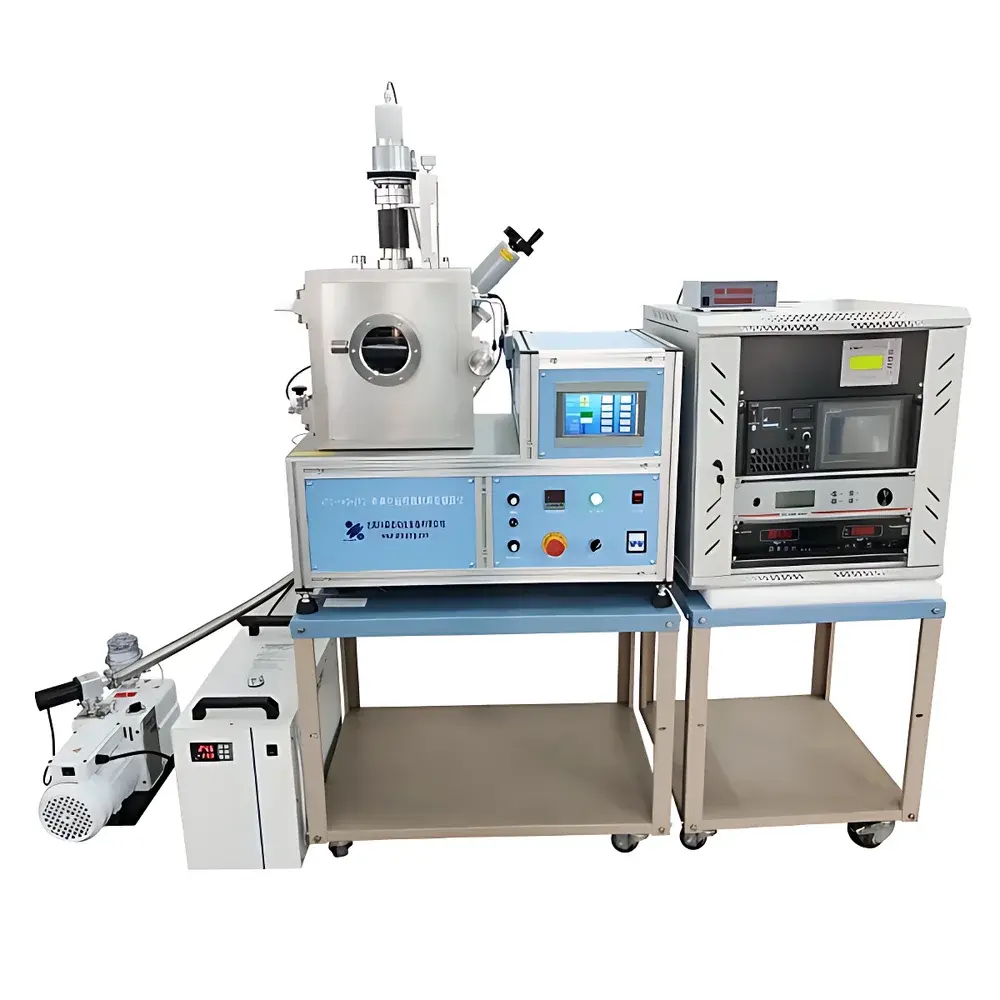
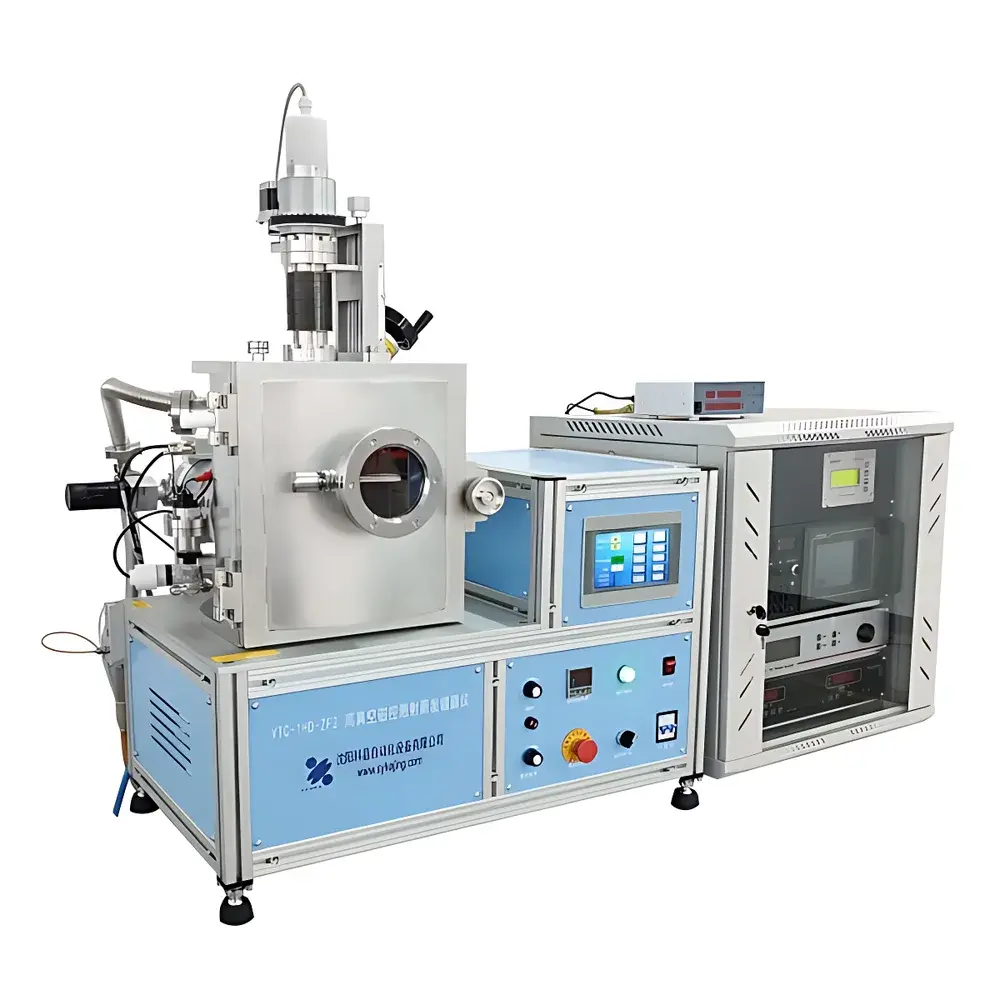
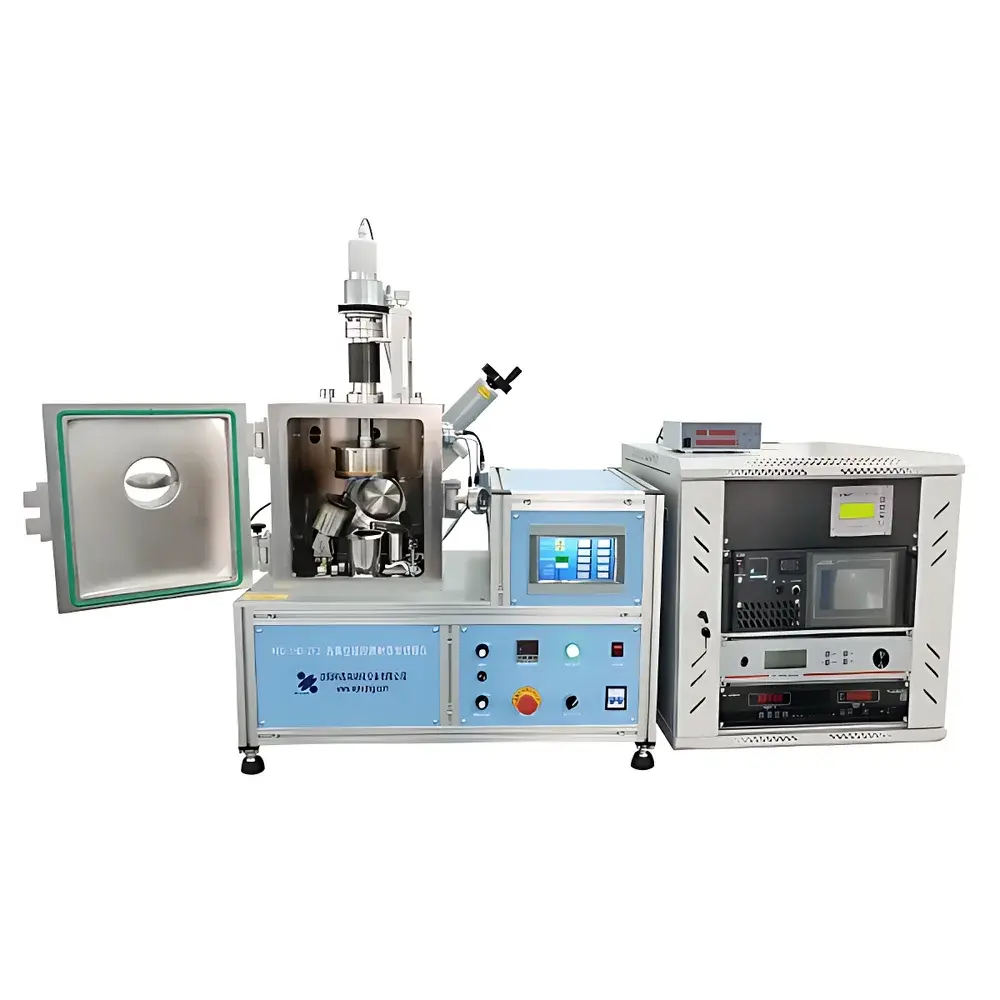
KJ GROUP VTC-1HD-ZF2 High-Vacuum Magnetron Sputtering & Thermal Evaporation Coating System
| Brand | KJ GROUP |
|---|---|
| Origin | Liaoning, China |
| Manufacturer Type | Original Equipment Manufacturer (OEM) |
| Country of Origin | China |
| Model | VTC-1HD-ZF2 |
| Pricing | Upon Request |
| Vacuum Chamber | Ø324 × 330 mm |
| Ultimate Vacuum | ≤6.0 × 10⁻⁴ Pa (with FF-150 turbo-molecular pump + backing mechanical pump) |
| Leak Rate | ≤2.0 × 10⁻¹⁰ Pa·m³/s |
| Chamber Material | Electropolished 304 stainless steel |
| Sealing | Viton O-rings (movable joints), oxygen-free copper gaskets (static flanges) |
| Drive Mechanism | Magnetic coupling transmission |
| Magnetron Target | 2-inch (Ø50.8 mm), DC-powered, max. 240 W (water-cooled), operating pressure range: 0.2–10 Pa |
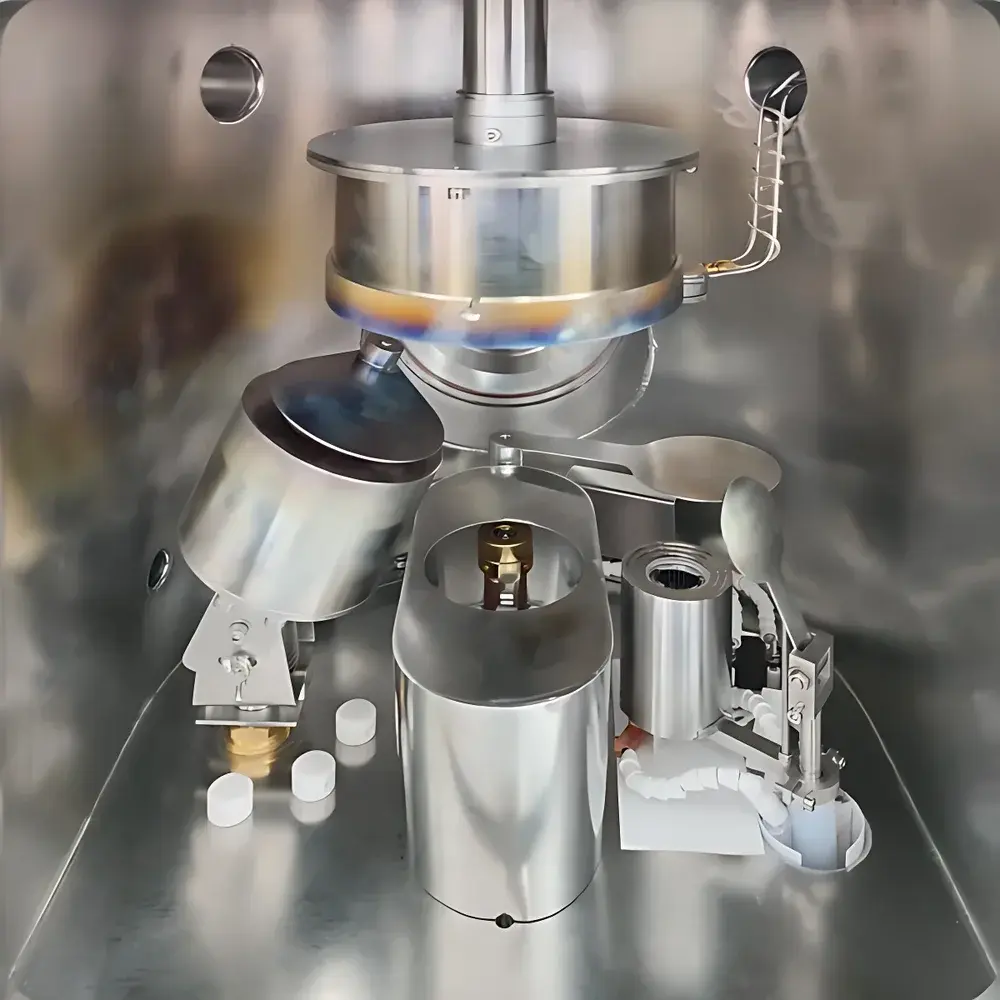
| Evaporation Source | Dual-electrode resistive boat (AC 0–8 V, up to 200 A, <1.6 kW), optimized for O₂-sensitive metals (Ti, Al, Au) |
| E-beam Source | Two positions (1 standard e-beam crucible, 3 cm³ capacity, 36 V / 500 W, 25–700 °C, ±0.5 °C control accuracy) |
| Substrate Stage | Ø120 mm, temperature-controlled (RT–500 °C), rotation speed 1–20 rpm, manual vertical adjustment (50 mm travel) |
| Quartz Crystal Monitor | EQ-TM106-1 thickness controller (6 MHz sensor, Al resolution: 0.0136 Å, accuracy ±0.5%, RS-232/485 interface, PWM analog output) |
| Gas Control | Single-channel mass flow controller (Ar only) |
| Viewport | Ø150 mm borosilicate glass window |
| Additional Port | One CF-35 flange for optional instrumentation |
| Cooling | Integrated KJ5000 chiller unit (deionized water or purified water required) |
| Power Input | AC 220 V / 50 Hz, total system load <3.5 kW |
| Dimensions (W×D×H) | ~1300 × 660 × 1200 mm |
| Weight | ~160 kg |
Overview
The KJ GROUP VTC-1HD-ZF2 is a dual-mode high-vacuum thin-film deposition system engineered for research-grade versatility in physical vapor deposition (PVD). It integrates magnetron sputtering and resistive thermal evaporation within a single electropolished 304 stainless steel vacuum chamber, enabling precise fabrication of functional thin films under controlled inert-gas environments. The system operates on the principle of plasma-assisted sputtering—where argon ions bombard a conductive target (e.g., Ti, Cu, ITO) to eject atoms that condense onto a heated, rotating substrate—and complementary resistive heating of low-melting-point or oxygen-sensitive materials (e.g., Al, Au, Ag) via tungsten or molybdenum boats. Its design adheres to fundamental UHV engineering standards: ultra-low leak rate (<2.0 × 10⁻¹⁰ Pa·m³/s), all-metal static seals, magnetic-coupled motion transmission to preserve vacuum integrity, and modular flange interfaces—including a CF-35 port—for future integration of RHEED, residual gas analyzers, or in-situ spectroscopic ellipsometers. The chamber’s ultimate vacuum of ≤6.0 × 10⁻⁴ Pa—achieved with a 150 L/s turbo-molecular pump backed by a dry scroll mechanical pump—ensures minimal hydrocarbon contamination and high film purity, critical for reproducible dielectric, ferroelectric, and optical multilayer stacks.
Key Features
- Hybrid PVD architecture supporting both DC magnetron sputtering (2-inch target, water-cooled, up to 240 W) and resistive thermal evaporation (dual-electrode boat, AC 0–8 V, 200 A capability)
- Dedicated O₂-sensitive metal evaporation zone with rotating shutter above the boat, minimizing oxidation during deposition of Ti, Al, and Au
- Two-position electron-beam source station (one standard 3 cm³ quartz crucible, 25–700 °C, ±0.5 °C PID control, thermocouple feedback)
- Motorized, temperature-regulated substrate stage (Ø120 mm, RT–500 °C, 1–20 rpm rotation, 50 mm manual Z-axis adjustment)
- Real-time quartz crystal microbalance (QCM) monitoring via EQ-TM106-1 controller: 6 MHz sensor, 0.0136 Å resolution (Al), ±0.5 % thickness accuracy (process-dependent), RS-232/485 communication
- Integrated KJ5000 recirculating chiller (500 W cooling capacity) with temperature-stabilized deionized water loop for target and power supply thermal management
- Optical viewport (Ø150 mm borosilicate glass) and standardized CF-35 flange for auxiliary diagnostics or process monitoring
Sample Compatibility & Compliance
The VTC-1HD-ZF2 accommodates substrates up to Ø120 mm and supports deposition on silicon wafers, fused silica, sapphire, glass slides, flexible polymer foils (e.g., PET, PI), and ceramic tiles. It is routinely employed to fabricate ferroelectric oxides (PZT, BTO), transparent conductive oxides (ITO, AZO), metallic electrodes (Ti/Au, Cr/Au), hard coatings (TiN, DLC), and low-k dielectrics (SiO₂, Si₃N₄). All wetted components comply with ASTM F86 (standard practice for surface preparation and marking of metallic surgical implants) for cleanliness, while vacuum chamber electropolishing meets ISO 15730 requirements for ultraclean stainless-steel surfaces. The system’s electrical architecture conforms to IEC 61000-6-3 (EMC emission limits) and IEC 61000-6-2 (immunity standards). Though not certified for GMP production, its closed-loop temperature control, calibrated QCM feedback, and audit-ready parameter logging (via optional software extension) support GLP-compliant thin-film development workflows per ISO/IEC 17025 guidelines.
Software & Data Management
The VTC-1HD-ZF2 operates via front-panel digital controls with real-time display of vacuum pressure, substrate temperature, rotation speed, and QCM thickness rate. For advanced data acquisition, the EQ-TM106-1 thickness monitor provides RS-232/485 serial output at configurable baud rates (1200–38400 bps), enabling integration with LabVIEW, Python-based acquisition scripts, or MATLAB instrument control toolboxes. Thickness data are timestamped and exportable as CSV files; analog PWM output allows direct connection to chart recorders or PLC-based process controllers. Optional KJ-DataLink software (sold separately) adds automated recipe storage, multi-step deposition scheduling, and event-triggered logging—supporting traceability requirements for academic publication or internal R&D documentation. All firmware updates are delivered via USB flash drive; no cloud connectivity or remote access is implemented, preserving network security in regulated lab environments.
Applications
- Ferroelectric and piezoelectric thin-film synthesis (e.g., Pb(Zr,Ti)O₃, BaTiO₃) for MEMS actuators and non-volatile memory devices
- Transparent conductive oxide (TCO) deposition for photovoltaic front contacts and OLED anodes
- Ohmic and Schottky contact metallization on GaN, SiC, and 2D semiconductors (MoS₂, WS₂)
- Optical interference coatings (anti-reflection, high-reflectance stacks) on laser optics and spectrometer windows
- Protective barrier layers (Al₂O₃, SiO₂) for flexible electronics encapsulation
- Model catalyst studies using well-defined bimetallic films (e.g., Pt/Ni, Pd/Cu) deposited via sequential sputtering and evaporation
- Surface modification of biomedical implants with bioactive calcium phosphate or antimicrobial Ag films
FAQ
What vacuum level is required for high-quality oxide film growth?
For stoichiometric metal oxide deposition (e.g., ITO, TiO₂), base pressure ≤5 × 10⁻⁴ Pa is recommended prior to Ar introduction; partial pressure during sputtering should be maintained between 0.5–2.0 Pa to balance ion energy and target utilization.
Can the system deposit insulating targets like Al₂O₃ or SiO₂?
Yes—using RF magnetron sputtering (requires optional RF generator upgrade); the standard configuration supports only DC-sputterable conductive targets.
Is the EQ-TM106-1 thickness monitor compatible with reactive gas environments?
The sensor is rated for inert gas (Ar, N₂) operation only; reactive gases (O₂, NH₃) may oxidize or nitride the quartz crystal, degrading calibration stability.
What maintenance is required for the turbo-molecular pump?
Annual bearing inspection and rotor balancing are advised; pump oil in the backing mechanical pump must be replaced every 500 operational hours or quarterly, whichever occurs first.
Does the system meet CE or UL safety certification?
The VTC-1HD-ZF2 complies with EN 61000-6-2/-6-3 and EN 61000-3-2 for EMC and harmonic emissions; full CE marking requires site-specific risk assessment and local electrical installation verification.



