
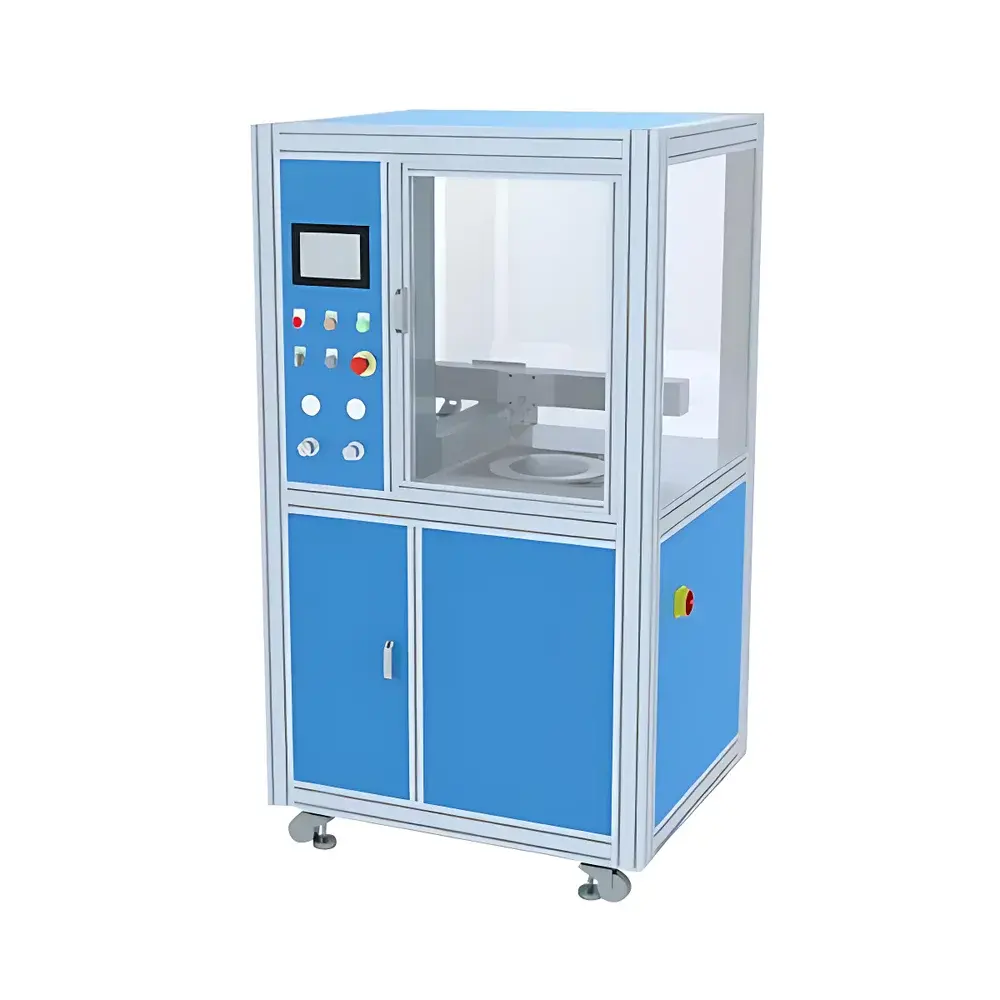
KJ GROUP VTC-200-SE 8-Inch Cabinet-Type Ultrasonic Spray Coater
| Brand | KJ GROUP |
|---|---|
| Origin | Liaoning, China |
| Manufacturer Type | Authorized Distributor |
| Origin Category | Domestic |
| Model | VTC-200-SE |
| Quotation | Upon Request |
| Power Supply | AC 220 V, 50 Hz, 1.5 kW |
| Operating Environment | 20–30 °C, 20–90 % RH |
| Max Substrate Size | ≤200 mm (8-inch wafer) |
| Hotplate Temperature Range | Ambient to 200 °C, Control Accuracy ±0.5 °C, Uniformity <±1 % |
| Substrate Lift Stroke | 0–15 mm, Resolution 0.1 mm |
| Liquid Flow Rate | 1–20 mL/min |
| Hotplate Max Speed | 1000 rpm |
| XY Axis Travel | 300 mm × 300 mm |
| XY Max Speed | 200 mm/s |
| Ultrasonic Droplet Size | 30–50 µm |
| Control System | PLC with HMI |
| Nozzle Motion | Motorized XYZ Electric Cylinder Assembly |
| Machine Dimensions (L×W×H) | 1000 × 880 × 1800 mm |
| Weight | 55 kg |
Overview
The KJ GROUP VTC-200-SE 8-Inch Cabinet-Type Ultrasonic Spray Coater is an engineered solution for precision thin-film deposition in advanced microfabrication processes—including Through-Silicon Via (TSV), Micro-Electro-Mechanical Systems (MEMS), and Wafer-Level Packaging (WLP). It employs a dual-technology approach: controlled microfluidic laminar flow delivery combined with high-frequency ultrasonic atomization (1.7 MHz typical) to generate monodisperse aerosol droplets. These droplets are deposited onto thermally stabilized substrates under programmable rotational and translational motion, enabling conformal, pinhole-free coatings on non-planar or topographically complex surfaces. Unlike spin coating—limited by centrifugal force constraints—the VTC-200-SE achieves uniform film thickness across edges, trenches, and stepped features via spatially resolved spray trajectory control and real-time thermal management. Its cabinet-integrated architecture ensures operator safety, solvent containment, and environmental stability during extended process runs.
Key Features
- Industrial-grade cabinet construction using corrosion-resistant aluminum extrusions, powder-coated steel panels, and transparent polycarbonate viewing windows for full process visibility and chemical compatibility.
- Programmable XYZ electric cylinder stage with 300 mm × 300 mm travel range and 0.1 mm lift resolution—enabling precise nozzle standoff distance adjustment for optimized droplet impingement angle and coverage uniformity.
- Heated rotating chuck system with PID-controlled hotplate (ambient to 200 °C, ±0.5 °C accuracy) and radial temperature uniformity better than ±1 % across the full 200 mm working zone.
- Microfluidic metering pump delivering stable, pulseless liquid flow from 1 to 20 mL/min, calibrated for low-viscosity photoresists, polymer precursors, and functional nanosuspensions.
- Ultrasonic nebulizer operating at adjustable power levels to maintain consistent droplet size distribution (30–50 µm Sauter mean diameter), minimizing overspray and material waste.
- Integrated substrate handling: vacuum-assisted chucking, motorized lift pins (0–15 mm stroke), and automatic load/unload timing logic synchronized with process sequence.
- Real-time monitoring of glue level, airflow velocity in the exhaust duct, and thermal drift—triggering audible/visual alerts and safe shutdown if thresholds are exceeded.
- 7-inch color touchscreen HMI with dual-mode operation: intuitive manual jogging for alignment and recipe-driven automatic execution with full parameter logging.
Sample Compatibility & Compliance
The VTC-200-SE accommodates substrates up to 200 mm in diameter—including silicon wafers, glass carriers, ceramic packages, and flexible polyimide films—with quick-change tooling fixtures for rapid reconfiguration. Its enclosed design meets ISO Class 7 cleanroom compatibility requirements when operated with HEPA-filtered inlet air and activated carbon exhaust filtration. All wetted components are chemically inert (e.g., PTFE, stainless steel 316, fused silica nozzles) to resist solvents such as PGMEA, acetone, and IPA. The system supports audit-ready process documentation aligned with GLP and GMP principles, including timestamped parameter records, user login tracking, and change history logs—facilitating compliance with internal SOPs and external quality audits.
Software & Data Management
Control firmware is built on a deterministic PLC platform with deterministic I/O response (<10 ms cycle time) and non-volatile recipe storage (≥100 protocols). Each process script stores nozzle position coordinates, flow rate setpoints, hotplate ramp profiles, rotation speed, dwell times, and ultrasonic duty cycles. Data export is supported via USB 2.0 to CSV format for offline analysis in MATLAB or JMP. Optional Ethernet/IP or Modbus TCP interfaces enable integration into factory MES systems for traceability and SPC charting. All human-machine interactions comply with IEC 61508 functional safety guidelines for industrial control equipment.
Applications
- Photoresist priming and edge-bead removal for lithography pre-processing
- Deposition of anti-reflective coatings (ARC) and planarization layers in TSV fabrication
- Functional ink spraying for MEMS sensor passivation and encapsulation
- Conformal dielectric layer formation on 3D stacked IC packages
- R&D-scale deposition of perovskite precursors, conductive polymers, and bio-ink formulations
- Low-waste coating of fragile substrates where spin-off or dip-coating induces stress or cracking
FAQ
What wafer sizes does the VTC-200-SE support?
It is optimized for 200 mm (8-inch) wafers but supports smaller formats—including 100 mm, 150 mm, and square substrates—via interchangeable chucks and alignment fixtures.
Is the ultrasonic nozzle compatible with high-viscosity solutions?
The system is designed for low-to-medium viscosity fluids (≤50 cP); for higher viscosities, optional heated fluid lines and pressure-assisted delivery modules are available upon request.
Does the unit meet electrical safety standards for international use?
Yes—it carries CE marking per EN 61000-6-2 (immunity) and EN 61000-6-4 (emissions), and complies with UL 61010-1 for laboratory equipment safety.
Can process data be exported for regulatory submission?
All runtime parameters, timestamps, operator IDs, and alarm events are logged in tamper-resistant binary files; conversion tools for FDA 21 CFR Part 11–compliant PDF reports are provided with software license.
What maintenance intervals are recommended?
Ultrasonic transducers require quarterly calibration; fluid path filters should be replaced every 200 hours of operation; hotplate surface inspection and recalibration are advised biannually.



