
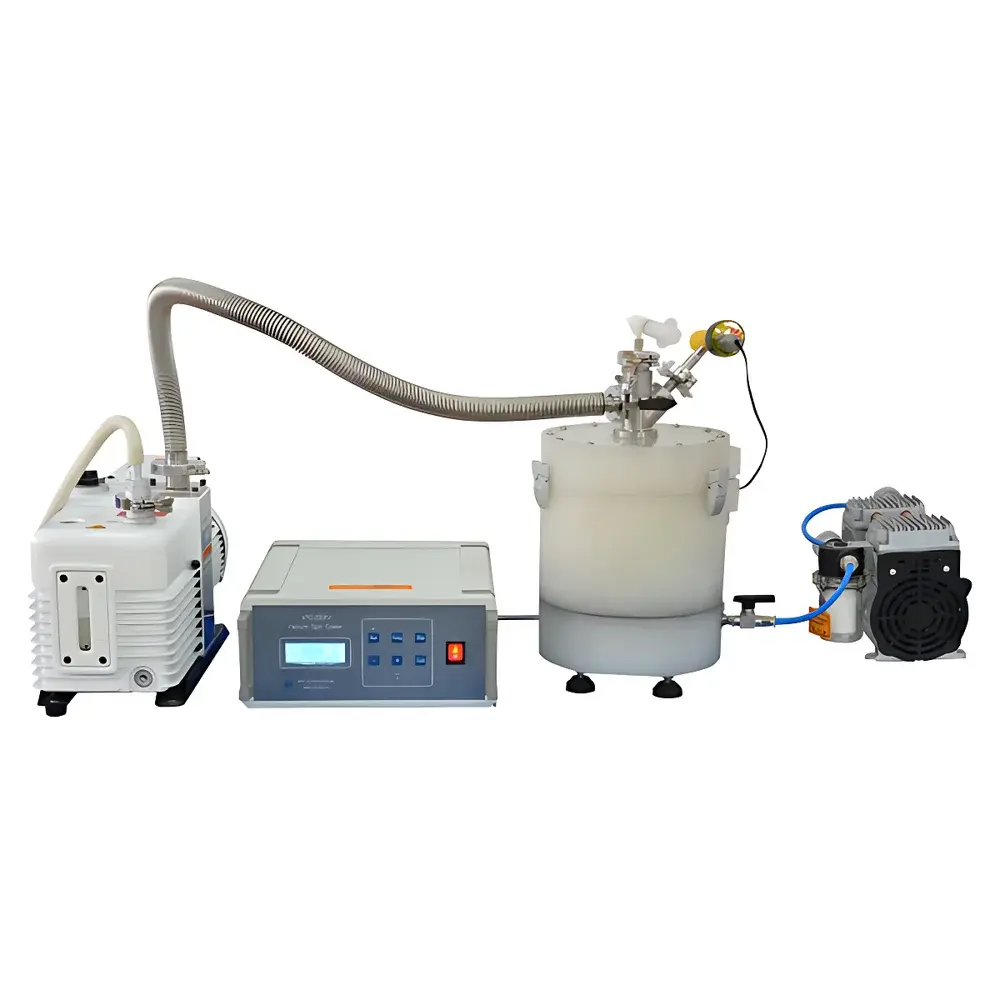
KJ GROUP VTC-200PV Vacuum Spin Coater
| Brand | KJ GROUP |
|---|---|
| Origin | Liaoning, China |
| Model | VTC-200PV |
| Maximum Rotation Speed | 6000 rpm |
| Acceleration/Deceleration Rate | 100–2000 rpm/s per stage |
| Programmable Stages | 12 programs × 6 stages each |
| Stage Duration | 0–60 s |
| Speed Stability | ±1% |
| Vacuum Capability | Chamber vacuum down to 5×10⁻² Pa (mechanical pump) |
| Sample chuck vacuum | −0.0933 MPa (oil-free diaphragm pump) |
| Chamber Material | Polypropylene (PP) |
| Power Supply | AC 220 V, 50 Hz, ≤150 W (host only) |
| Dimensions (Host) | Φ250 mm × 360 mm |
| Weight | 25 kg |
| Compliance | Full English UI, Lid-safety interlock, GLP-ready operation logging via optional PC interface |
Overview
The KJ GROUP VTC-200PV Vacuum Spin Coater is an engineered solution for precision thin-film deposition in research and development environments where ambient sensitivity, chemical compatibility, and process repeatability are critical. Operating on the principle of centrifugal force-driven fluid dispersion, the system uniformly distributes viscous or volatile coating solutions—including strong acids, strong bases, and oxygen-sensitive precursors—across planar substrates via controlled rotational acceleration. Its dual-vacuum architecture enables two distinct operational modes: (1) vacuum-assisted substrate immobilization using a −0.0933 MPa oil-free diaphragm pump for sample clamping, and (2) full-chamber evacuation (down to 5×10⁻² Pa with VRD-8 rotary vane pump) to suppress oxidation, solvent evaporation, or atmospheric contamination during spin-casting. The chamber’s all-polypropylene construction ensures long-term resistance to aggressive solvents and stress cracking—critical for labs processing photoresists, perovskites, metal-organic frameworks (MOFs), or conductive polymer dispersions.
Key Features
- 12 programmable protocols, each supporting up to six independent motion stages with individually adjustable acceleration/deceleration rates (100–2000 rpm/s) and dwell times (0–60 s), enabling multi-step ramped spin profiles for gradient film thickness control.
- High-stability 24 V DC brushless motor delivering precise speed regulation (±1% stability) across the 500–6000 rpm range, minimizing vibration-induced non-uniformity and ensuring reproducible coating thickness distribution.
- Dual fixation methods: vacuum chucking (for flat, rigid wafers up to Ø100 mm) and mechanical clamping (using interchangeable chucks for 2″, 3″, and 4″ substrates), supported by centering alignment tools to eliminate eccentric mass imbalance.
- Integrated safety architecture including lid-open emergency deceleration, real-time motor thermal monitoring, and hardware-enforced interlocks compliant with IEC 61000-6-2 EMC standards.
- Modular vacuum subsystems: AP-1400C oil-free diaphragm pump (150 L/min, −0.0933 MPa) for sample holding; VRD-8 two-stage rotary vane pump (70 L/min, 5×10⁻² Pa base pressure) for chamber evacuation—both independently powered and configurable for inert gas purging (N₂ or Ar).
- Full English graphical LCD interface with PCB-based microcontroller, eliminating language barriers in international academic and industrial labs; supports optional RS-232/USB data export for audit-trail documentation.
Sample Compatibility & Compliance
The VTC-200PV accommodates rigid, flat substrates including silicon wafers, glass slides, quartz plates, and metal foils (thickness ≥0.1 mm). Its polypropylene chamber and PP vacuum chuck resist corrosion from hydrochloric acid, nitric acid, KOH, TMAH, DMF, chlorobenzene, and other common thin-film processing solvents. Substrate positioning accuracy is maintained within ±0.2 mm via calibrated centering pins. The system meets fundamental requirements for GLP-compliant thin-film R&D workflows: traceable parameter logging (via optional PC software), operator-accessible calibration routines, and deterministic start/stop timing. While not certified to ISO 13485 or FDA 21 CFR Part 11 out-of-box, its deterministic control architecture and programmable sequence retention support validation under internal SOPs aligned with ASTM D1730 (Standard Practice for Spin Coating of Organic Coatings) and ISO 15184 (Paints and Varnishes — Determination of Film Thickness).
Software & Data Management
The embedded controller stores all 12 protocols locally with non-volatile memory retention (>100,000 write cycles). Each program records setpoints (speed, time, acceleration), actual motor response logs (sampled at 10 Hz), and vacuum status flags. Optional Windows-compatible software enables remote configuration, real-time monitoring, CSV export of runtime traces, and PDF report generation—including timestamped operator ID fields and version-controlled protocol archives. Audit trails comply with ALCOA+ principles when deployed with networked authentication and electronic signature modules. No cloud connectivity is implemented; all data remains on-premise unless explicitly exported.
Applications
- Academic and industrial R&D of photovoltaic layers (e.g., perovskite precursor films, PEDOT:PSS hole transport layers).
- Microfabrication of lithographic resists (SU-8, PMMA) under inert or vacuum conditions to prevent moisture uptake.
- Preparation of corrosion-resistant barrier coatings on metallic substrates using sol-gel precursors.
- Controlled deposition of quantum dot suspensions, graphene oxide dispersions, and conductive nanocomposites.
- Process development for flexible electronics, where low-temperature, solvent-controlled drying kinetics directly impact film morphology and charge transport.
FAQ
What vacuum level is achievable inside the coating chamber?
The VRD-8 mechanical pump achieves a base pressure of 5×10⁻² Pa, sufficient to suppress solvent boiling and atmospheric oxidation during spin-casting of air-sensitive materials.
Can the system operate under inert gas flow?
Yes—gas inlet ports allow continuous N₂ or Ar purging during chamber evacuation or ambient-pressure spin-coating, maintaining oxygen levels below 1 ppm when paired with proper gas cabinet integration.
Is the vacuum chuck compatible with non-conductive substrates?
Yes—the −0.0933 MPa vacuum force provides reliable adhesion for glass, quartz, and ceramic substrates without requiring conductive backside metallization.
How is film thickness repeatability ensured across multiple runs?
Through closed-loop speed stability (±1%), consistent vacuum chucking force, and programmable multi-stage acceleration that minimizes edge-thinning effects and Marangoni-driven defects.
Does the system support external trigger inputs or TTL synchronization?
No native TTL I/O is provided; however, the RS-232 port enables external PLC coordination via ASCII command protocol for integrated cleanroom automation.
Related Products



