
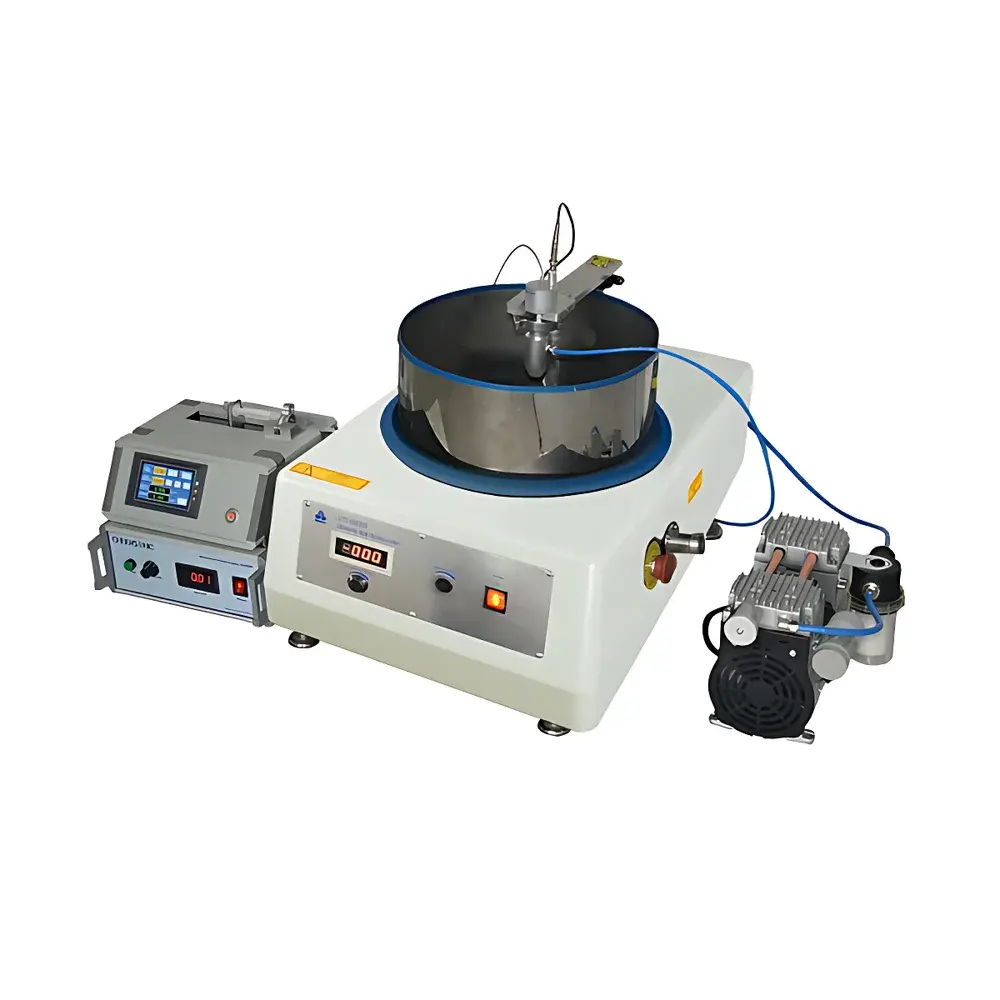
KJ GROUP VTC-300USS Ultrasonic Nebulization Spin Coater
| Brand | KJ GROUP |
|---|---|
| Origin | Liaoning, China |
| Manufacturer Type | Authorized Distributor |
| Country of Origin | China |
| Model | VTC-300USS |
| Power Input | AC 220 V, 250 W, 50/60 Hz |
| Max Substrate Diameter | 300 mm (12") |
| Max Spin Speed | 3000 rpm |
| Nebulizer Particle Size | 10–20 µm |
| Liquid Flow Rate | 0.6 pL–4 mL/min |
| Max Solid Content | ≤10 wt% |
| Max Solution Viscosity | ≤100 cP |
| Heating Capability | Optional heated substrate stage with IR lamp |
| Operating Environment | Altitude <1000 m, Ambient Temp. 25 °C ±15 °C, RH 55% ±10% |
| Pneumatic Requirement | Compressed air source (regulated, 0.4–0.6 MPa) required for nebulizer assist |
Overview
The KJ GROUP VTC-300USS Ultrasonic Nebulization Spin Coater is an integrated thin-film deposition system combining precision rotational dynamics with high-stability ultrasonic atomization. It operates on the principle of controlled solution nebulization—where a piezoelectric transducer vibrates at resonant frequency to generate fine, monodisperse aerosol droplets (10–20 µm)—followed by directed impingement onto a rapidly rotating substrate. Concurrent centrifugal force governs lateral droplet dispersion and solvent evaporation kinetics, enabling reproducible formation of uniform micro- to nanoscale coatings. Unlike conventional spin coating relying solely on viscous shear and solvent volatility, the VTC-300USS decouples fluid delivery from rotation control, permitting independent optimization of precursor stoichiometry, mass flux, and residence time. This architecture is especially suited for thermally sensitive or low-volatility precursors, where thermal decomposition or incomplete drying compromises film integrity in standard spin coaters.
Key Features
- Motor-driven spin module with closed-loop stepper motor control, delivering stable rotational speeds up to 3000 rpm across substrates up to 300 mm (12″) in diameter
- Ultrasonic nebulizer mounted on a pivoting support arm, ensuring consistent nozzle-to-substrate distance and radial spray symmetry during rotation
- Programmable volumetric dosing system using microprocessor-controlled peristaltic or syringe pump (configurable for single/multi-channel, heated or ambient delivery)
- Optional integrated infrared heating stage (up to 200 °C) for real-time solvent removal and crystallization enhancement during deposition
- Pneumatically assisted雾化 (air-assisted nebulization) improves droplet trajectory stability and reduces nozzle clogging, particularly with nanoparticle suspensions or viscous sol-gel precursors
- Modular design compliant with ISO 14644-1 Class 8 cleanroom footprint requirements; occupies ≤2 m² floor space with standard ventilation integration
Sample Compatibility & Compliance
The VTC-300USS accommodates rigid and semi-rigid planar substrates—including silicon wafers, glass slides, ITO/PET flexible electrodes, and ceramic tiles—up to 300 mm in diameter and 10 mm in thickness. Its low-shear, low-thermal-load deposition mechanism preserves molecular integrity of perovskite precursors (e.g., MAPbI₃, FAPbBr₃), metal oxide sols (TiO₂, SnO₂, NiOₓ), and conductive polymer dispersions (PEDOT:PSS). The system meets mechanical safety requirements per IEC 61000-6-2 (immunity) and IEC 61000-6-4 (emission), and supports GLP-compliant operation when paired with audit-trail-enabled software (see Software section). While not certified to ASTM F2659 or ISO 13485 out-of-box, its process parameters align with thin-film characterization standards including ASTM E1727 (optical coating thickness measurement) and ISO 20502 (nanomaterial dispersion stability testing).
Software & Data Management
The embedded microcontroller enables standalone operation via front-panel keypad and LCD interface, supporting up to 99 programmable recipes with independent setpoints for rotation profile (acceleration/deceleration ramps), nebulizer duty cycle, flow rate ramping, and substrate heating schedule. For traceable R&D workflows, optional PC-based control software provides full parameter logging (timestamped RPM, flow rate, temperature, pressure), CSV export, and compatibility with LIMS environments. Audit trail functionality complies with FDA 21 CFR Part 11 requirements when deployed with user authentication, electronic signatures, and immutable log archiving—enabling use in regulated QC/QA labs producing transparent conductive oxides for display or photovoltaic applications.
Applications
- Deposition of mesoporous TiO₂ and SnO₂ electron transport layers for n-i-p and p-i-n perovskite solar cells
- Uniform coating of NiOₓ and CuSCN hole transport films without pinhole formation
- Scalable fabrication of anti-reflective SiO₂ and MgF₂ multilayers on optical lenses and photovoltaic cover glass
- Rapid prototyping of humidity-sensitive MOF thin films (e.g., MIL-101, UiO-66) requiring low-temperature, solvent-controlled nucleation
- Functionalization of biosensor substrates with enzyme-loaded chitosan or alginate hydrogels under mild processing conditions
FAQ
What compressed air specifications are required for pneumatic assistance?
A clean, oil-free air supply regulated to 0.4–0.6 MPa (4–6 bar) is required; dew point must be ≤−20 °C to prevent condensation in the nebulizer head.
Can the system handle nanoparticle suspensions above 50 nm in hydrodynamic diameter?
Yes—provided solid content remains ≤10 wt% and dynamic viscosity stays below 100 cP; sonication pretreatment and inline filtration (0.45 µm) are recommended prior to loading.
Is substrate heating compatible with quartz or sapphire wafers?
Yes—the IR heating stage delivers uniform radiant energy; maximum recommended temperature for fused silica substrates is 180 °C to avoid thermal stress cracking.
Does the VTC-300USS support sequential multi-layer deposition without breaking vacuum?
No—it is an ambient-pressure system; however, it integrates seamlessly with glovebox transfer modules (optional add-on) for inert-atmosphere processing.
What maintenance intervals are recommended for the ultrasonic transducer and pump tubing?
Transducer performance should be verified quarterly using calibrated particle sizer; peristaltic tubing requires replacement every 500 operational hours or after exposure to aggressive solvents (e.g., DMF, NMP).



