
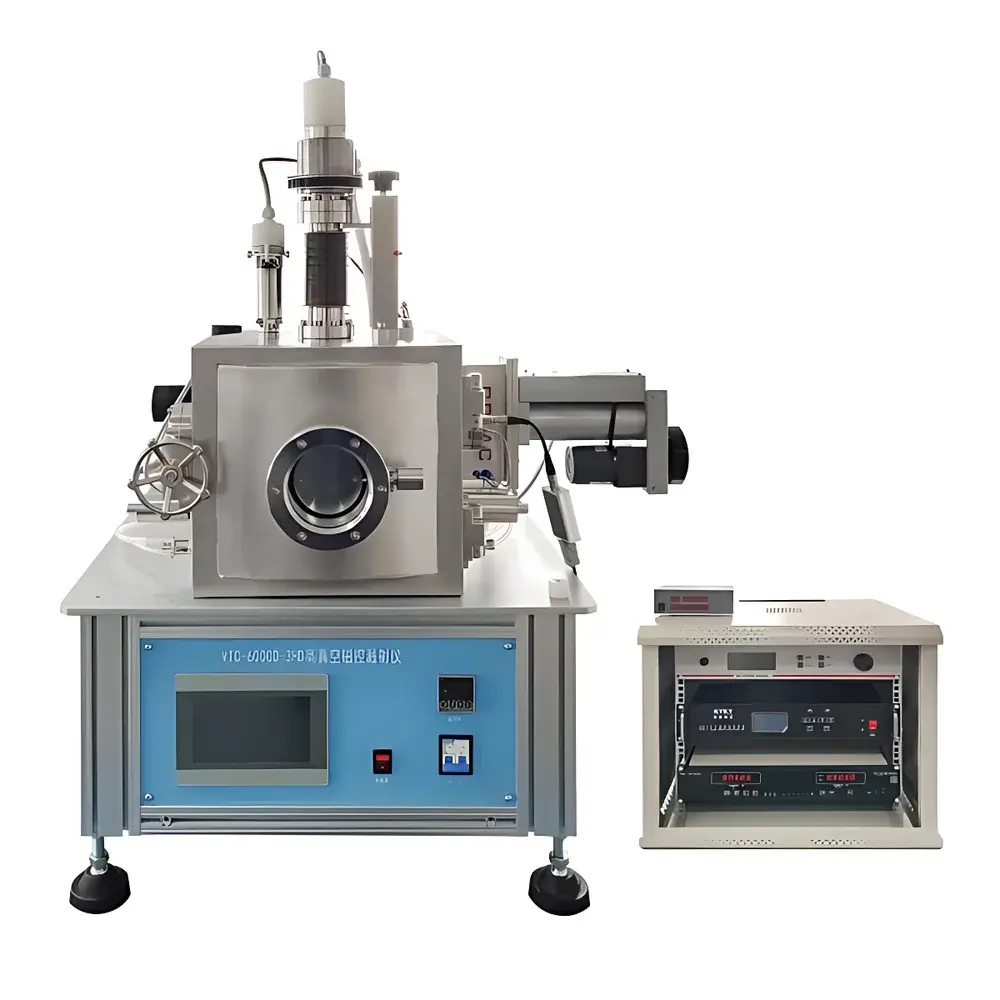
KJ GROUP VTC-600GD High-Vacuum Magnetron Sputtering System
| Brand | KJ GROUP |
|---|---|
| Origin | Liaoning, China |
| Manufacturer Type | Direct Manufacturer |
| Country of Origin | China |
| Model | VTC-600GD |
| Vacuum Base Pressure | ≤8.0×10⁻⁵ Pa |
| Chamber Inner Diameter | Ø300 mm |
| Substrate Heater Temperature Range | RT–500 °C (±1 °C) |
| Max. Number of Sputter Targets | 4 |
| DC Sputtering Power | Up to 500 W (optional) |
| RF Sputtering Power | Up to 300 W |
| Substrate Holder Diameter | Ø140 mm |
| Substrate Rotation Speed | 1–20 rpm |
| Cooling Method | Water-cooled targets |
| Target Size | Ø2″ (50.8 mm), thickness 0.1–5 mm |
| Gas Inlet Control | Dual MFCs (100 SCCM + 200 SCCM) |
| Process Gases | Ar, N₂, or other inert gases |
| Total Power Consumption | <3.5 kW |
| Dimensions (Main Unit) | 850×760×660 mm |
| Overall Dimensions | 1300×660×1200 mm |
| Weight | 190 kg |
Overview
The KJ GROUP VTC-600GD High-Vacuum Magnetron Sputtering System is a compact, modular thin-film deposition platform engineered for precision research in solid-state materials science. It operates on the principle of magnetron sputtering—where energetic argon ions, generated under controlled low-pressure plasma conditions, bombard solid target materials to eject atoms that subsequently condense onto a heated, rotating substrate. This physical vapor deposition (PVD) technique enables reproducible synthesis of stoichiometrically stable, dense, and adherent thin films—including oxides, nitrides, metals, alloys, dielectrics, and organic-inorganic hybrid layers—with sub-nanometer thickness control when integrated with optional quartz crystal microbalance (QCM) monitoring. Designed for laboratory-scale development of functional coatings, the VTC-600GD supports fundamental studies in solid-state electrolytes for all-solid-state batteries, emissive and charge-transport layers in OLED device stacks, ferroelectric memory elements, and transparent conductive oxides (TCOs) for optoelectronic integration.
Key Features
- Modular architecture: Separately housed vacuum chamber, pumping system (turbo-molecular pump + backing pump), and power supply units allow flexible installation and service access.
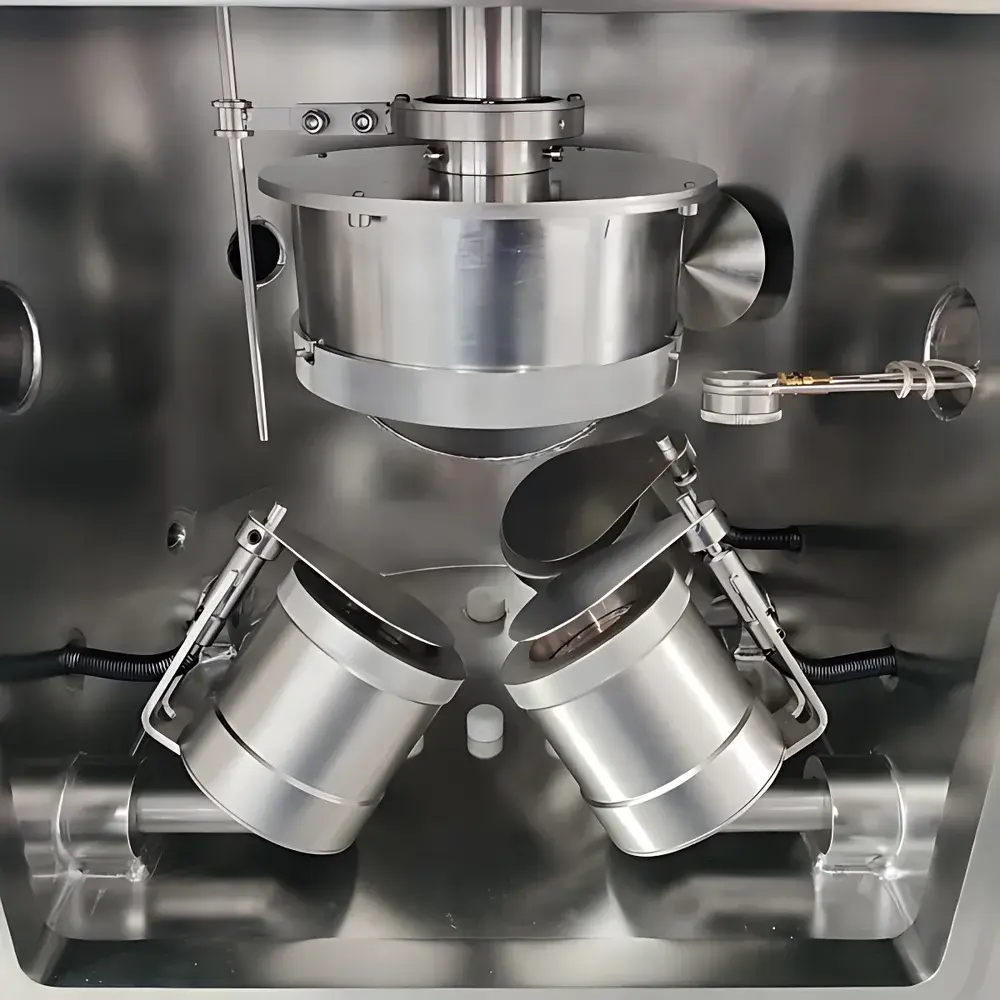
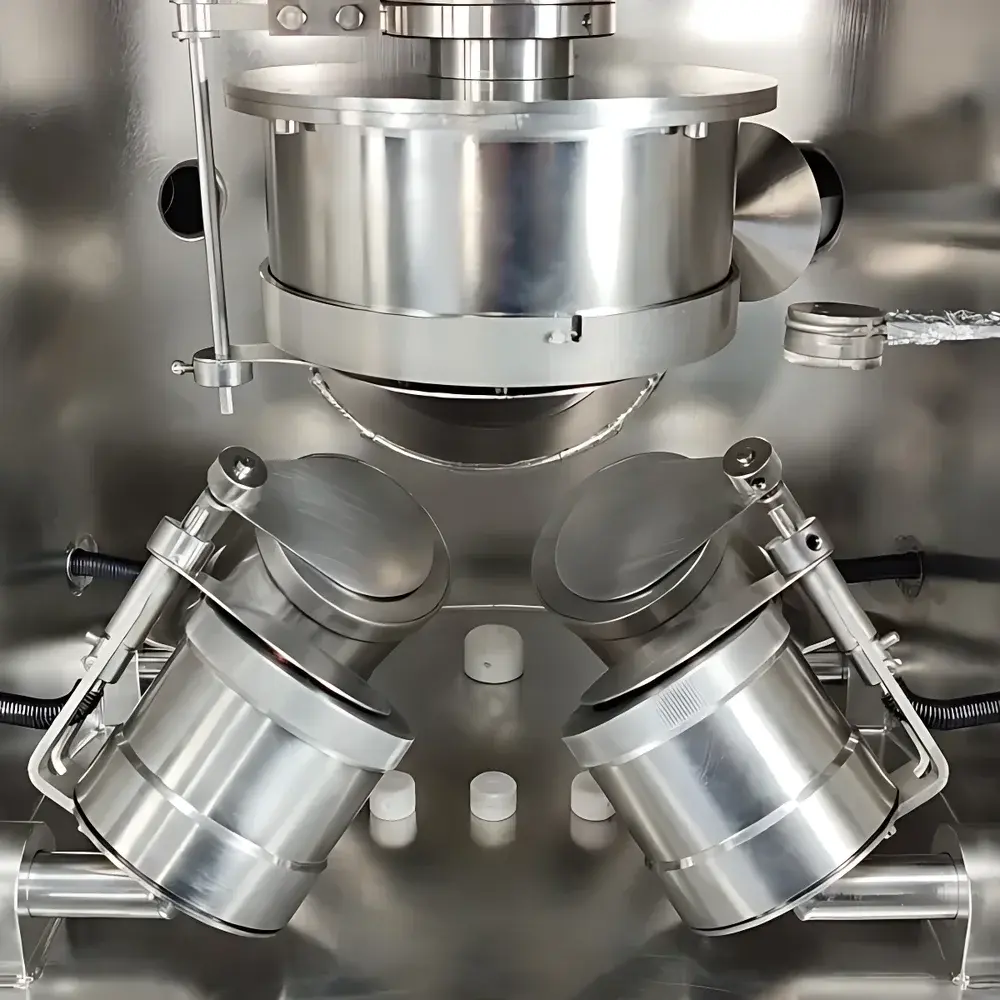
- Four-position target mounting station: Supports simultaneous or sequential co-sputtering from up to four independently controllable magnetron sources—configurable with DC, RF, or hybrid excitation.
- Dual-mode power compatibility: Integrated DC power supply (up to 500 W) for conductive targets (e.g., Al, Ti, ITO); optional RF generator (up to 300 W, 13.56 MHz) for insulating or semiconducting targets (e.g., Al₂O₃, LiNbO₃, SiO₂).
- Precision substrate thermal management: Resistively heated stage (RT–500 °C, ±1 °C stability) with programmable ramp rates and uniformity <±3 °C across Ø140 mm area.
- Controlled film growth environment: Dual mass flow controllers (100 SCCM + 200 SCCM) enable precise gas mixture tuning; chamber base pressure ≤8.0×10⁻⁵ Pa ensures minimal residual contamination during deposition.
- Water-cooled target assembly: Maintains thermal stability during extended high-power operation; accommodates standard Ø2″ (50.8 mm) targets, thickness 0.1–5 mm depending on material thermal conductivity.
Sample Compatibility & Compliance
The VTC-600GD accommodates substrates up to Ø140 mm (e.g., silicon wafers, glass slides, flexible polymer foils, ceramic pellets) mounted on a motorized rotation stage (1–20 rpm). Its design conforms to standard laboratory safety protocols for Class II vacuum systems and inert-gas handling. While not certified to ISO/IEC 17025 or FDA 21 CFR Part 11 out-of-the-box, the system’s modular electrical interfaces, analog/digital I/O ports, and optional data-logging modules support integration into GLP/GMP-compliant workflows when paired with validated third-party software and audit-trail-capable controllers. All gas lines use VCR-style fittings; argon supply must meet ASTM D1946 purity specifications (≥99.99% Ar, H₂O <1 ppm, O₂ <0.5 ppm).
Software & Data Management
The system is operated via an industrial-grade touchscreen HMI with embedded PLC logic, supporting manual mode, recipe-based automation, and real-time parameter logging (pressure, power, temperature, gas flow, rotation speed). Optional USB/RS485/Ethernet connectivity enables remote monitoring and integration with LabVIEW™, MATLAB®, or custom Python-based acquisition platforms. When equipped with the optional QCM film-thickness monitor, deposition rate and cumulative thickness are recorded with timestamped metadata, satisfying basic traceability requirements for academic publication and internal R&D documentation. No cloud storage or proprietary SaaS dependencies are required.
Applications
- Development of Li-ion and solid-state battery components: LiCoO₂ cathodes, LiPON and LLZO electrolyte layers, Cu or Al current collectors.
- OLED and perovskite optoelectronics: MoO₃ hole injection layers, ZnO electron transport layers, Ag or Al reflective electrodes.
- Ferroelectric and piezoelectric thin films: PZT, BTO, and SBT for MEMS actuators and non-volatile memory prototypes.
- Optical interference coatings: TiO₂/SiO₂ multilayer anti-reflection or high-reflectance stacks for laser optics and photovoltaic encapsulation.
- Hard protective coatings: CrN, TiAlN, and DLC on micro-tools or biomedical implants.
- Functional polymer composites: RF-sputtered PTFE nanocomposite films for low-friction or hydrophobic surface engineering.
FAQ
What vacuum level can the VTC-600GD achieve, and what pumping configuration is used?
The system achieves a base pressure of ≤8.0×10⁻⁵ Pa using a combination of a turbo-molecular pump (standard) and a dry scroll backing pump. Optional cryo-pumping or ion-getter upgrades are available for ultra-high-vacuum applications.
Can the VTC-600GD deposit magnetic materials such as Fe, Co, or Ni?
Yes—when equipped with optional high-strength magnetron assemblies (e.g., “strong-magnet” targets), the system supports sputtering of ferromagnetic materials without significant plasma instability or target poisoning.
Is the substrate heating stage compatible with in-situ XRD or Raman characterization?
The Ø140 mm heated stage is designed for ex-situ post-deposition analysis. For in-situ measurements, users may integrate custom viewports or consult KJ GROUP’s OEM interface documentation for third-party synchrotron or lab-based beamline adaptation.
What safety interlocks are built into the system?
Hardware interlocks include vacuum-pressure threshold cutoffs, cooling-water flow sensors, overtemperature shutdown, and door-open plasma suppression. All comply with IEC 61000-6-2/6-4 electromagnetic compatibility standards.
Does the system support reactive sputtering with oxygen or nitrogen?
Yes—the dual-MFC gas delivery system allows precise introduction of O₂ or N₂ alongside Ar for reactive sputtering of oxides (e.g., ITO, ZnO) or nitrides (e.g., TiN, AlN), with process stability maintained via closed-loop pressure feedback control.



