
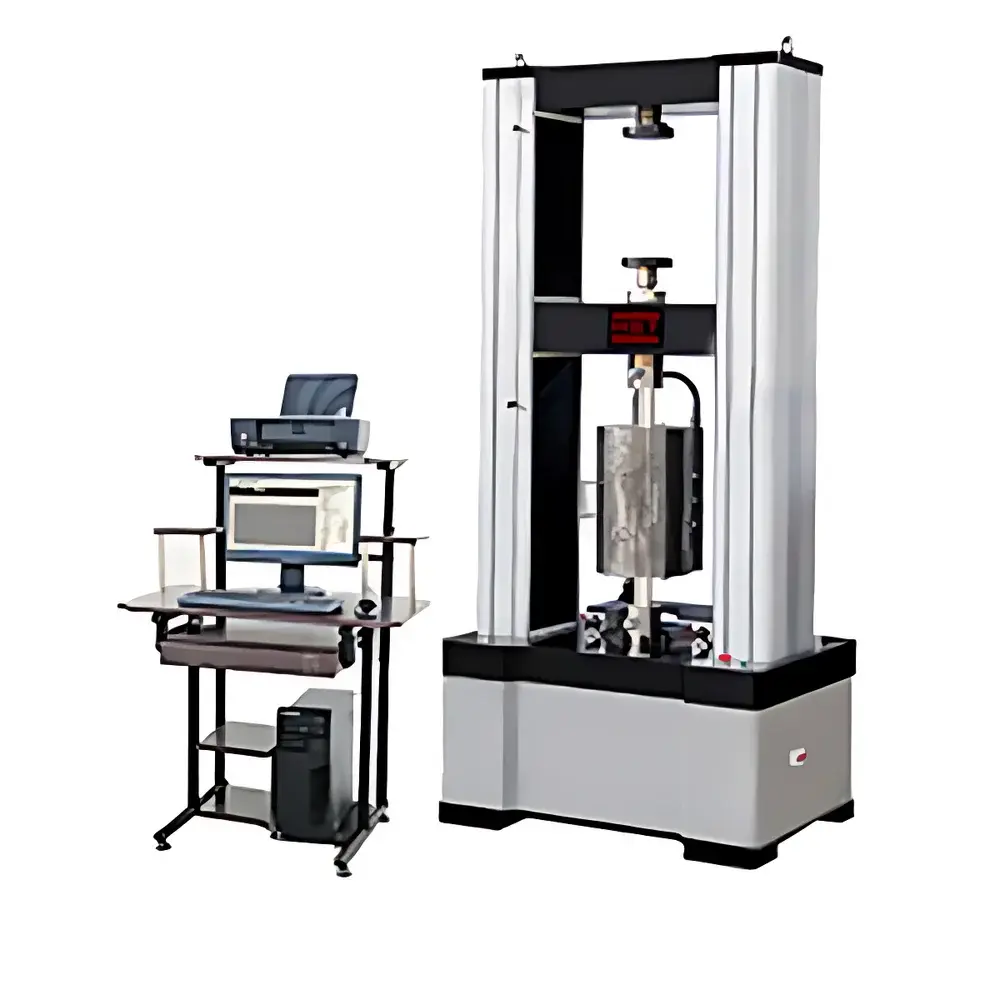
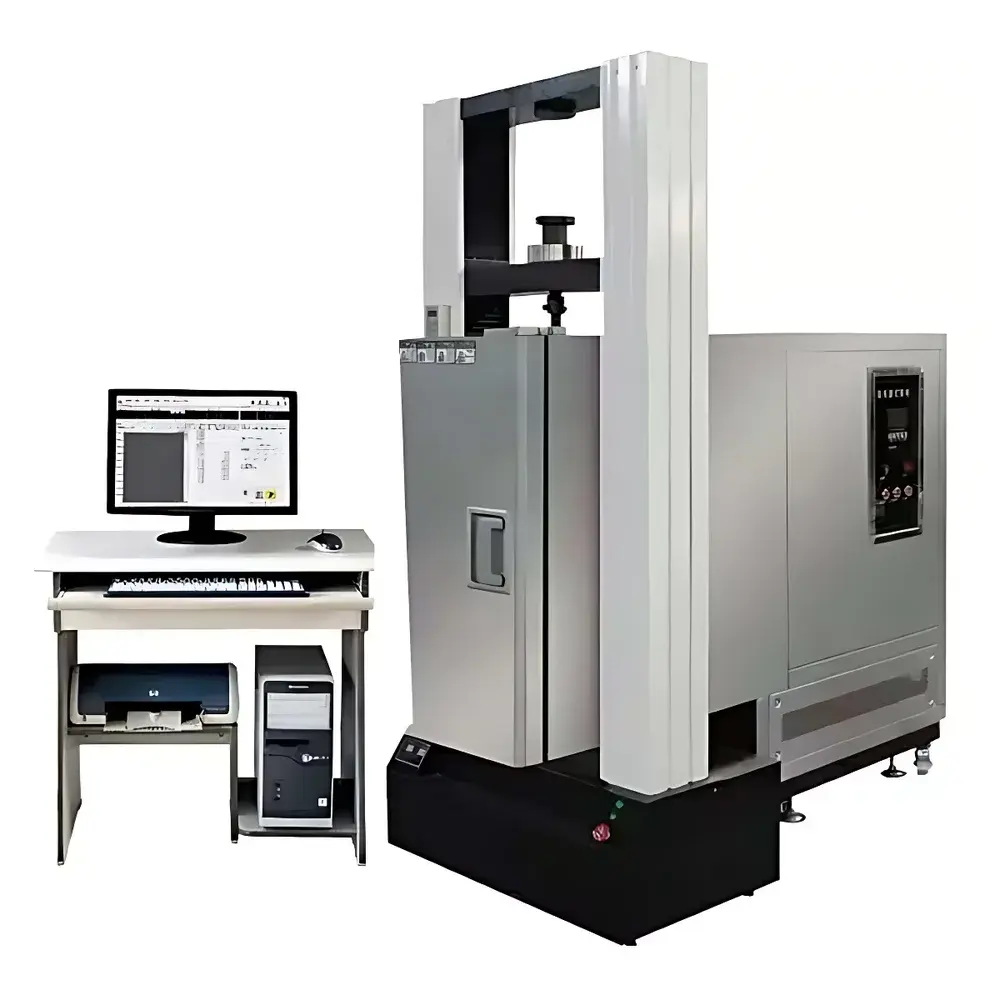
KJ GROUP WDW-100D High-Temperature Universal Testing Machine
| Brand | KJ GROUP |
|---|---|
| Origin | Liaoning, China |
| Manufacturer Type | Authorized Distributor |
| Country of Origin | China |
| Model | WDW-100D |
| Maximum Test Load | 100 kN |
| Temperature Range (Furnace) | 200–1100 °C |
| Temperature Range (Environmental Chamber) | −70 to 300 °C |
| Control System | Windows-based Closed-Loop Servo Control |
| Accuracy Class | ISO 7500-1 Class 1 / Optional Class 0.5 |
| Load Measurement Range | 2–100% FS |
| Load Resolution | 20,000 counts |
| Displacement Resolution | 0.01 mm |
| Speed Range | 0.01–500 mm/min |
| Effective Tensile Space | 700 mm (customizable) |
| Test Width | 550 mm (customizable) |
| Gripping Options | Manual Lever or Hydraulic |
| Specimen Compatibility | Flat (0–21 mm), Round (Ø9–26 mm) |
| Furnace Uniformity | ≤±2 °C (200–600 °C), ≤±3 °C (600–900 °C), ≤±4 °C (900–1100 °C) |
| Chamber Stability | ±0.5 °C temperature fluctuation, ±2% RH humidity fluctuation |
| Power Supply | 380 V AC, 50 Hz, Grounded |
| Total Power Consumption | <10 kW (furnace), 5 kW (chamber) |
Overview
The KJ GROUP WDW-100D High-Temperature Universal Testing Machine is an electromechanical servo-controlled system engineered for precise mechanical characterization of materials under controlled thermal conditions. It operates on the principle of closed-loop force, displacement, and strain control—compliant with ISO 7500-1, ASTM E4, ASTM E8/E8M, ASTM D638, ISO 6892-1, and GB/T 228.1—enabling quantitative evaluation of tensile, compressive, flexural, shear, peel, tear, and puncture behavior across a broad thermal spectrum. The system integrates a high-stiffness dual-column frame with interchangeable environmental modules: a three-zone resistive furnace (200–1100 °C) for elevated-temperature testing and a forced-air thermal chamber (−70 to 300 °C) for cryogenic and ambient-range studies. This dual-capability architecture supports comparative thermomechanical analysis—e.g., quantifying how yield strength, ultimate tensile strength, elongation at break, Young’s modulus, and strain hardening exponent evolve with temperature—critical for alloy development, aerospace component qualification, and high-temperature polymer validation.
Key Features
- Modular thermal environment integration: Interchangeable high-temperature furnace (up to 1100 °C) and low-temperature chamber (down to −70 °C) mounted directly on the load frame without realignment
- Precision three-zone furnace with independent PID controllers, K-type thermocouples, and iron-chromium-aluminum heating elements ensuring axial temperature uniformity ≤±2 °C over a 150 mm hot zone
- Class 1 (ISO 7500-1) load cell with 100 kN capacity, 20,000-count resolution, and ≤±1% FS accuracy; optional Class 0.5 calibration available for GLP/GMP-compliant laboratories
- High-fidelity displacement measurement via linear encoder (0.01 mm resolution, ≤±1% accuracy) and extensometer-ready interfaces for true strain acquisition
- Multi-mode closed-loop control: constant crosshead speed, constant stress rate, constant strain rate, and constant load rate—programmable per test segment
- Robust mechanical design: rigid cast-iron base, preloaded ball-screw drive, and adjustable manual lever or hydraulic grips accommodating flat specimens (0–21 mm thick) and round specimens (Ø9–26 mm)
- Compliance with electrical safety standards: grounded 380 V AC, 50 Hz supply; no water or compressed air required; ventilation recommended for furnace operation
Sample Compatibility & Compliance
The WDW-100D accommodates standardized and custom geometries per ASTM, ISO, and GB specimen configurations—including dog-bone tensile bars, cylindrical compression samples, three- and four-point bend fixtures, and peel/adhesion coupons. Its modular gripping system supports metallic alloys (titanium, nickel superalloys, stainless steels), ceramics, composites (CFRP, GFRP), high-performance polymers (PEEK, polyimides), and elastomers. All thermal modules meet IEC 61000-6-3 (EMC) and IEC 61000-6-2 (immunity) requirements. The furnace complies with ASTM E220 for thermocouple calibration traceability, while the environmental chamber satisfies ISO 17025 metrological validation protocols when operated within specified humidity (±2% RH stability) and thermal uniformity tolerances. Data acquisition and reporting align with FDA 21 CFR Part 11 requirements when paired with audit-trail-enabled software configuration.
Software & Data Management
The Windows-native control and analysis platform provides real-time graphical monitoring of load, displacement, strain, temperature, and time. It supports multi-curve overlay, automatic yield point detection (0.2% offset method), modulus calculation (secant/tangent), and fracture energy integration. Raw data exports to CSV, Excel, and XML formats; report templates are configurable to match internal QA documentation or regulatory submission requirements (e.g., ASTM-certified reports with operator ID, timestamp, calibration certificate references). Optional software modules include fatigue test sequencing, creep/relaxation hold protocols, and user-defined pass/fail criteria with automated flagging. All test files retain full metadata—including environmental chamber/furnace setpoints, controller gains, and hardware configuration logs—for full traceability in GLP, GMP, or ISO 17025 audits.
Applications
- Aerospace: Creep rupture testing of turbine disk alloys at 850–1000 °C; thermal expansion coefficient mapping of CMCs
- Energy: Mechanical integrity assessment of nuclear fuel cladding (Zr-alloys) under simulated LOCA conditions
- Automotive: High-cycle fatigue behavior of aluminum die-cast components at 150–250 °C
- Academia & Standards Labs: Interlaboratory comparison studies per ISO/IEC 17043 proficiency testing schemes
- Polymers & Elastomers: Glass transition identification via modulus drop in DMA-like tensile sweeps from −40 to 120 °C
- Quality Assurance: Batch release testing per ASTM A370 for structural steel plates across service-relevant temperature bands
FAQ
What is the maximum allowable operating altitude for this system?
The WDW-100D is rated for use at elevations ≤1000 m above sea level to ensure stable thermal convection in the furnace and consistent servo amplifier performance.
Can the system perform simultaneous temperature and humidity control?
No—the high-temperature furnace and environmental chamber are separate, mutually exclusive modules. Humidity control (±2% RH) is only available in the −70 to 300 °C chamber; the furnace operates in dry, inert-atmosphere-compatible mode.
Is third-party calibration certification included with delivery?
A factory-issued calibration certificate traceable to NIM (China National Institute of Metrology) is provided. Full ISO/IEC 17025-accredited calibration with uncertainty budgets requires optional on-site service.
What safety interlocks are implemented during high-temperature operation?
The furnace features dual redundant overtemperature cutoffs, door-open thermal shutdown, and real-time thermocouple fault detection—all compliant with EN 61000-6-2 functional safety guidelines.
Does the software support automated compliance checking against ASTM or ISO standard pass/fail thresholds?
Yes—user-defined acceptance criteria (e.g., minimum elongation ≥20%, yield strength deviation ≤±3%) can be embedded into test methods and enforced during post-test evaluation with auto-generated nonconformance alerts.



