
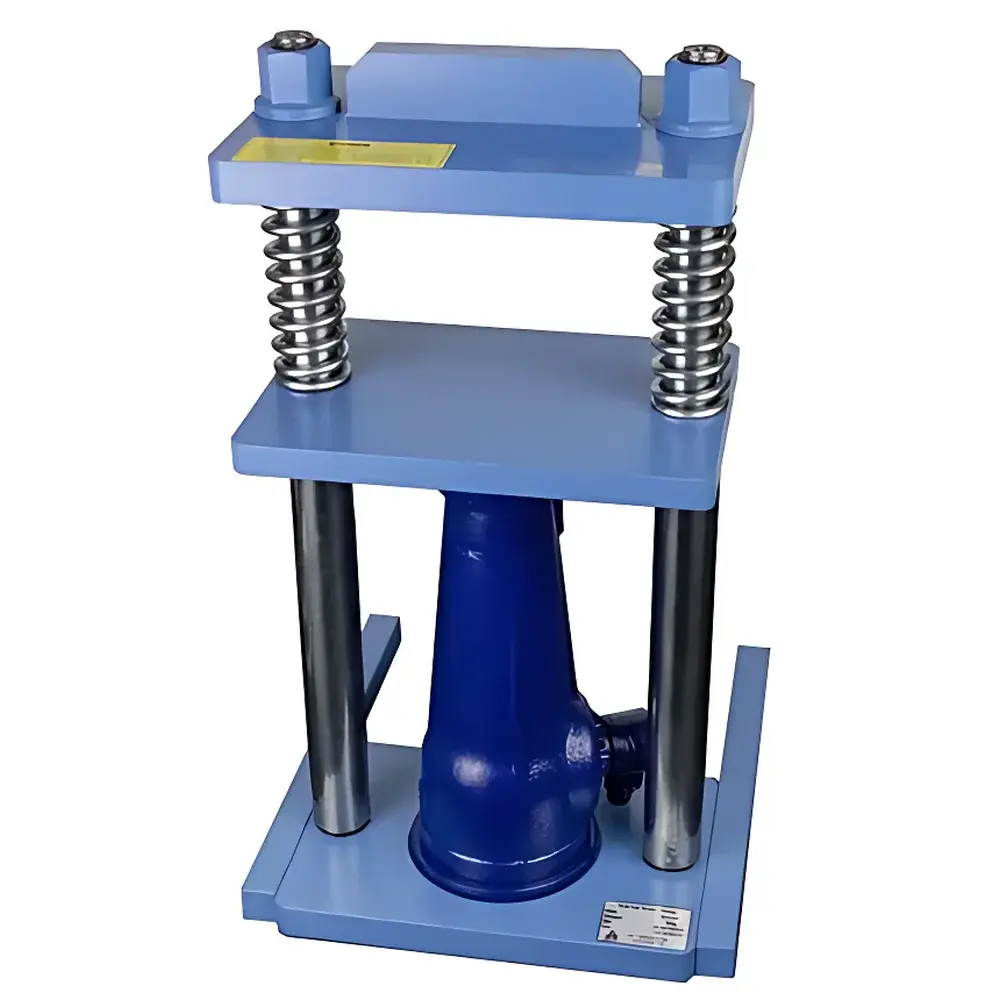
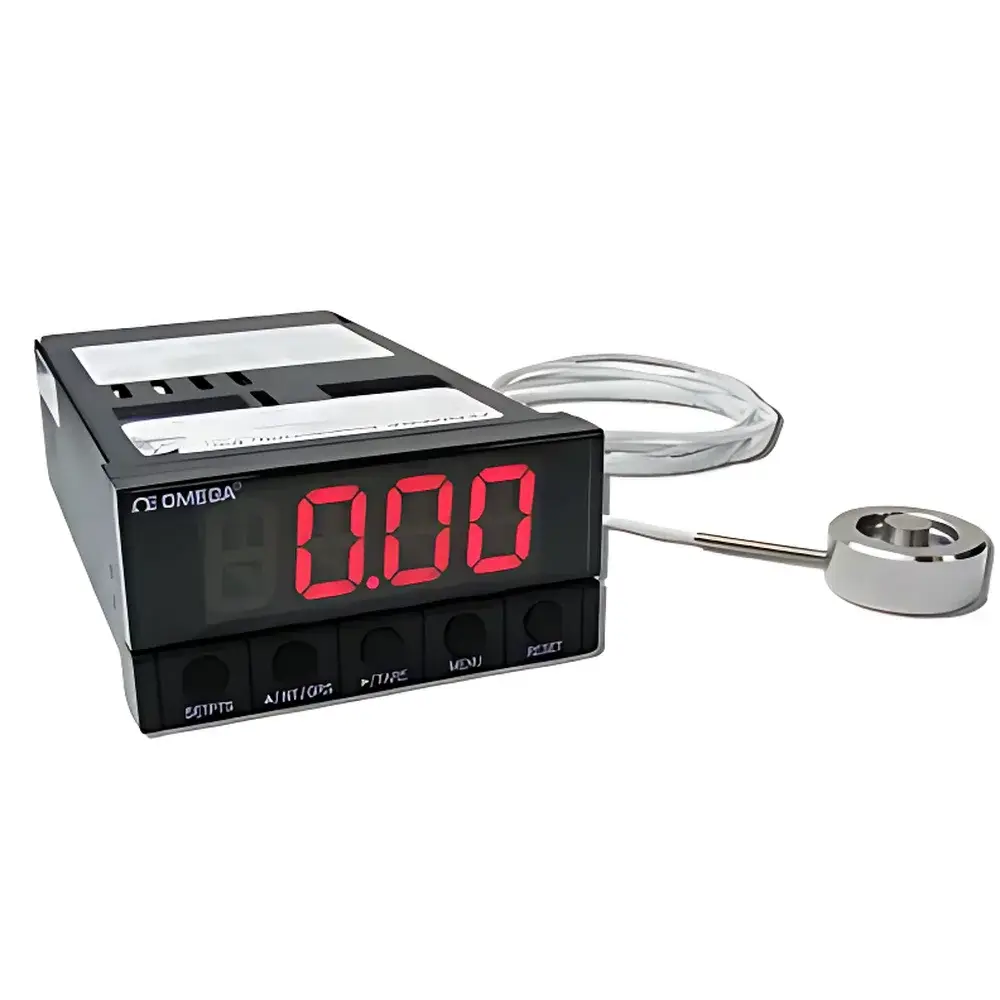
KJ GROUP YLJ-5T Manual Oil-Free Pellet Press
| Brand | KJ GROUP |
|---|---|
| Origin | Liaoning, China |
| Manufacturer Type | Authorized Distributor |
| Country of Origin | China |
| Model | YLJ-5T |
| Instrument Type | Manual Pellet Press |
| Maximum Pressure | 5 Ton (49 kN) |
| Sensor Mounting | Removable, placed in working zone during operation |
| Maximum Stroke | 100 mm |
| Maximum Die Cavity Width | 130 mm |
| Dimensions (L×W×H) | 220 × 150 × 450 mm |
| Weight | 15 kg |
| Warranty | 1 year standard, lifetime technical support |
| Optional Accessories | Dry-press dies in multiple standardized diameters (e.g., 6 mm, 8 mm, 10 mm, 13 mm, 16 mm, 20 mm) available upon request |
Overview
The KJ GROUP YLJ-5T Manual Oil-Free Pellet Press is a precision-engineered laboratory device designed for the safe, controlled consolidation of air- and moisture-sensitive powders into mechanically stable pellets or discs. Unlike conventional hydraulic or pneumatic presses, the YLJ-5T employs a high-strength, oil-free mechanical screw jack system—eliminating risk of lubricant contamination and enabling reliable operation inside inert-atmosphere gloveboxes (Ar/N₂). Its core measurement principle relies on calibrated mechanical force transmission via a threaded lead screw, with real-time load feedback provided by an external, removable piezoresistive pressure sensor mounted directly within the die cavity zone. This architecture ensures traceable, repeatable compaction forces up to 5 metric tons (49 kN), critical for reproducible sample preparation in battery electrode fabrication, solid-state electrolyte testing, catalyst characterization, and X-ray diffraction (XRD) or FTIR pellet formation.
Key Features
- Oil-free mechanical actuation: Eliminates hydrocarbon contamination risk and complies with strict inert-gas glovebox protocols (O₂ < 1 ppm, H₂O < 0.1 ppm).
- Modular frame design: Main press body and screw jack assembly are fully separable—enabling disassembly for transit through standard glovebox antechambers (typical port diameter: 150–200 mm).
- Dedicated external load sensing: Integrated digital pressure sensor (0–50 kN range, ±0.5% FS accuracy) mounts directly adjacent to the die set, minimizing signal path error and enabling in-situ force verification.
- Adjustable stroke limit: Mechanical stop mechanism allows precise control of compression depth (0–100 mm), essential for thickness-critical applications such as uniform electrode pellet fabrication.
- Compact footprint & lightweight construction: 220 × 150 × 450 mm (L×W×H) dimensions and 15 kg mass facilitate integration into space-constrained glovebox workstations or fume hood setups.
- Tool-free die compatibility: Accepts industry-standard cylindrical dry-press dies (6–20 mm ID); all dies feature hardened stainless-steel construction and are certified for ≤5 T loading without plastic deformation.
Sample Compatibility & Compliance
The YLJ-5T supports a broad spectrum of inorganic and organic powders—including lithium-ion cathode/anode materials (e.g., NMC, LFP, Si/C composites), metal oxides (e.g., TiO₂, ZnO), MOFs, pharmaceutical APIs, and geological standards—provided particle size distribution falls within D₅₀ = 0.5–50 µm and flowability permits uniform die filling. All structural components conform to ISO 9001-certified manufacturing practices. While not intrinsically rated for hazardous area use, the press meets IEC 61000-6-3 EMC emission limits and carries CE marking for laboratory equipment under Directive 2014/30/EU. For GLP-compliant labs, optional audit-ready calibration certificates (traceable to NIST standards) are available for both the pressure sensor and mechanical stroke scale.
Software & Data Management
The YLJ-5T operates as a standalone manual instrument with no embedded firmware or connectivity. Load data from the external pressure sensor is output via analog (0–10 V) or RS-485 interface, enabling direct acquisition into third-party DAQ systems (e.g., National Instruments LabVIEW, MATLAB Data Acquisition Toolbox) or industrial PLCs. Users may log force vs. displacement profiles, generate CSV reports, and apply post-processing filters (e.g., moving average smoothing, peak hold) using open-source or commercial analysis platforms. The system inherently supports 21 CFR Part 11–compliant workflows when paired with validated electronic lab notebooks (ELNs) that enforce user authentication, audit trails, and electronic signatures.
Applications
- Preparation of XRD and FTIR pellets for quantitative phase analysis of air-sensitive battery materials.
- Consolidation of solid-state electrolyte powders (e.g., LLZO, LATP) into dense green bodies prior to sintering.
- Manufacturing of reference standards for elemental analysis (XRF, SEM-EDS) under inert atmosphere.
- Controlled densification studies correlating applied pressure with pellet density, porosity, and ionic conductivity.
- Routine QA/QC pressing of catalyst powders (e.g., Pt/C, Ni/Al₂O₃) for surface area and pore volume validation (BET).
FAQ
Can the YLJ-5T be used outside a glovebox?
Yes—the oil-free mechanical design poses no hazard in ambient labs; however, its primary engineering rationale is inert-atmosphere compatibility. Use outside gloveboxes requires standard lab PPE and dust control measures.
Is the pressure sensor calibrated before shipment?
Each unit ships with a factory calibration certificate (valid for 12 months) traceable to national metrology institutes. Recalibration is recommended annually or after 500 operational cycles.
What die sizes are supported out-of-the-box?
The base configuration includes a 13 mm diameter die set. Additional diameters (6, 8, 10, 16, and 20 mm) are available as optional accessories with matching punches and alignment guides.
Does the press include overload protection?
No automatic cutoff is integrated; users must monitor the digital display and halt rotation manually at target load. Mechanical thread design inherently limits maximum torque transfer to prevent catastrophic failure.
How is maintenance performed?
Maintenance is limited to periodic inspection of screw threads and die surfaces for wear or galling. No lubrication is required. Cleaning is performed with ethanol or isopropanol wipes—never aqueous solutions.



