
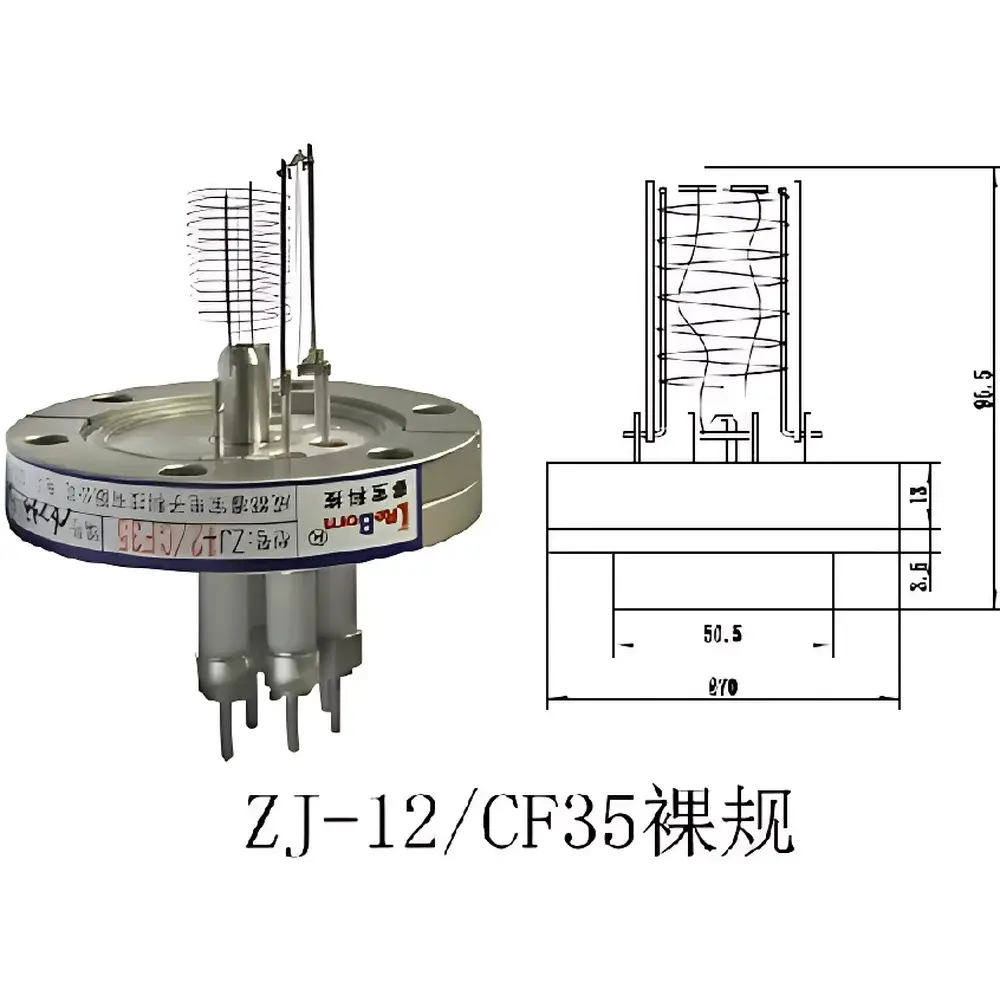
KJ GROUP ZJ-12 Bayard-Alpert Hot Cathode Ionization Gauge
| Brand | KJ GROUP (Shenyang Kejing) |
|---|---|
| Origin | Liaoning, China |
| Manufacturer Type | Authorized Distributor |
| Country of Origin | China |
| Model | ZJ-12 |
| Measurement Range | 1×10⁻¹ – 1×10⁻⁸ Pa |
| Accelerating Electrode Potential | +200 V (vs. ground) |
| Cathode Potential | –50 V (vs. ground) |
| Collector Potential | 0 V (vs. ground) |
| Emission Current | 400 µA (1×10⁻¹ – 1×10⁻³ Pa), 4 mA (1×10⁻³ – 1×10⁻⁸ Pa) |
| Gauge Constant | 0.15 ±15% Pa⁻¹ |
| Degassing Method | Electron Bombardment (<30 W) |
| Maximum Bakeout Temperature | ≤400 °C |
| Flange Type | CF35 (ConFlat) |
| Reference-Only Range | 5×10⁻⁸ – 1×10⁻⁸ Pa |
Overview
The KJ GROUP ZJ-12 Bayard-Alpert (B-A) hot cathode ionization gauge is a precision vacuum measurement instrument engineered for stable, long-term operation in high vacuum (HV) and ultra-high vacuum (UHV) environments. Based on the classical B-A configuration, it employs a directly heated noble-metal oxide cathode—typically barium oxide or thoriated iridium—to generate thermionic electrons. These electrons traverse a cylindrical grid (accelerating electrode at +200 V) and ionize residual gas molecules; resulting positive ions are collected at a central wire (collector at 0 V), producing a current linearly proportional to gas density under constant emission conditions. The ZJ-12’s design prioritizes resistance to transient atmospheric exposure and oxidative degradation, enabling reliable performance during system venting, pump-down cycles, and extended bakeout procedures. Its gauge constant of 0.15 ±15% Pa⁻¹ is calibrated against nitrogen-equivalent pressure, consistent with ISO 3567:2019 and ASTM E857–22 standards for ionization gauge characterization.
Key Features
- Robust noble-metal oxide cathode architecture optimized for thermal stability and resistance to oxidation during repeated atmospheric exposure.
- Dual-range emission current control: 400 µA for pressures from 1×10⁻¹ Pa to 1×10⁻³ Pa; automatically switches to 4 mA mode for enhanced signal-to-noise ratio in the 1×10⁻³ Pa to 1×10⁻⁸ Pa range.
- Integrated electron bombardment degassing capability (<30 W) supporting in-situ cleaning of electrode surfaces without external power supplies.
- CF35 ConFlat flange interface compliant with ISO 16055:2017, rated for bakeout up to 400 °C—compatible with standard UHV chamber conditioning protocols.
- Low outgassing envelope and minimal virtual leak risk due to all-metal, ceramic-insulated construction and helium-leak-tested assembly.
Sample Compatibility & Compliance
The ZJ-12 operates exclusively in continuous gas-phase environments and is not intended for use with condensable vapors, reactive halogenated species, or hydrocarbon-rich atmospheres without prior assessment of cathode poisoning risk. It is suitable for inert gases (N₂, Ar, He), common process gases (H₂, O₂, N₂O), and clean UHV systems containing residual H₂, H₂O, CO, and CO₂. Calibration is traceable to national metrology institutes via nitrogen reference standards. The gauge complies with electromagnetic compatibility requirements per IEC 61326-1:2022 (industrial environment) and meets mechanical safety provisions outlined in ISO 14120:2015 for guarded vacuum components. For GLP/GMP-regulated applications, its analog output (0–10 V or 4–20 mA) supports integration into validated vacuum monitoring systems with audit-trail-capable controllers.
Software & Data Management
While the ZJ-12 is an analog-output gauge requiring external controller instrumentation (e.g., KJ GROUP’s VAC-3000 series or third-party compatible vacuum controllers), its signal interface is designed for seamless integration into SCADA and LabVIEW-based data acquisition architectures. When paired with a controller supporting IEEE 488.2 or Modbus RTU protocols, full operational logs—including emission current, collector current, and derived pressure values—can be timestamped and archived in accordance with FDA 21 CFR Part 11 requirements for electronic records and signatures. Firmware-upgradable controllers enable configurable averaging windows, zero-offset compensation, and automatic range-switching logic synchronized to emission current thresholds.
Applications
- UHV deposition systems (e-beam evaporation, sputtering, MBE) requiring real-time pressure feedback below 1×10⁻⁷ Pa.
- Surface science chambers where reproducible base pressure validation is critical prior to XPS, AES, or LEED experiments.
- Accelerator beamline vacuum diagnostics, particularly in sections downstream of turbomolecular pumps and cryopanels.
- Space simulation test facilities operating under sustained bakeout conditions up to 400 °C.
- Research-grade vacuum furnaces and getter-pumped systems requiring long-term drift monitoring over >12-month intervals.
FAQ
What gases can the ZJ-12 accurately measure?
The ZJ-12 provides nitrogen-equivalent pressure readings; accuracy varies by gas species due to differences in ionization cross-section and collection efficiency. Correction factors are available for H₂, He, Ar, O₂, and CO per ISO 27893:2015.
Is the ZJ-12 compatible with active bakeout?
Yes—its all-metal, ceramic-insulated construction and CF35 flange support continuous operation at ≤400 °C; however, cathode emission must be disabled during bakeout to prevent thermal runaway.
Why is the 5×10⁻⁸ Pa to 1×10⁻⁸ Pa range labeled “reference-only”?
At pressures below 5×10⁻⁸ Pa, background x-ray photoelectron current becomes comparable to true ion current, introducing systematic uncertainty exceeding ±50%; thus, measurements in this band serve only as qualitative trend indicators.
Can the ZJ-12 be used in corrosive process environments?
No—halogen-containing gases (e.g., Cl₂, NF₃), silanes, or high-humidity atmospheres accelerate cathode degradation and compromise calibration integrity.
What is the typical service life under continuous UHV operation?
With proper emission management and avoidance of accidental air exposure, functional lifetime exceeds 15,000 hours—validated through accelerated aging tests per IEC 60068-2-60.



