
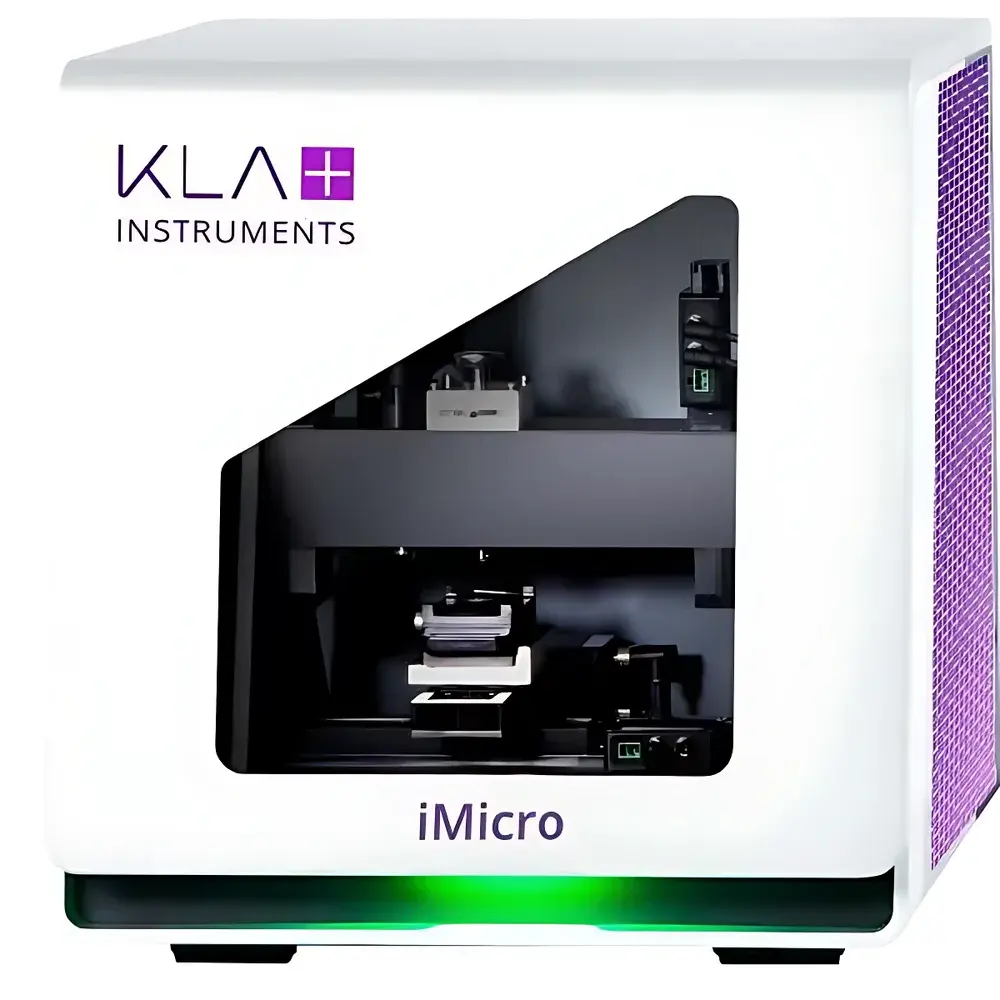
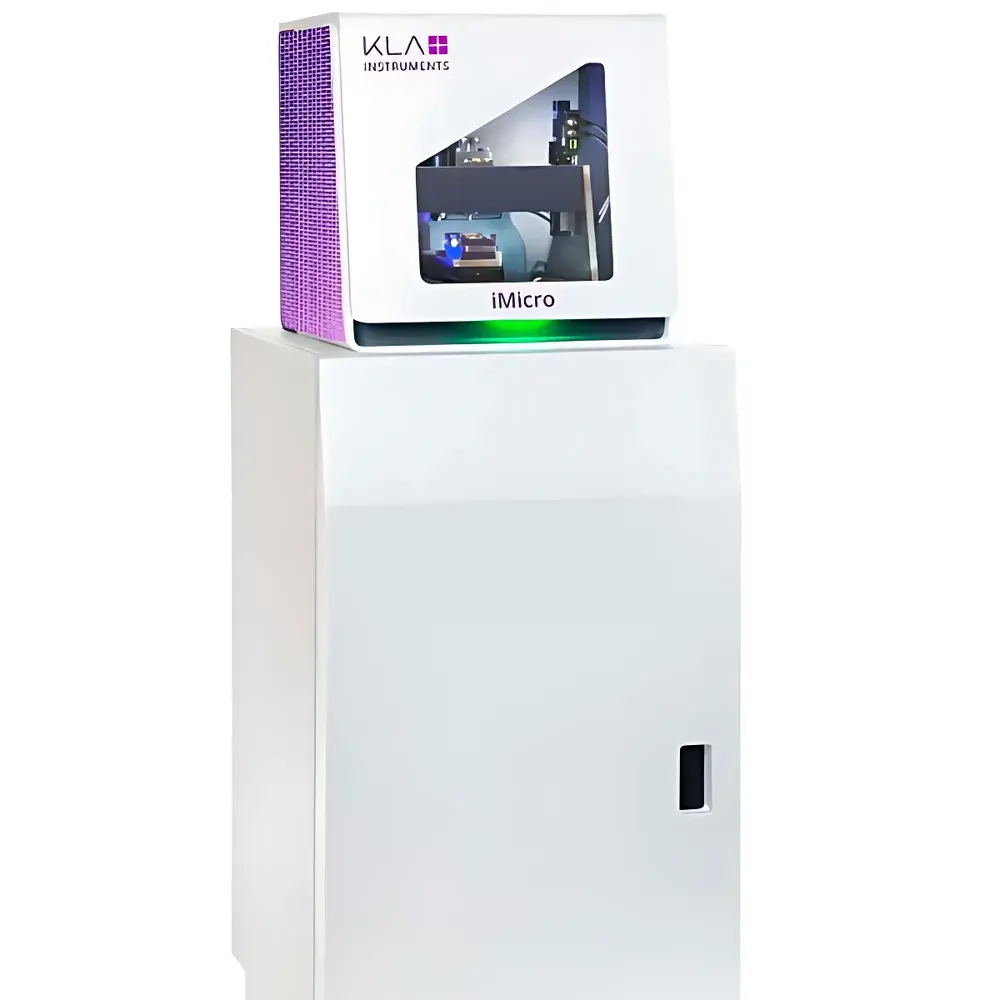
KLA iMicro Nanoindentation and Scratch Testing System
| Brand | KLA |
|---|---|
| Origin | USA |
| Model | iMicro |
| Instrument Type | Integrated Nanoindentation and Scratch Tester |
| Maximum Normal Load | 1 N |
| Load Resolution | <1 nN |
| Displacement Range | ±25 µm |
| Displacement Resolution | <0.05 nm |
| Indenter Types | Dozens of diamond indenters (Berkovich, cube corner, Vickers, spherical, flat punch, etc.) |
| Controller | InQuest high-speed controller (100 kHz data acquisition, 20 µs time constant) |
| Software | InView Suite (RunTest, ReviewData, InFocus, InView University, mobile app) |
| Compliance | Fully supports ISO 14577-1/2/3, ASTM E2546, and GLP/GMP-aligned audit trails |
Overview
The KLA iMicro Nanoindentation and Scratch Testing System is a modular, high-precision platform engineered for quantitative nanomechanical characterization across diverse material classes—from ultra-soft hydrogels (E ≈ 1 kPa) to hard ceramic coatings (E > 500 GPa). It operates on the principle of controlled quasi-static and dynamic force-displacement actuation, coupled with real-time capacitance-based displacement sensing and electromagnetic force actuation. The system implements the Oliver-Pharr method (ISO 14577-1) for hardness and reduced modulus extraction, while supporting advanced dynamic mechanical analysis via Continuous Stiffness Measurement (CSM), ProbeDMA™, and NanoBlitz® 3D/4D mapping protocols. Its integrated high-rigidity龙门 frame, internal active vibration isolation, and optical microscope with digital zoom enable sub-micron positioning accuracy and robust measurement reproducibility under ambient or elevated temperature (up to 300 °C) conditions.
Key Features
- Modular actuator architecture: Standard InForce 1000 actuator (0–1 N, <1 nN resolution) for hard materials; optional InForce 50 (0–50 mN) for soft polymers and biomaterials; Gemini 2D dual-axis actuator for lateral force, friction coefficient, Poisson’s ratio, and scratch trajectory control.
- InQuest high-speed controller: 100 kHz sampling rate, 20 µs time constant, enabling detection of pop-in events, creep response, and transient plasticity onset.
- Integrated optical microscope with motorized zoom and precise XY-stage (100 mm × 100 mm travel, 25 mm Z-range), facilitating rapid site-specific indentation and large-area mechanical mapping.
- Unified indenter interface: Compatible with Berkovich, cube corner, Vickers, spherical, flat-punch, and custom geometries—all calibrated in situ using KLA’s embedded tip geometry verification algorithm.
- True Test I-V option: Synchronized nanomechanical loading and electrical characterization (voltage biasing, current measurement through conductive indenters), enabling electromechanical coupling studies in piezoelectrics, battery electrodes, and 2D materials.
- Active six-degree-of-freedom vibration isolation cabinet (optional): Eliminates floor-borne noise without manual tuning—critical for low-load (<10 mN) and high-resolution depth-sensing applications.
Sample Compatibility & Compliance
The iMicro accommodates bulk metals, ceramics, thin films (10 nm–10 µm), PVD/CVD coatings (TiN, DLC, Al₂O₃), MEMS devices, polymer blends, pharmaceutical tablets, battery cathode/anode layers, and hydrated biological tissues. All standard test methods—including ISO 14577-1 (instrumented indentation), ASTM E2546 (nanoindentation of thin films), and USP <1042> (mechanical testing of pharmaceutical excipients)—are preconfigured in InView software with full audit trail support per FDA 21 CFR Part 11. Calibration traceability follows NIST-traceable reference standards (e.g., fused silica, sapphire, SiC), and thermal drift compensation is applied automatically during extended-duration tests.
Software & Data Management
InView software provides a unified environment for experiment design, real-time monitoring, post-processing, and statistical reporting. Core modules include RunTest (method scripting with conditional logic), ReviewData (multi-parameter curve fitting, modulus/hardness depth profiling), and InFocus (automated focus and feature recognition). Advanced capabilities include user-defined method development (UDD), DataBurst™ mode (>1 kHz displacement logging), and export-compatible HDF5/CSV formats for third-party analysis (MATLAB, Python, Origin). All test sequences generate timestamped, digitally signed metadata logs compliant with GLP and GMP documentation requirements. InView University offers role-based online training (operator, engineer, scientist), and the mobile application enables remote system status monitoring and queue management.
Applications
- Nanomechanical property mapping: NanoBlitz® 3D generates 300×300 arrays (≤100,000 indents) in <2 hours, delivering spatially resolved E, H, and S distributions for phase identification in composites and graded coatings.
- Thin-film metrology: AccuFilm™ applies Hay-Crawford modeling with CSM to decouple film properties from substrate influence—valid for both stiff-on-soft (e.g., TiN/Si) and soft-on-stiff (e.g., PMMA/Si) systems.
- Viscoelastic quantification: ProbeDMA™ measures storage/loss moduli (E′, E″) and loss tangent (tan δ) across frequencies (0.1–100 Hz) using flat-punch indenters—bridging the gap between macro-DMA and nanoscale rheology.
- Adhesion and wear assessment: Quantitative scratch testing (linear or constant-load modes) evaluates coating delamination thresholds, critical load (Lc), and residual groove morphology via post-scan profilometry.
- High-temperature mechanics: 300 °C heating stage with inert gas purge enables in situ thermomechanical testing—critical for evaluating thermal barrier coatings, solder joints, and polymer degradation kinetics.
- Biomaterials characterization: Biomaterials Method Pack extends sensitivity to shear moduli as low as 1 kPa using low-force CSM and specialized flat indenters, supporting regulatory submissions for implantable device materials.
FAQ
What standards does the iMicro comply with for hardness and modulus reporting?
The system implements ISO 14577-1/2/3, ASTM E2546, and JIS Z 2244 for instrumented indentation, with automated calculation of reduced modulus, nanoindentation hardness, Vickers hardness, and normalized indentation work.
Can the iMicro perform both nanoindentation and scratch testing on the same sample without repositioning?
Yes—the integrated XY-stage and interchangeable actuators allow sequential indentation, scratch, and topography mapping within a single vacuum or inert-gas chamber, minimizing thermal drift and registration error.
Is continuous stiffness measurement (CSM) available as a field-upgradeable option?
CSM is fully integrated into the InQuest controller firmware and InView software; no hardware modification is required—activation is licensed per instrument.
How does the system ensure indenter tip geometry integrity during high-cycle testing?
All diamond indenters are certified per ISO 14577 Annex B, and in situ tip shape verification is performed before each test series using a dedicated calibration routine embedded in InView.
Does the iMicro support automated batch testing for quality control environments?
Yes—via InView’s scriptable RunTest module and API integration, users can define pass/fail criteria, auto-generate PDF reports, and export results to LIMS or MES platforms.



