

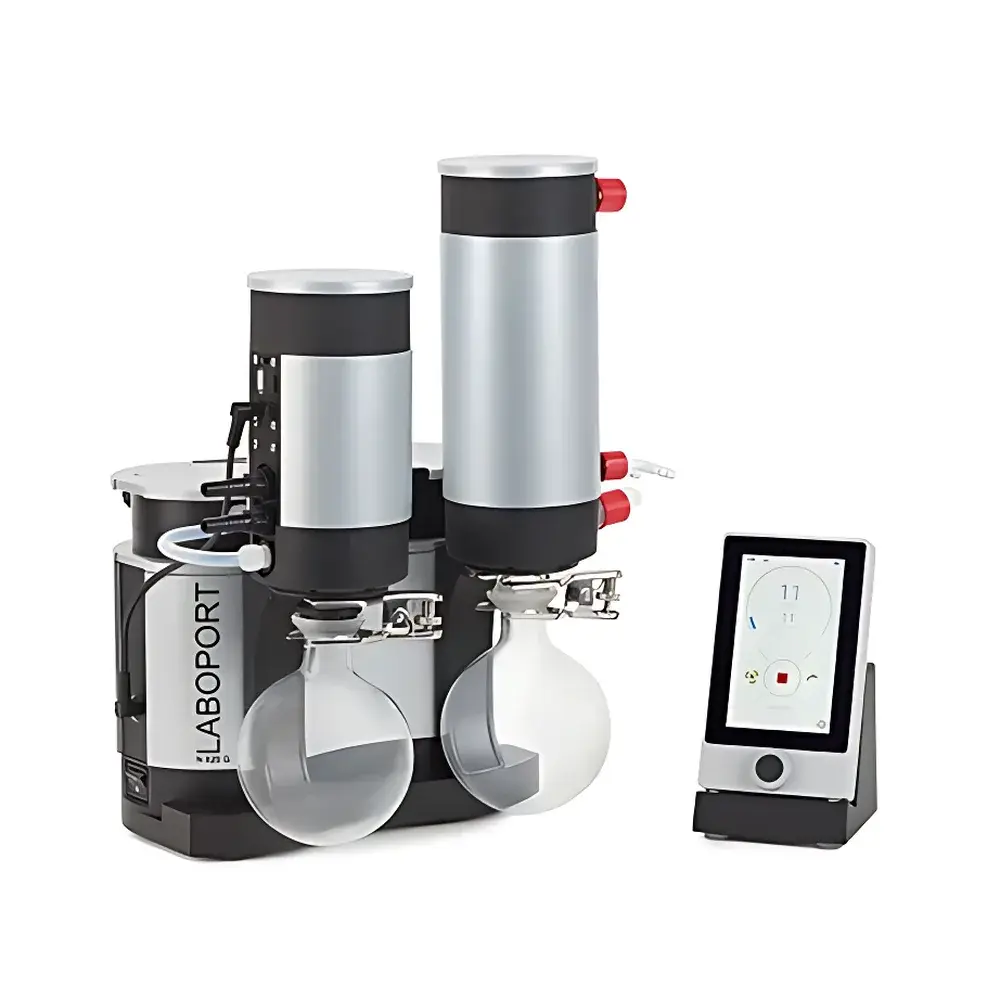
KNF SC 820 G LABOPORT® Vacuum System
| Brand | KNF |
|---|---|
| Origin | Germany |
| Pump Type | Chemically Resistant Diaphragm Vacuum Pump |
| Ultimate Vacuum | 6 mbar (abs.) |
| Maximum Flow Rate | 20 L/min |
| Motor Power | 60 W |
| Dimensions (W × D × H) | 347 × 416 × 260 mm |
| Weight | 13.35 kg |
| Compliance | CE, RoHS, UL Recognized Components |
| Control Interface | Integrated Touchscreen + Precision Rotary Knob |
| Operating Modes | 4 Predefined Vacuum Profiles (Constant Pressure, Ramp, Boiling Point Detection, Manual) |
| Condensate Handling | Dual-Stage Separation — Inlet Solvent Trap + Outlet High-Efficiency Cold Trap |
Overview
The KNF SC 820 G LABOPORT® Vacuum System is an integrated, chemically resistant diaphragm vacuum solution engineered for precision-controlled laboratory applications requiring stable, oil-free vacuum generation. Based on KNF’s proven NMP series diaphragm pump architecture, the SC 820 G combines a corrosion-resistant PTFE/EPDM fluid path with intelligent vacuum regulation to deliver reproducible performance in demanding organic solvent environments. Unlike conventional single-pump setups, this system integrates a dedicated inlet solvent separator, a high-efficiency outlet cold trap, a rigid mounting base, and a fully programmable vacuum controller—enabling closed-loop pressure management down to 6 mbar (absolute). Its core measurement principle relies on real-time pressure feedback combined with adaptive motor speed modulation, allowing dynamic response to vapor load fluctuations during rotary evaporation, fractional distillation, or vacuum drying. Designed for continuous operation under variable load conditions, the SC 820 G meets essential engineering requirements for GLP-compliant laboratories where trace solvent recovery, operator safety, and long-term calibration stability are critical.
Key Features
- Integrated boiling point detection algorithm: Automatically identifies solvent boiling points via pressure ramp analysis and adjusts vacuum setpoint in real time to prevent bumping and foaming.
- Oil-free, chemically inert pumping mechanism: PTFE-coated diaphragms, EPDM valves, and stainless-steel housing ensure compatibility with aggressive solvents including acetone, THF, chloroform, and concentrated acids.
- Four configurable operating modes: Constant vacuum, linear ramp, boiling point–adaptive control, and manual override—each selectable via intuitive touchscreen interface or tactile rotary encoder.
- Remote operation capability: Full system control and monitoring via Ethernet or optional RS-485 interface, enabling safe use inside fume hoods without physical access to controls.
- Dual-stage condensate management: Front-end separation bottle captures bulk condensate; rear-mounted high-surface-area cold trap minimizes solvent vapor carryover and extends pump service life.
- Energy-optimized drive: 60 W brushless DC motor delivers full 20 L/min flow at low power draw, reducing thermal load and improving placement flexibility in temperature-sensitive lab environments.
Sample Compatibility & Compliance
The SC 820 G is validated for use with volatile organic compounds (VOCs), aqueous solutions, and moderately corrosive vapors encountered in synthetic chemistry, pharmaceutical process development, and analytical sample preparation. Its wetted materials comply with USP Class VI biocompatibility standards and meet ASTM D471 resistance requirements for elastomers exposed to organic solvents. The system conforms to IEC 61000-6-3 (EMC emissions) and IEC 61000-6-2 (immunity), carries CE marking per Directive 2014/30/EU (EMC) and 2014/35/EU (LVD), and incorporates UL-recognized components for North American installations. All firmware supports audit trail logging and user-access level configuration, aligning with FDA 21 CFR Part 11 requirements for electronic records when deployed in regulated QC/QA workflows.
Software & Data Management
The embedded LABOPORT® controller runs KNF’s proprietary vacuum management firmware (v3.2+), supporting CSV export of time-stamped pressure, flow, and motor current data via USB or network connection. Optional LabVIEW™ drivers and Modbus TCP integration enable seamless incorporation into centralized lab automation platforms (e.g., DeltaV, LabArchives, or custom SCADA systems). Calibration parameters are stored in non-volatile memory with tamper-evident checksums; factory calibration certificates include NIST-traceable pressure transducer verification at three points (100 mbar, 20 mbar, and 6 mbar). Audit logs record all parameter changes, user logins, and mode transitions with ISO 8601 timestamps—essential for internal audits and regulatory inspections.
Applications
- Rotary evaporation of heat-sensitive compounds under precisely controlled vacuum gradients
- Vacuum-assisted drying of lyophilized samples and polymer films
- Short-path and fractional distillation with automated endpoint detection
- Multi-station vacuum manifolds serving parallel reaction blocks or filtration rigs
- Controlled degassing of solvents prior to HPLC or GC injection
- Integration into automated synthesis platforms requiring repeatable vacuum sequencing
FAQ
What vacuum range is supported for precise boiling point detection?
The SC 820 G operates stably between 100 mbar and 6 mbar (absolute); its ramp-based boiling point algorithm is optimized for pressures from 50–10 mbar, where most common solvents exhibit clear vapor pressure inflection points.
Can the system be integrated into existing lab networks?
Yes—Ethernet (TCP/IP) and RS-485 interfaces support standard protocols including Modbus TCP and KNF’s native ASCII command set for remote scripting and status polling.
Is routine maintenance required beyond condensate emptying?
No scheduled maintenance is needed within the first 5,000 operating hours; diaphragm lifetime exceeds 15,000 hours under typical lab loads. Replacement kits include pre-aligned valve assemblies to minimize downtime.
Does the cold trap require external cooling?
No—the integrated cold trap uses passive heat-sink design with high thermal mass aluminum fins; no coolant or Peltier elements are required.
How is compliance with GLP/GMP documentation ensured?
All firmware versions include configurable electronic signature fields, automatic log archiving, and exportable calibration history—fully compatible with QbD-driven quality systems.



