
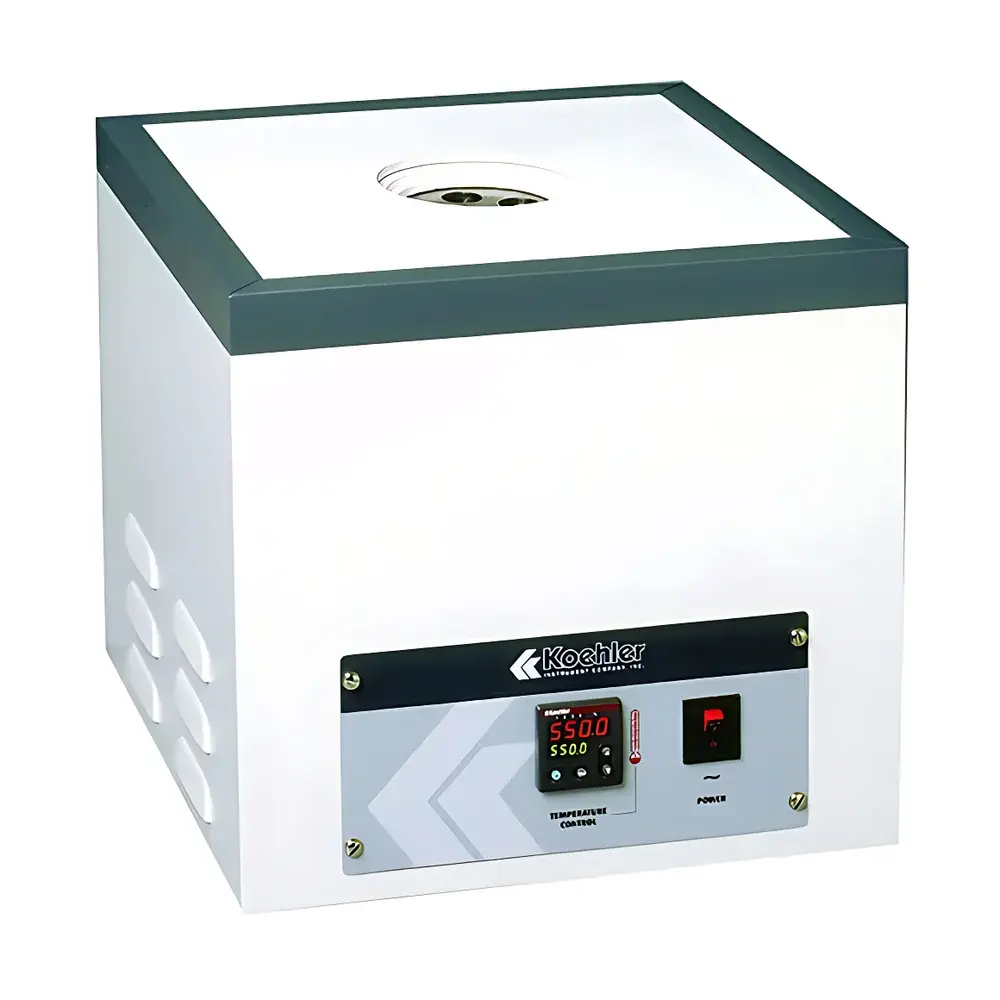
Koehler K27190 Ramsbottom Carbon Residue Tester
| Brand | Koehler |
|---|---|
| Origin | USA |
| Model | K27190 |
| Temperature Range | Ambient to 650 °C |
| Temperature Stability | ±1 °C (±2 °F) |
| Sample Capacity | 5 samples per run |
| Furnace Material | Cast iron |
| Heating Power | 0–2400 W, ceramic band heater |
| Dimensions | 41 × 55 × 37 cm |
| Weight | 29 kg |
| Power Supply | 220–240 V, 50/60 Hz, single-phase, 10.9 A |
| Compliance | ASTM D524, ASTM D6074, IP 14, ISO 4262, FTM 791-5002, NF T 60-117 |
Overview
The Koehler K27190 Ramsbottom Carbon Residue Tester is a precision-engineered laboratory instrument designed for the quantitative determination of carbon residue in petroleum products following the classical Ramsbottom method. It measures the amount of carbonaceous material remaining after controlled evaporation and thermal decomposition under specified conditions—providing a critical indicator of coke-forming tendency during refining, combustion, or high-temperature processing. Unlike micro-methods such as Conradson or微量 (micro) carbon residue (ASTM D4530), the Ramsbottom test employs a standardized coking vessel geometry and heating profile defined in ASTM D524 and ISO 4262, yielding results directly correlated with real-world fouling behavior in furnace tubes, catalytic crackers, and diesel injectors. The K27190 delivers reproducible, traceable data essential for feedstock screening, lubricant formulation validation, and refinery process optimization.
Key Features
- Cast-iron furnace body engineered for rapid thermal response and exceptional thermal mass stability—reaches and maintains 550 °C within tight tolerances (±1 °C) required by ASTM D524.
- Microprocessor-based temperature controller with dual-scale digital display (°C/°F), programmable ramp profiles, and automatic over-temperature cut-off circuitry for operator and equipment safety.
- Integrated triple-layer refractory insulation housed within a stainless-steel insulated cabinet—minimizes external surface temperature rise and improves energy efficiency.
- Five-position sample holder accommodates standard Ramsbottom crucibles (10 mL capacity), enabling parallel testing without cross-contamination or positional bias.
- Ceramic band heater rated up to 2400 W ensures uniform radial heat distribution across the furnace chamber, critical for consistent coking kinetics across all sample positions.
- Compliance-ready design supports audit trails through manual log documentation; optional integration with LIMS via RS232 or analog output (available on request).
Sample Compatibility & Compliance
The K27190 is validated for use with crude oils, fuel oils (No. 2, No. 4, No. 6), residual fuels, distillates, and lubricating base stocks. It is not intended for highly volatile or low-boiling fractions (e.g., gasoline, naphtha) due to flashpoint and vapor loss constraints inherent to the Ramsbottom protocol. All operational parameters—including ramp rate, soak duration at 550 °C, and cooling procedures—conform strictly to ASTM D524 (Standard Test Method for Ramsbottom Carbon Residue of Petroleum Products), ASTM D6074 (for viscous residues), IP 14, ISO 4262, FTM 791-5002, and NF T 60-117. The system’s mechanical and thermal architecture enables full adherence to GLP documentation requirements when paired with calibrated thermocouples (Type K, NIST-traceable) and certified reference materials (CRM) for routine verification.
Software & Data Management
The K27190 operates as a standalone benchtop instrument with no embedded software or touchscreen interface—intentionally designed to align with legacy refinery QC labs where simplicity, reliability, and regulatory transparency are prioritized over automation. Temperature setpoints, dwell times, and shutdown sequences are configured manually via front-panel controls. All measurement data—including ambient temperature, start time, final residue mass, and calculated % carbon residue—is recorded externally using laboratory notebooks or electronic lab notebooks (ELN) compliant with 21 CFR Part 11 when configured with digital balance interfaces and audit-log enabled systems. Optional analog voltage output (0–5 V DC proportional to furnace temperature) facilitates connection to third-party data acquisition systems for long-term trending and SPC analysis.
Applications
- Refinery process control: Monitoring carbon residue trends in vacuum residuum to predict coker feed quality and optimize drum cycle times.
- Lubricant manufacturing: Verifying base oil stability and additive package compatibility prior to blending.
- Fuel specification compliance: Certifying residual fuel oils against ISO 8217 marine fuel limits (e.g., RMG 380, RMK 500).
- R&D laboratories: Evaluating thermal degradation pathways of alternative fuels, bio-oils, and pyrolysis liquids.
- Contract testing labs: Delivering accredited test reports (ISO/IEC 17025) for custody transfer and regulatory submissions.
FAQ
What standards does the K27190 support?
It fully complies with ASTM D524, ASTM D6074, IP 14, ISO 4262, FTM 791-5002, and NF T 60-117.
Can it be used for ASTM D4530 (Micro Carbon Residue)?
No—the K27190 is specifically configured for the Ramsbottom method; micro-methods require different crucible geometry, heating rates, and furnace configurations.
Is calibration certification included?
The unit ships with factory calibration verification documentation; NIST-traceable thermocouple calibration and annual performance qualification are user responsibilities per ISO/IEC 17025 requirements.
What maintenance is required?
Routine cleaning of crucible holders and inspection of ceramic heater integrity every 200 runs; refractory insulation replacement recommended every 5 years under continuous operation.
Does it meet electrical safety standards for international use?
Yes—it conforms to IEC 61010-1 for laboratory electrical equipment and includes CE marking for EU markets; input voltage range (220–240 V) supports global operation with appropriate local plug adapters.





