
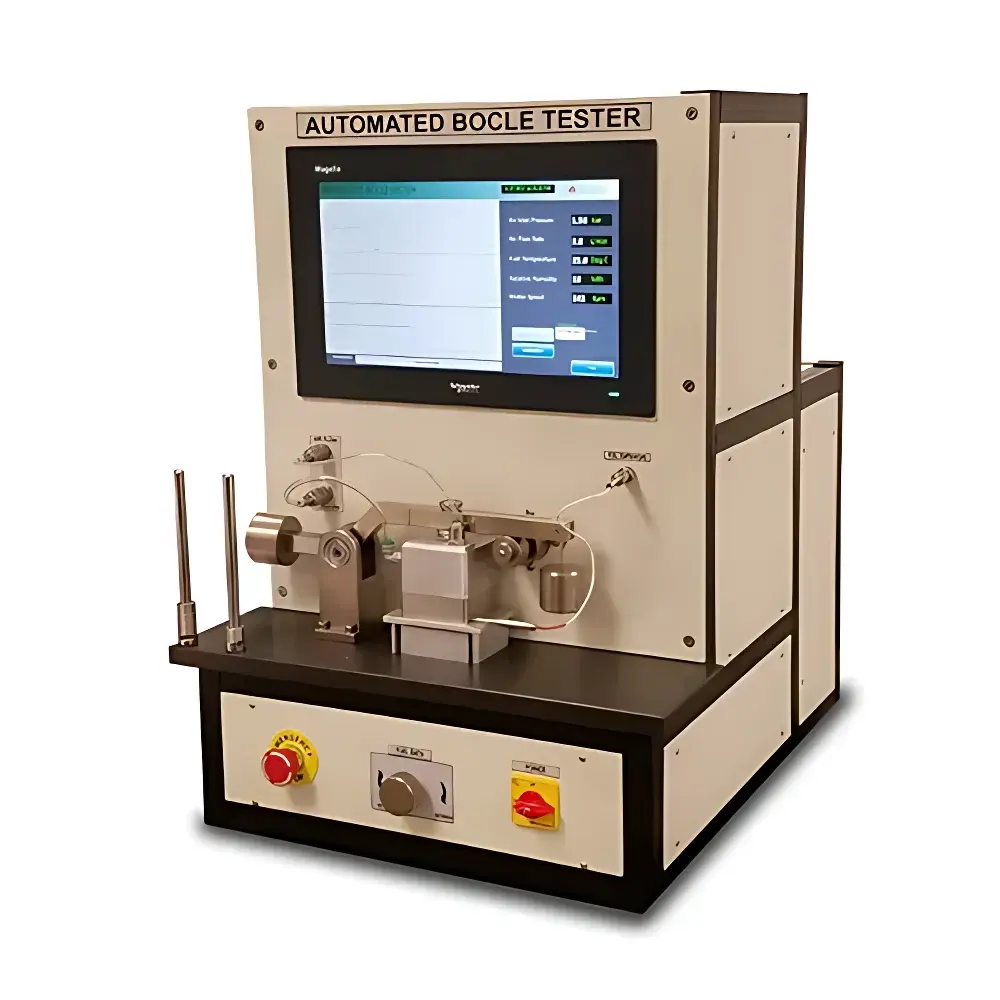
Koehler K94190 Aviation Turbine Fuel Lubricity Tester (BOCLE Method)
| Brand | Koehler |
|---|---|
| Origin | USA |
| Model | K94190 |
| Compliance | ASTM D5001 |
| Test Principle | Ball-on-Cylinder Lubricity Evaluation (BOCLE) |
| Sample Volume | 50 ± 1.0 mL |
| Test Temperature | 25 ± 1 °C |
| Regulated Air RH | 10 ± 0.2 % at 25 °C |
| Dry/Air Flow Rates | 0.5 L/min (through sample), 3.8 L/min (over test surface) |
| Load | 1000 g (±1 g) |
| Cylinder Speed | 240 ± 0.5 rpm |
| Test Duration | 30 ± 0.1 min |
| Test Ring | SAE 8720 steel, Ø49.10–49.25 mm × 13.0–13.11 mm, hardness 58–62 Rc, Rq 0.51–0.71 µm |
| Test Ball | AISI 52100 steel, Ø12.7 mm, hardness 64–66 Rc |
| Power Supply | 230 V AC, single-phase, 5 A |
Overview
The Koehler K94190 Aviation Turbine Fuel Lubricity Tester is a fully automated, benchtop Ball-on-Cylinder Lubricity Evaluation (BOCLE) system engineered for precise, reproducible assessment of boundary lubricity performance in jet fuels—specifically conforming to ASTM D5001. This method quantifies the wear scar diameter formed on a hardened steel cylinder surface when subjected to sliding contact with a rotating steel ball under controlled temperature, humidity, and airflow conditions. The instrument directly addresses the critical requirement for evaluating the inherent lubricating capacity of aviation turbine fuels (e.g., Jet A, Jet A-1, JP-8), which lack natural lubricity due to extensive hydrotreating. Low lubricity can lead to premature wear in fuel system components—including high-pressure fuel pumps and servo-valves—posing operational and safety risks. The K94190 implements the standardized BOCLE geometry and kinematic parameters defined in ASTM D5001, ensuring metrological traceability and interlaboratory comparability required for refinery QC, fuel certification, and regulatory compliance.
Key Features
- Dedicated microprocessor-based ABT (Automated BOCLE Tester) controller with preloaded ASTM D5001 test sequences—no manual programming required.
- Integrated Peltier heating/cooling system maintaining fuel temperature at 25 ± 1 °C throughout the 30-minute test cycle.
- Automated dual-stage air conditioning: desiccant-based air dryer and hydrocarbon scrubber delivering clean, dry air (<0.1 ppm total hydrocarbons) meeting ASTM D5001 specifications.
- Precise digital control of humidified air delivery: relative humidity stabilized at 10 ± 0.2 % at 25 °C via closed-loop feedback from a calibrated RH/temperature probe.
- Motorized cylinder rotation at 240 ± 0.5 rpm under constant 1000 g load (500 g dead weight + 500 g mechanical amplification), ensuring consistent shear stress application.
- Onboard data acquisition logging motor speed, fuel temperature, ambient air temperature, relative humidity, and elapsed time—exportable to CSV or PDF reports.
- Interchangeable, factory-calibrated RH/temperature sensor modules—no field recalibration needed upon replacement.
- Integrated 100× digital microscope with image capture software for automated wear scar measurement per ASTM D5001 Annex A1.
- Ultrasonic cleaning station included for standardized post-test specimen preparation.
Sample Compatibility & Compliance
The K94190 is validated exclusively for aviation turbine fuels compliant with ASTM D1655, DEF STAN 91-91, and NATO F-34 specifications. It accommodates 50 ± 1.0 mL samples without modification and supports routine testing across batch-release, in-service monitoring, and additive qualification workflows. All operational parameters—including air flow rates (0.5 L/min through sample; 3.8 L/min over test surface), cylinder geometry (SAE 8720 steel, 49.10–49.25 mm OD, 13.0–13.11 mm thickness, 58–62 Rc hardness, Rq 0.51–0.71 µm finish), and test ball specification (AISI 52100, Ø12.7 mm, 64–66 Rc)—are rigorously aligned with ASTM D5001 requirements. The system meets GLP-compliant data integrity standards: audit trails, electronic signatures, and secure user access levels are supported via optional Koehler LabManager™ software (FDA 21 CFR Part 11 ready). Calibration certificates traceable to NIST standards are provided with each unit shipment.
Software & Data Management
Data acquisition and analysis are managed through Koehler’s Windows-based ABT Control Suite, compatible with Windows 10/11 (64-bit). The software records real-time process variables—including motor RPM, fuel temperature, air temperature, RH, and test duration—with timestamped logging at 1 Hz resolution. Post-test, the system automatically imports high-resolution wear scar images from the integrated digital microscope, applies edge-detection algorithms per ASTM D5001 Annex A1, and computes mean wear scar diameter (WSD) with statistical uncertainty reporting. Reports include raw data tables, trend charts, pass/fail flags against specification limits (e.g., ≤0.65 mm WSD for Jet A-1 per ASTM D1655), and digital signatures for QA sign-off. Export formats include PDF, CSV, and XML for LIMS integration. Optional validation packages support IQ/OQ/PQ documentation for regulated environments.
Applications
- Refinery final product release testing for Jet A, Jet A-1, and JP-8 fuels.
- Evaluation of lubricity-enhancing additives (e.g., FSII, diacids, esters) during formulation development.
- Monitoring lubricity degradation during fuel storage and distribution (e.g., oxidation-induced loss).
- Investigation of filter blocking, pump wear, and servo-valve stiction root causes in field failure analysis.
- Supporting ASTM D5001 round-robin studies and proficiency testing programs.
- Compliance verification for military fuel procurement (MIL-DTL-83133, MIL-DTL-5624) and civil aviation authorities (EASA, FAA).
FAQ
Does the K94190 comply with the latest revision of ASTM D5001?
Yes—the K94190 implements all mandatory requirements of ASTM D5001–23, including updated air purity specifications, wear scar measurement protocols, and procedural controls for humidity stability.
What maintenance intervals are recommended for the air dryer and deionized water reservoir?
The desiccant air dryer requires replacement every ~1000 tests or when hydrocarbon breakthrough exceeds 0.1 ppm; the internal DI water tank must be refilled after approximately 1000 test cycles to maintain RH calibration.
Can the system be integrated into an existing LIMS environment?
Yes—CSV and XML data export formats, along with configurable ODBC connectivity, enable seamless integration with major laboratory information management systems.
Is operator training and method validation support available?
Koehler provides on-site or virtual installation qualification (IQ), operational qualification (OQ), and comprehensive operator training—including ASTM D5001 procedural interpretation, troubleshooting, and preventive maintenance protocols.
Are replacement test rings and balls supplied with NIST-traceable calibration certificates?
All consumables—including SAE 8720 test rings and AISI 52100 test balls—are supplied with individual calibration reports traceable to NIST SRM 2135c and certified for hardness, dimensional tolerance, and surface roughness per ASTM E10, E18, and E1065.





