
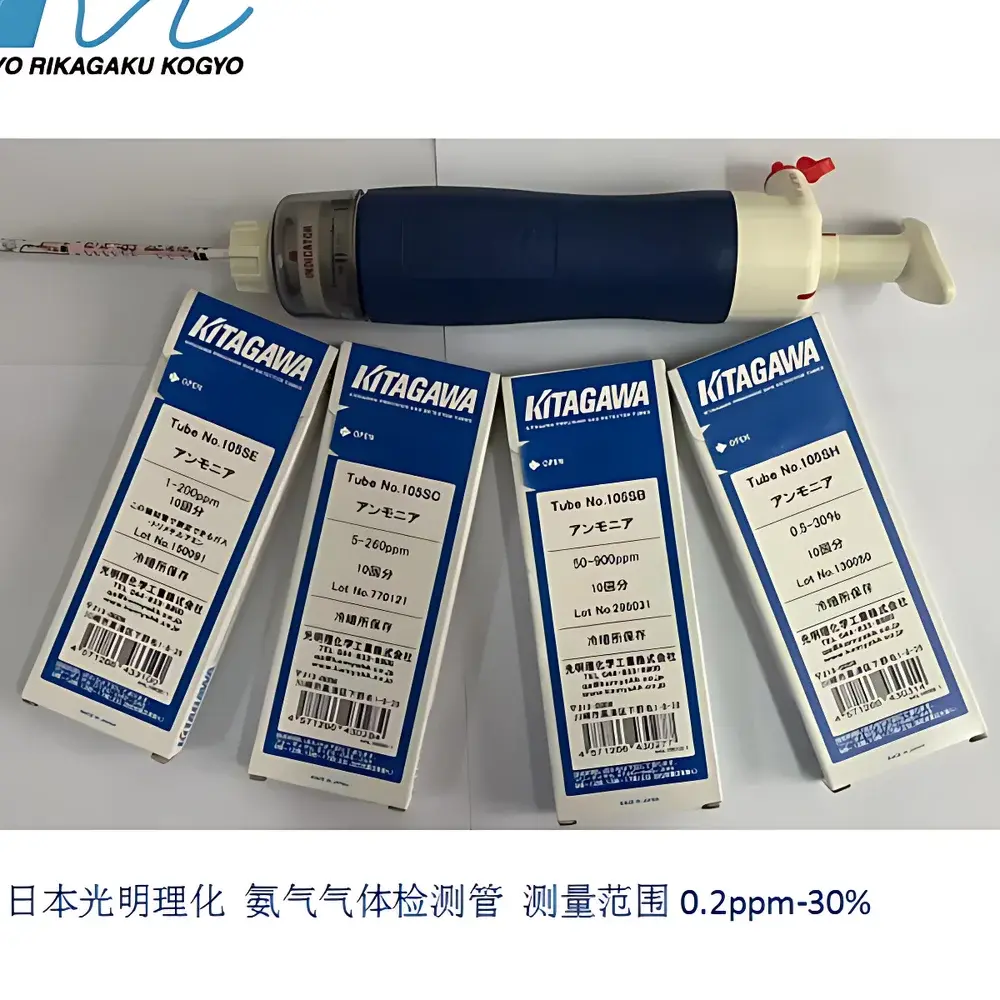
Komyo Ammonia Gas Detection Tubes
| Brand | Komyo |
|---|---|
| Origin | Japan |
| Model Numbers | 105SE, 105SC, 105SH, 105SM |
| Detection Principle | Colorimetric Reaction with Visual Endpoint Reading |
| Compatible Pump | AP-20 Hand Pump (sold separately) |
| Measurement Range | Multiple Scales Available (e.g., 0.5–10 ppm, 5–100 ppm, 50–1000 ppm, 200–4000 ppm — model-dependent) |
| Packaging | Individual sealed glass tubes, supplied in protective foil pouches |
| Compliance | Designed per JIS K 0321 and ISO 8573-5 for qualitative/semi-quantitative gas analysis |
Overview
Komyo ammonia gas detection tubes are precision-engineered, single-use colorimetric devices for rapid, on-site quantification of gaseous ammonia (NH₃) concentrations in ambient air or process streams. Based on the well-established length-of-stain principle, each tube contains a chemically impregnated silica gel reagent that undergoes a stoichiometric, irreversible color change upon exposure to ammonia. When a defined volume of sample air is drawn through the tube using the AP-20 hand pump, ammonia molecules react with the reagent—typically an acid-dyed indicator system—generating a sharp, stable color front. The distance traveled by this front along the calibrated scale corresponds directly to the concentration (in ppm or mg/m³), eliminating the need for electronic instrumentation, power sources, or laboratory infrastructure.
Key Features
- True portable operation: No batteries, no calibration gases, no warm-up time—functional immediately upon removal from packaging.
- Multiple range options: Four distinct models (105SE, 105SC, 105SH, 105SM) cover complementary concentration spans—from trace-level occupational exposure monitoring (0.5–10 ppm) to high-concentration industrial leak screening (up to 4000 ppm).
- High reproducibility: Manufactured under strict JIS-compliant quality control in Japan; batch-certified for inter-tube consistency and shelf-life stability (typically 24 months when stored at ≤25°C and protected from light and moisture).
- Robust architecture: Borosilicate glass construction ensures mechanical integrity during field use; hermetically sealed aluminum foil pouches preserve reagent activity until point of use.
- Operator safety: Intrinsically safe design—no ignition sources, no electrical components, no hazardous solvents—suitable for Zone 1/2 classified areas per IEC 60079 standards.
Sample Compatibility & Compliance
These tubes are validated for use with ambient air, ventilated ducts, storage facility headspaces, refrigeration systems, and wastewater treatment off-gas streams. They are not intended for use in high-humidity (>90% RH) or high-particulate environments without optional particulate filters (e.g., Komyo FP-1). Each lot undergoes independent verification against NIST-traceable ammonia reference standards. While not a primary compliance method under OSHA 29 CFR 1910.1000 or EU Directive 2017/2398, Komyo detection tubes serve as accepted screening tools under ISO 8573-5 Annex B and JIS K 0321 for preliminary hazard assessment, leak localization, and routine area monitoring where real-time decision-making is critical. Documentation supports GLP-aligned recordkeeping when paired with standardized field logs.
Software & Data Management
The detection tube methodology operates entirely offline and does not require software integration. However, quantitative results can be digitally recorded via compatible mobile applications (e.g., Komyo FieldLog™ companion app) for timestamped entry, photo capture of stain endpoints, geotagging, and export to CSV or PDF reports. All data entries include operator ID, pump stroke count, ambient temperature/humidity notes, and tube lot number—supporting audit readiness under ISO/IEC 17025 and FDA 21 CFR Part 11 compliant workflows when used in conjunction with validated electronic log systems.
Applications
- Occupational health surveillance: Monitoring worker exposure near fertilizer handling zones, animal housing, or refrigeration maintenance sites.
- Emergency response: Rapid triage during ammonia transport incidents or chemical spills—providing actionable data within 60 seconds.
- Process safety management: Routine checks of scrubber efficiency, valve packing integrity, and storage tank vent lines.
- Environmental compliance: Screening emissions from agricultural facilities, composting operations, and municipal wastewater plants prior to formal stack testing.
- QA/QC in food processing: Verifying ammonia levels in cold storage rooms and protein hydrolysis units.
FAQ
What is the shelf life of unopened Komyo ammonia detection tubes?
Unopened tubes retain full performance for 24 months from date of manufacture when stored at ≤25°C in original foil packaging and away from direct sunlight or volatile organics.
Can these tubes be reused after sampling?
No—each tube is a single-use, disposable analytical device. Reuse compromises accuracy due to irreversible reagent consumption and potential cross-contamination.
Is temperature correction required during reading?
Yes. For measurements conducted outside 20–25°C, apply the correction factor printed on the tube’s instruction sheet—derived from empirical validation across ±10°C operational range.
How does humidity affect measurement accuracy?
Relative humidity above 90% may cause diffusion artifacts or premature reagent saturation; use Komyo FP-1 particulate/moisture filter upstream if high moisture is anticipated.
Are these tubes suitable for regulatory reporting?
They meet ASTM D5402 and ISO 8573-5 criteria for screening-level analysis but are not substitutes for certified reference methods (e.g., NIOSH Method 6012 or EPA TO-11A) in formal compliance submissions.
Related Products







