
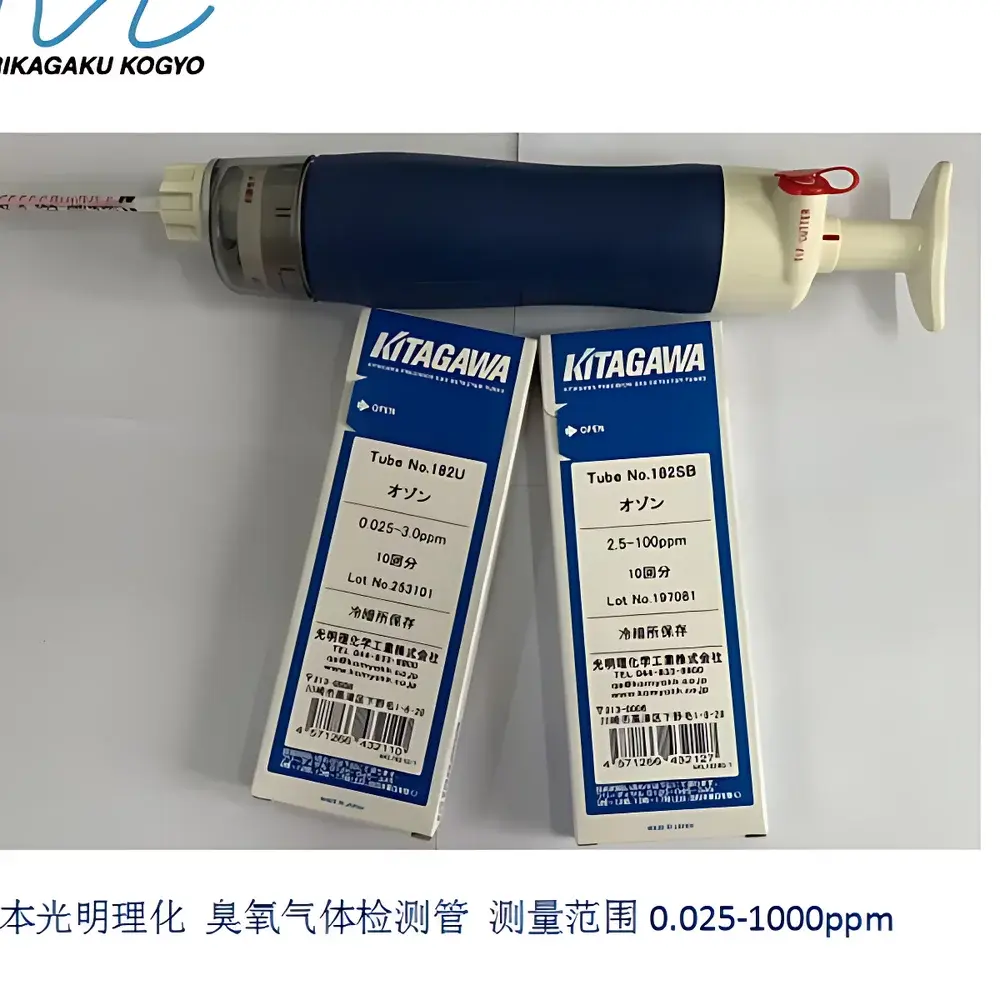
KOMYO RIKAGAKU North川-Style Ozone Gas Detection Tube (Model 182U)
| Brand | KOMYO RIKAGAKU |
|---|---|
| Origin | Japan |
| Model | 182U |
| Detection Range | 0.025–1000 ppm O₃ |
| Principle | Colorimetric Reaction with Pre-impregnated Reagent |
| Calibration | Linear Scale with Visual Endpoint Reading |
| Compatible Pump | AP-20 Manual Bellows Pump (sold separately) |
| Compliance | JIS K 0803, ISO 8573-4 (gas purity assessment reference), CE-marked for portable occupational hygiene use |
Overview
The KOMYO RIKAGAKU North川-Style Ozone Gas Detection Tube (Model 182U) is a precision-engineered, single-use colorimetric indicator tube designed for rapid, on-site quantification of ozone (O₃) in ambient air, workplace environments, and industrial exhaust streams. Developed from the foundational North川 (Kitagawa) detection tube methodology—first introduced in Japan in the 1940s—the 182U tube employs a chemically stabilized reagent system immobilized within calibrated borosilicate glass tubing. Upon manual aspiration using the AP-20 bellows pump (100 mL per stroke, standard draw volume), sampled air passes through the reagent bed, triggering an irreversible oxidation reaction that produces a discrete, linear color front. The length of color development corresponds directly to ozone concentration via a factory-calibrated scale printed along the tube’s exterior—enabling immediate visual interpretation without electronic instrumentation or external power.
Key Features
- Wide dynamic range: Accurate visual quantification across 0.025–1000 ppm O₃ in a single tube format—covering occupational exposure limits (e.g., OSHA PEL: 0.1 ppm TWA), indoor air quality thresholds (e.g., EPA guideline: 0.07 ppm), and high-concentration industrial process monitoring.
- Trace-level sensitivity: Detects ozone down to 0.025 ppm with ±15% accuracy at mid-range concentrations (0.1–10 ppm), validated against NIST-traceable ozone calibrators per JIS K 0803 Annex B protocols.
- Robust chemical formulation: Reagent matrix based on potassium iodide–starch oxidation chemistry, optimized for humidity tolerance (operational up to 90% RH) and minimal interference from common co-contaminants including NO₂, SO₂, and VOCs below 50 ppm.
- Standardized mechanical interface: 6 mm outer diameter, 100 mm length—compatible with all globally recognized bellows-type sampling pumps (AP-20, Gastec GV-100, Dräger Accuro) meeting ISO 16000-23 requirements for manual air sampling devices.
- Shelf-stable packaging: Individually sealed in aluminum-laminated foil pouches with desiccant; guaranteed performance for 24 months from date of manufacture when stored at 5–30 °C.
Sample Compatibility & Compliance
The 182U tube is validated for direct analysis of uncompressed ambient air, ducted ventilation streams, and cleanroom effluents. It is not intended for use in high-particulate, oil-laden, or highly acidic gas matrices without upstream filtration (e.g., PTFE membrane filter, 0.3 µm pore size). All tubes are manufactured under ISO 9001-certified production controls at KOMYO RIKAGAKU’s Shizuoka facility and conform to Japanese Industrial Standard JIS K 0803 (“Method for Determination of Gaseous Pollutants Using Detector Tubes”). Batch-specific calibration certificates—including lot number, expiration date, and traceability to JCSS (Japan Calibration Service System)—accompany each package. The system supports GLP-aligned field documentation when used with standardized sampling logs and photodocumented endpoint readings.
Software & Data Management
As a passive, analog measurement device, the 182U tube requires no firmware, drivers, or software integration. However, quantitative results may be digitally archived using KOMYO’s optional TubeScan™ Mobile App (iOS/Android), which enables photo-based endpoint capture, automatic scale interpolation via AI-assisted image analysis, and export to CSV or PDF reports compliant with ISO/IEC 17025 record-keeping requirements. For regulated environments, manual entries into LIMS or EHS platforms must include operator ID, sampling location, time/date stamp, pump strokes, and observed color front position—fulfilling audit trails required under OSHA 1910.120 and EU Directive 2004/37/EC.
Applications
- Occupational health monitoring: Real-time verification of ozone levels near UV sterilization units, laser printers, and corona discharge equipment.
- Indoor air quality (IAQ) surveys: Post-remediation validation following ozone-based mold abatement protocols.
- Environmental compliance checks: Spot-checking emissions from water treatment ozonation systems and semiconductor fab exhaust stacks.
- Emergency response: Rapid triage during accidental ozone release incidents—no warm-up time or battery dependency.
- Educational laboratories: Demonstrating stoichiometric gas-phase redox reactions and calibration curve fundamentals in analytical chemistry curricula.
FAQ
How many pump strokes are required for a valid reading?
A single 100 mL stroke is sufficient for concentrations ≥1 ppm; for sub-ppm measurements (0.025–0.5 ppm), two consecutive strokes (200 mL total) are recommended to enhance visual contrast and reduce reading uncertainty.
Can the tube be reused after partial color development?
No—each tube is designed for one-time use only. The reaction is irreversible and diffusion-driven; residual color front migration may occur post-sampling, compromising result integrity.
Does temperature affect accuracy?
Yes. Readings should be performed at 20–25 °C. For field use outside this range, apply the correction factors provided in the technical datasheet (±0.5% per °C deviation, referenced to 20 °C).
Is the 182U tube suitable for continuous monitoring?
No. It is a discrete, grab-sampling tool. For continuous ozone surveillance, consider electrochemical or UV-absorption analyzers with data logging capabilities.
What is the shelf life, and how should tubes be stored?
24 months from manufacture date when unopened and stored at 5–30 °C in original foil packaging, away from direct sunlight and oxidizing agents.







