
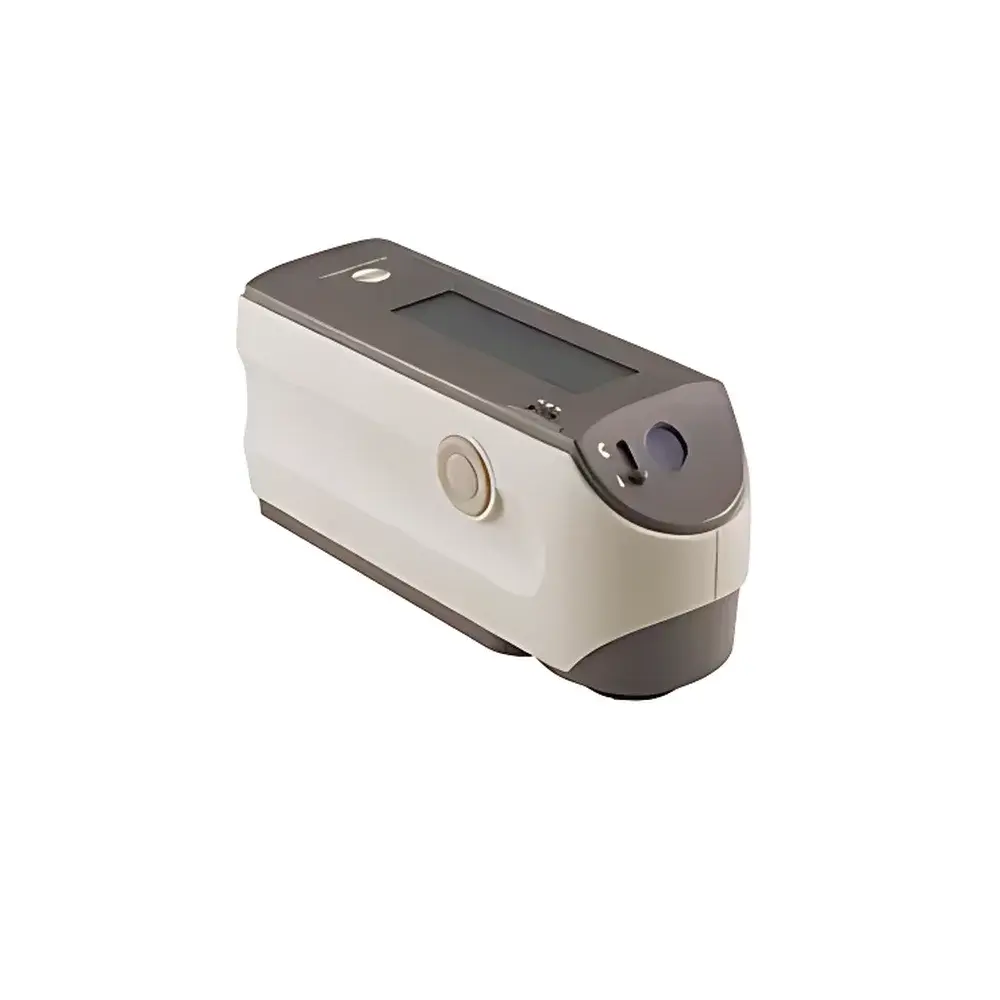
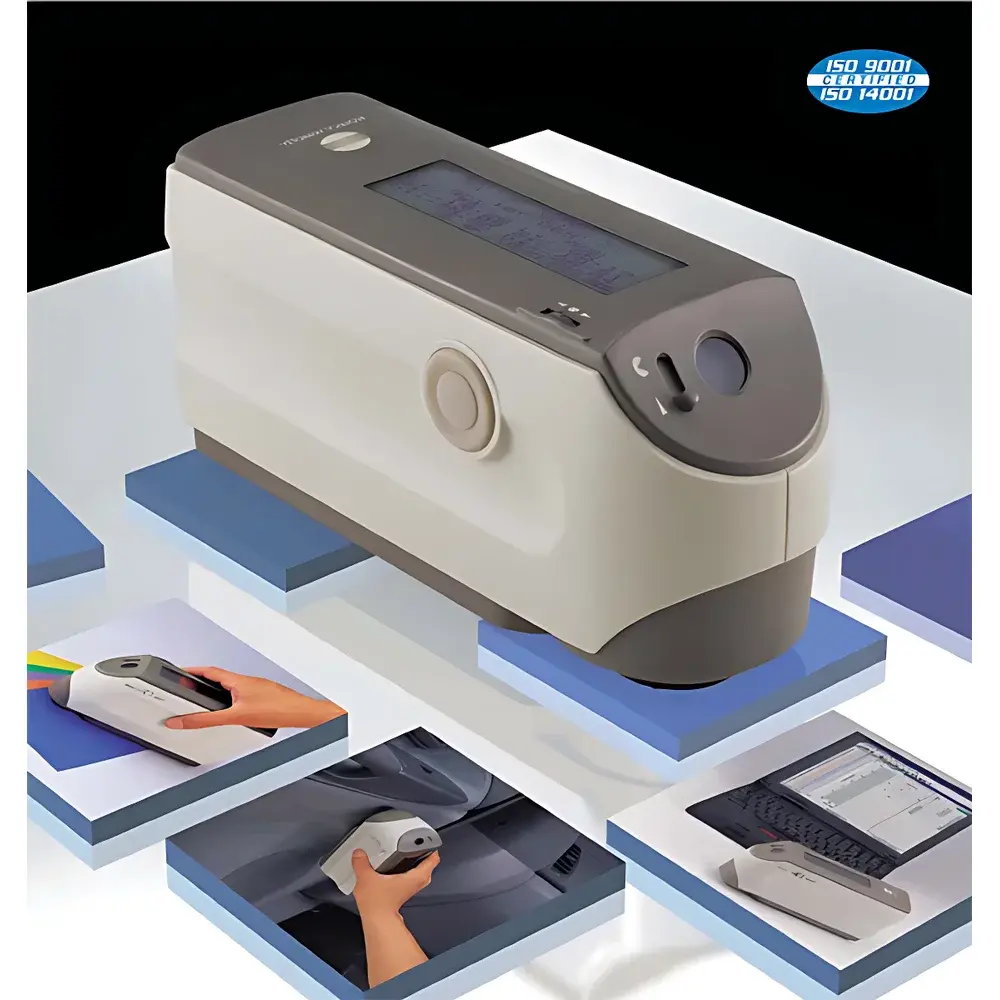
Konica Minolta CM-2600d Portable Spectrophotometer
| Brand | Konica Minolta |
|---|---|
| Origin | Japan |
| Model | CM-2600d |
| Instrument Type | Portable |
| Optical Geometry | d/8° integrating sphere |
| Light Source | Dual pulsed xenon lamp |
| Spectral Range | 360 nm – 740 nm |
| Repeatability | ΔE*ab ≤ 0.04 (std. dev., after white calibration, n=30) |
Overview
The Konica Minolta CM-2600d is a high-precision portable spectrophotometer engineered for reliable, repeatable color measurement in industrial quality control environments. It operates on the CIE d/8° geometry—diffuse illumination with 8° viewing angle—and supports simultaneous measurement of both Specular Component Included (SCI) and Specular Component Excluded (SCE) modes via its patented digital gloss control system. Unlike mechanical filter-based instruments, the CM-2600d employs dual xenon lamps—one optimized for SCI and one for SCE—to deliver instantaneous, artifact-free separation of surface reflectance components without moving parts. Its optical architecture integrates a high-resolution flat-field holographic grating, a dual-row silicon photodiode array (40 elements per row), and an Φ52 mm integrating sphere, ensuring spectral stability and long-term calibration integrity. The instrument’s core measurement principle relies on absolute spectral reflectance acquisition at 10 nm intervals across the visible and near-UV spectrum (360–740 nm), followed by CIE-compliant tristimulus calculation under multiple standard illuminants (D65, A, C, F2, F7, etc.) and observer angles (2° and 10°). Designed for field-deployable use, it delivers laboratory-grade accuracy in a compact, battery-powered form factor (193 × 69 × 96 mm, ~670 g).
Key Features
- Digital Gloss Control: Simultaneous SCI/SCE measurement in ≤1.5 seconds; no mechanical filters or moving parts—enhances reliability and eliminates wear-related drift.
- Digital UV Control: World’s first portable spectrophotometer with patented dual-xenon UV modulation; enables rapid assessment of fluorescent whitening agents (FWAs) in paper, textiles, and detergents without manual filter insertion or recalibration.
- Two Measuring Apertures: Switchable Φ8 mm (MAV) and Φ3 mm (SAV) ports with dedicated lens positioning mechanisms to maintain geometric accuracy and minimize edge effects during small-area measurements.
- Intuitive Human Interface: Single navigation wheel (functionally equivalent to a computer mouse) and one dedicated measurement button replace complex keypad layouts; large backlit LCD displays spectral graphs, color difference vectors, pass/fail status, and relative gloss in real time.
- Robust Optical Design: Fixed-optics architecture with pulsed xenon illumination ensures consistent spectral power distribution and thermal stability; no warm-up time required between measurements.
- Comprehensive Standard Compliance: Fully aligned with ISO 7724-1, CIE No. 15, ASTM E1164, DIN 5033-7, JIS Z 8722, ISO 2470 (brightness), ASTM E313 (yellowness index), and VDA 280 Parts 1–3.
Sample Compatibility & Compliance
The CM-2600d accommodates heterogeneous sample types—including textured plastics, coated metals, woven fabrics, matte and glossy papers, liquid suspensions (in cuvettes), and irregularly shaped components—without requiring surface averaging or repositioning. Its d/8° geometry mitigates directional bias from surface texture or orientation, while the dual-aperture system ensures metrological validity across sample sizes ranging from >Φ10 mm (MAV) down to discrete features as small as Φ4 mm (SAV). All firmware and data handling protocols conform to GLP/GMP documentation requirements, supporting audit-ready traceability through timestamped measurement logs, operator ID tagging, and instrument-specific calibration history. While not FDA 21 CFR Part 11–certified out-of-the-box, the device generates raw spectral data compatible with validated third-party LIMS and electronic lab notebook (ELN) systems when paired with SpectraMagic™ NX software.
Software & Data Management
SpectraMagic™ NX (CM-S100w) serves as the official data acquisition and analysis platform, enabling full spectral visualization, multi-illuminant comparison, tolerance mapping (ΔE*ab, ΔE00, CMC), batch statistical reporting, and export to CSV, XML, or PDF formats. The software supports customizable pass/fail criteria based on user-defined tolerances per color space (L*a*b*, CIEDE2000, Hunter Lab), and includes built-in tools for whiteness (ISO 2470, CIE Whiteness), yellowness (ASTM E313/D1925), and density (Status A/T). Measurement data is stored onboard (1,700 spectra pairs: SCI+SCE), with RS-232C interface facilitating automated transfer to centralized QC databases. Firmware updates preserve backward compatibility with legacy calibration files and ensure alignment with evolving ISO/CIE technical reports.
Applications
The CM-2600d is deployed across industries where color consistency directly impacts brand integrity, regulatory compliance, and manufacturing yield. In automotive supply chains, it verifies paint and interior trim matches against OEM master standards under D65 and F12 illuminants. In packaging, it validates ink formulation consistency on flexible films and corrugated board under controlled ambient conditions. In textile mills, digital UV control accelerates lot-to-lot verification of optically brightened cotton and polyester blends. In cosmetics, it quantifies pigment dispersion uniformity in foundations and lipsticks using L*C*h and Munsell notation. In food-grade plastic production, it monitors polymer yellowing during extrusion and sterilization cycles via ASTM E313 YI tracking. Its portability also supports on-site validation in printing facilities, paint mixing centers, and architectural coating applicator audits.
FAQ
Does the CM-2600d require warm-up time before measurement?
No—pulsed xenon illumination provides stable spectral output immediately upon activation; no thermal stabilization delay is needed.
Can the instrument measure transparent or translucent samples?
Yes, when used with optional zero-calibration box (CM-A32) and appropriate backing (e.g., black/white tile or air gap), though transmission mode is not supported natively.
How is inter-instrument agreement ensured across a fleet of CM-2600d units?
Each unit ships with BCRA Series II ceramic tile characterization data; inter-instrument variability is specified as ΔE*ab ≤ 0.2 (SCI/MAV), verified at 23°C per ISO 13655.
Is spectral data export possible without SpectraMagic™ NX?
Yes—raw .spc files containing reflectance values at 10 nm intervals can be extracted via RS-232C using generic terminal emulation software.
What maintenance is required to sustain long-term accuracy?
Annual recalibration against NIST-traceable standards is recommended; routine cleaning of the integrating sphere port and aperture masks with lint-free swabs and isopropyl alcohol suffices for daily operation.




