
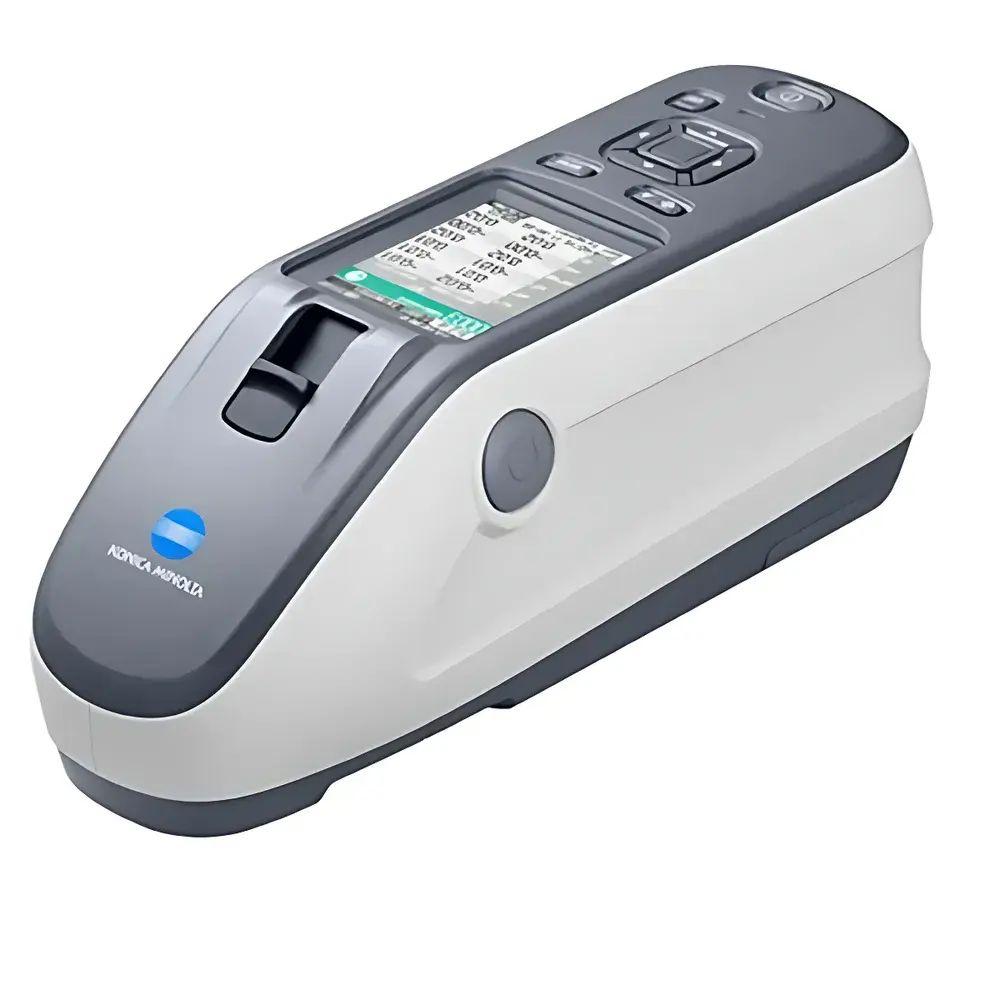
Konica Minolta CM-26dG / CM-26d / CM-25d Portable Spectrophotometer with Integrated Gloss Measurement (CM-26dG)
| Brand | Konica Minolta |
|---|---|
| Origin | Japan |
| Model | CM-26dG / CM-26d / CM-25d |
| Instrument Type | Portable |
| Optical Geometry | d/8° integrating sphere |
| Light Source | Pulsed Xenon Lamp |
| Spectral Range | 360–740 nm |
| Repeatability | σΔE*ab ≤ 0.02 |
| Inter-instrument Agreement | ΔE*ab ≤ 0.12 (BCRA Series II, avg. of 12 tiles) |
| Gloss Measurement Range (CM-26dG only) | 0–100 GU at 60° |
| Accuracy | ±0.2 GU (0–10 GU), ±0.5 GU (10–100 GU) |
Overview
The Konica Minolta CM-26dG, CM-26d, and CM-25d represent the third-generation portable spectrophotometers engineered for high-fidelity color measurement in industrial quality control environments. These instruments operate on the principle of diffuse illumination and 8° viewing geometry (d/8°) within a precision-machined integrating sphere, compliant with ISO 7724-1, CIE No. 15, and ASTM E308. The pulsed xenon lamp delivers stable, flash-based spectral irradiance across the full visible range (360–740 nm) without thermal drift or lamp aging effects—ensuring long-term photometric stability essential for cross-site data harmonization. Unlike filter-based tristimulus meters, these devices acquire full reflectance spectra at 10 nm intervals, enabling calculation of CIE L*a*b*, ΔE*ab, ΔE00, Yxy, L*C*h, and custom indices per ISO 11664 and CIE Publication 179. The CM-26dG uniquely integrates a 60° gloss sensor co-aligned with the optical path, allowing concurrent acquisition of spectral reflectance and gloss value (GU) in a single measurement cycle—eliminating sequential device swaps and registration errors inherent in multi-instrument workflows.
Key Features
- Simultaneous color and gloss measurement (CM-26dG only): Single-shot acquisition of CIE L*a*b* and 60° gloss (0–100 GU), reducing operator dependency and inter-measurement variability.
- High-speed spectral capture: <0.7 s for color-only (SCI or SCE mode); <1.0 s for combined color + gloss—optimized for inline sampling and high-volume production audits.
- Enhanced metrological performance: Inter-instrument agreement of ΔE*ab ≤ 0.12 (BCRA Series II, n=12), exceeding ISO 17972-1 Class A requirements for portable spectrophotometers.
- Ergonomic, low-profile design: Forward-tilted front housing and circular 8 mm aperture enable access to confined geometries (e.g., automotive instrument clusters, curved display bezels, interior trim recesses).
- Dual-position trigger buttons: Symmetrically placed on left and right sides for ambidextrous operation under gloves or constrained postures.
- Integrated target mask: Removable, scratch-resistant aperture shield minimizes surface damage during repeated contact measurements on textured or abrasive substrates.
Sample Compatibility & Compliance
The CM-26dG/d/25d series accommodates flat, curved, textured, and translucent samples—including painted metal, plastic injection-molded parts, coated paper, textiles, and anodized aluminum—without requiring sample repositioning or auxiliary fixtures. All models comply with ISO 13655 (M0/M1/M2/M3), ISO 12647-2 (graphic arts), and ASTM D2244 (color difference calculation). The CM-26dG’s gloss module adheres to ISO 2813 and ASTM D523 for 60° specular gloss. Data traceability meets GLP/GMP requirements via embedded audit trail logging (user ID, timestamp, measurement mode, calibration status), and firmware supports optional 21 CFR Part 11-compliant electronic signatures when paired with validated enterprise software.
Software & Data Management
Configuration and fleet management are centralized through the CM-CT1 Setup Tool—a Windows-based utility enabling standardized parameter deployment across distributed sites. Users define measurement modes (SCI/SCE), illuminants (D65, A, F2), observers (2°/10°), tolerances, and pass/fail logic, then export settings as encrypted .ct1 template files. These templates ensure identical configuration replication across hundreds of instruments—critical for Tier-1 automotive suppliers operating across APAC, EMEA, and NAFTA regions. Raw spectral data (.spc) and metadata (CSV/XML) are exportable for integration into LIMS, MES, or SPC platforms. Optional cloud synchronization (via Konica Minolta ColorEdge Portal) enables real-time deviation alerts and historical trend analysis aligned with IATF 16949 clause 8.5.1.2.
Applications
- Automotive: Paint batch verification on body panels, interior trim matching, headlight lens color consistency, and dashboard gloss uniformity.
- Consumer Electronics: Display bezel chromaticity validation, anodized aluminum housing hue control, and polymer housing batch-to-batch color release.
- Coatings & Plastics: QC of solvent-based and waterborne coatings on metal substrates; pigment dispersion homogeneity assessment in extruded profiles.
- Packaging: Spot-color fidelity checks on flexographic and gravure-printed cartons; substrate-dependent color shift compensation for corrugated board.
- Textiles & Apparel: Shade sorting of dyed fabrics against master standards; wet vs. dry state color difference quantification per AATCC Test Method 173.
FAQ
What distinguishes the CM-26dG from the CM-26d and CM-25d?
The CM-26dG integrates a calibrated 60° gloss sensor alongside its spectrophotometer; the CM-26d is a high-precision color-only variant; the CM-25d offers core spectral functionality at an optimized cost point for mid-tier QA labs.
Is the instrument suitable for measuring curved or recessed surfaces?
Yes—the forward-tilted chassis and 8 mm circular aperture allow stable contact measurement on radii ≥25 mm and in recesses up to 12 mm deep, verified per ISO 17972-2 mechanical interface testing.
How is inter-instrument agreement validated and maintained?
Each unit undergoes factory calibration against NIST-traceable ceramic tiles (BCRA Series II); field recalibration uses included white calibration tile (certified ΔE*ab < 0.05 vs. reference). Inter-unit variance is monitored quarterly using control samples per ISO 17972-1 Annex B.
Does the system support regulatory-compliant data archiving?
When used with CM-CT1 and optional ColorEdge Server, full audit trails—including user actions, calibration events, and raw spectra—are retained with immutable timestamps and digital signatures, satisfying FDA 21 CFR Part 11 and EU Annex 11 requirements.
Can measurement templates be deployed remotely across global facilities?
Yes—.ct1 template files can be distributed via secure FTP or internal network shares; CM-CT1 enforces cryptographic signature verification before applying configurations to prevent unauthorized parameter changes.





