
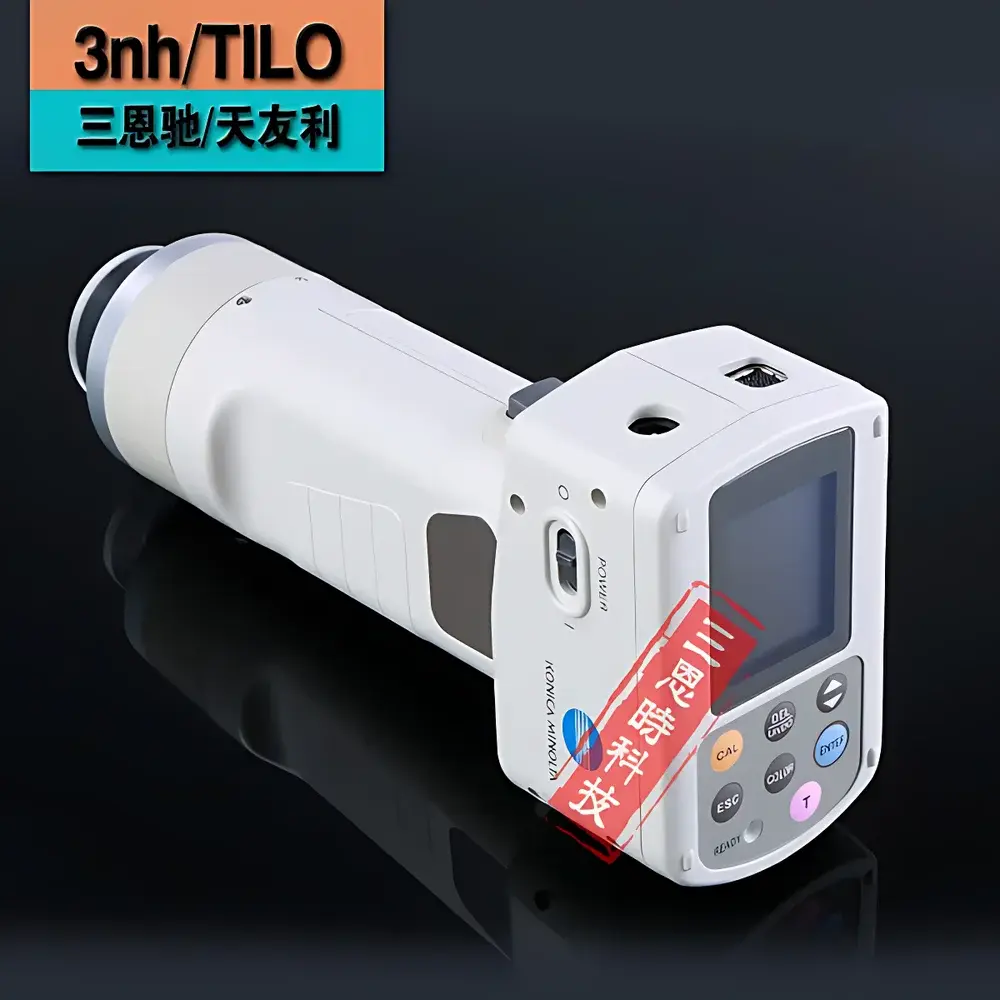
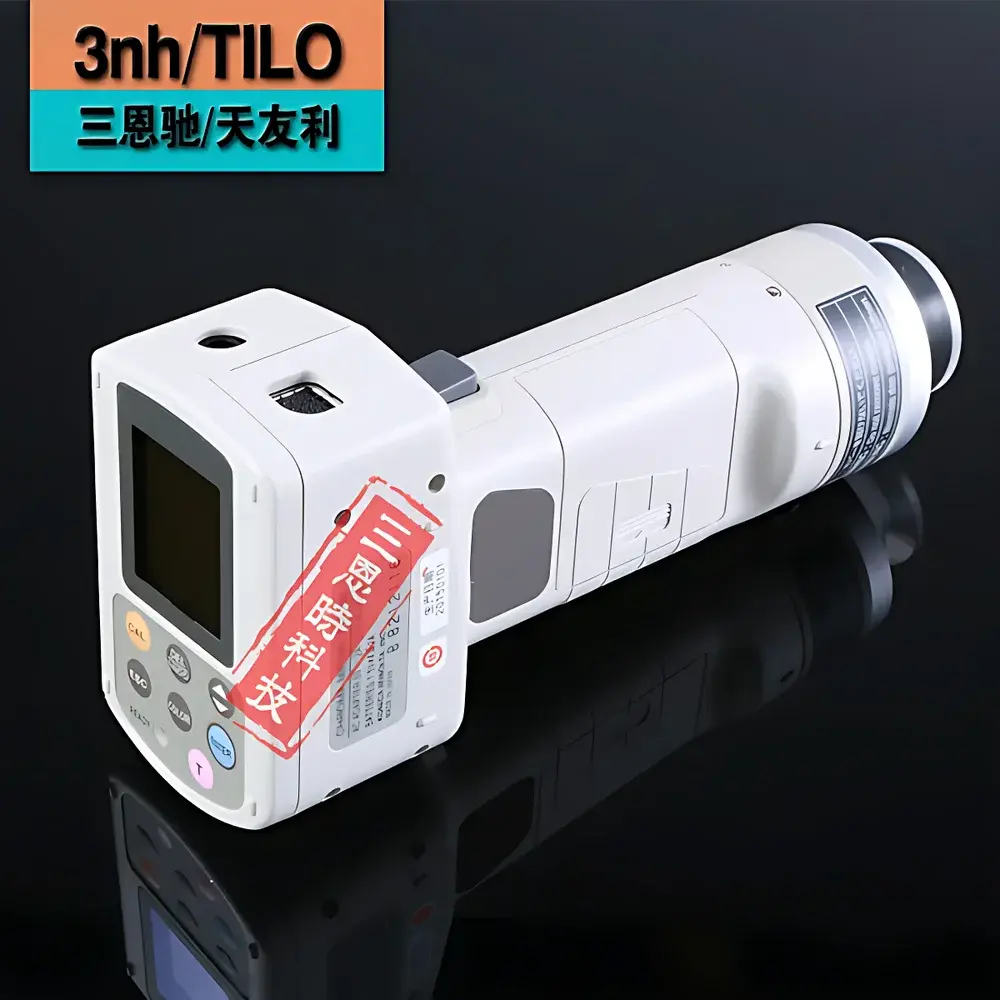
Konica Minolta CM-700D Spectrophotometer
| Brand | Konica Minolta |
|---|---|
| Origin | Shanghai, China |
| Manufacturer Type | Authorized Distributor |
| Product Category | Spectrophotometric Colorimeter |
| Instrument Type | Portable |
| Optical Geometry | d/8° Integrating Sphere |
| Light Source | Tungsten Halogen Lamp |
| Spectral Range | 360–750 nm |
| Repeatability | ΔE*ab ≤ 0.07 (for white calibration tile, 10 measurements) |
| Aperture Options | 8 mm and 3 mm (CM-700D only) |
| Display | Full-color LCD |
| Connectivity | Bluetooth® v4.0 + USB 2.0 |
Overview
The Konica Minolta CM-700D is a portable spectrophotometric colorimeter engineered for high-precision, field-deployable color measurement in industrial quality control and R&D environments. Based on the fundamental principle of diffuse illumination and 8° viewing geometry (d/8°), it captures spectral reflectance data across the visible spectrum (360–750 nm) using a tungsten halogen lamp and a diffraction grating monochromator. This optical architecture ensures compliance with CIE No. 15:2018 and ISO 7724-1 for colorimetric accuracy, enabling traceable L*a*b*, L*C*h*, ΔE*ab, ΔE00, and spectral data acquisition under standardized illuminants (e.g., D65, A, F2). Designed for robustness in production-floor conditions, the CM-700D integrates a thermally stabilized optical path and real-time drift compensation to maintain measurement integrity across ambient temperature fluctuations (10–30°C operational range). Its compact, vertically oriented housing—optimized via ergonomic simulation—reduces operator fatigue during extended handheld use and enables stable contact measurement on curved, recessed, or textured surfaces.
Key Features
- Ergonomic vertical design with balanced weight distribution (approx. 600 g), facilitating one-handed operation and repeatable probe placement on non-planar substrates.
- Dual-aperture capability (8 mm standard, 3 mm optional)—enabling precise measurement of small-area samples such as textile yarns, printed circuit board solder masks, or automotive interior trim seams.
- Full-color TFT-LCD display (320 × 240 pixels) with intuitive icon-based UI; supports on-screen color visualization via CIELAB vector plots and pass/fail indicators relative to user-defined tolerances.
- Bluetooth® 4.0 wireless communication (class 2, up to 10 m range) for real-time data streaming to Windows/macOS PCs or iOS/Android tablets running Konica Minolta’s proprietary SpectraMagic NX software; USB 2.0 fallback ensures compatibility with legacy systems and offline firmware updates.
- Integrated memory stores up to 1,000 measurement records with timestamp, illuminant/observer settings, and reference ID—each tagged with GPS metadata when paired with compatible mobile devices.
Sample Compatibility & Compliance
The CM-700D accommodates opaque, translucent, and textured surfaces—including injection-molded plastics, coated metals, woven fabrics, leather, ceramics, and food-grade packaging films—without requiring sample preparation beyond standard cleaning. Its conical measurement port ensures consistent 1.5 mm standoff distance and minimizes edge effects during contact measurement. The instrument conforms to ISO 13655:2017 (spectral measurement of prints), ASTM E308-22 (computing tristimulus values), and JIS Z 8722:2012 (colorimetric methods). Data export formats (CSV, TXT, CxF/XRGA) support integration into enterprise quality management systems (QMS) compliant with ISO 9001:2015 and IATF 16949. Audit trails, user authentication, and electronic signatures are managed through SpectraMagic NX in alignment with FDA 21 CFR Part 11 requirements for regulated industries.
Software & Data Management
SpectraMagic NX v3.5+ provides comprehensive analysis tools including statistical process control (SPC) charts, tolerance ellipsoid modeling (CIEDE2000), batch comparison reports, and multi-instrument fleet calibration tracking. Raw spectral data (10 nm intervals) is exportable for third-party analysis in MATLAB, Python (NumPy/Pandas), or JMP. Role-based access control allows lab managers to define operator permissions (e.g., read-only, calibration lockout, report generation). All measurement sessions generate immutable logs containing instrument serial number, firmware version, environmental sensor readings (ambient light/temperature), and operator ID—ensuring full GLP/GMP traceability.
Applications
- Automotive: Interior trim color matching (dashboards, seat fabrics, door panels) against OEM master standards under D65/10°.
- Consumer Electronics: Display bezel and housing color consistency verification across global manufacturing sites.
- Textiles & Apparel: Shade sorting of dyed yarns and finished garments per AATCC Evaluation Procedure 1; compliance with brand-specific color libraries (e.g., Pantone Textile Cotton).
- Food Packaging: Verification of ink density and substrate whiteness on laminated pouches and cartons per ISO 12048.
- Paint & Coatings: Batch-to-batch color release testing in OEM paint shops and supplier QC labs.
FAQ
Does the CM-700D support measurement under fluorescent or LED lighting conditions?
Yes—it includes built-in spectral correction algorithms for common industrial illuminants (F2, F7, F11) and allows custom illuminant definition via spectral power distribution (SPD) import.
Can the instrument be calibrated to NIST-traceable standards?
Yes—factory calibration uses ceramic tiles certified to NIST SRM 2035 and 2036; users may perform daily verification with included white calibration tile (certified to ±0.02 ΔE*ab).
Is spectral data export supported for spectral library development?
Yes—full 360–750 nm reflectance spectra at 10 nm resolution are exportable in ASCII format for integration into proprietary color formulation software.
What is the battery life under continuous Bluetooth operation?
Approximately 4,000 measurements per charge (using included rechargeable Li-ion battery); battery status and estimated remaining life are displayed in real time.
Does the device meet IP rating requirements for factory floor use?
It carries an IP52 rating—dust-protected and resistant to vertically falling water drops—suitable for controlled industrial environments but not wet-process areas.





