
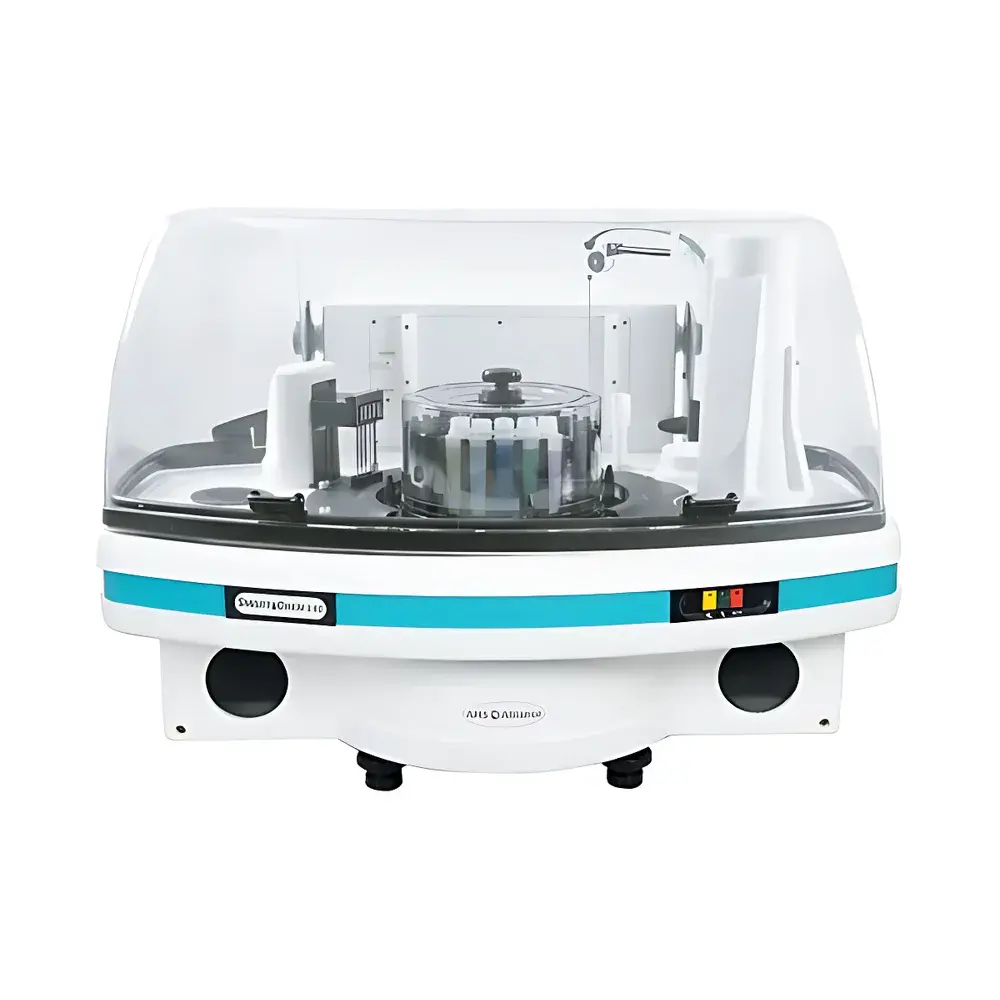
KPM AMS SmartChem 140 Discrete Chemistry Analyzer
| Brand | KPM AMS |
|---|---|
| Origin | USA |
| Model | SmartChem 140 |
| Product Type | Discrete Chemistry Analyzer |
| Wavelength Range | 340–1100 nm |
| Sample Capacity | ≥50 positions |
| Reagent Positions | ≥20 |
| Cuvette Path Length | 6 mm |
| Light Source | Tungsten-halogen lamp (6 V / 10 W, 2000 h lifetime) |
| Absorbance Range | 0–3.5 OD |
| Resolution | 0.0001 Abs |
| Optical System | Dual-beam with 9-position filter wheel + blind position |
| Detection | Silicon photodiode |
| Analysis Speed | Up to 140 samples/hour |
| Sample Volume | 3–450 µL |
| Reagent Consumption per Test | ~300 µL |
| Sample Tube Dimensions | 16 mm × 100 mm (diameter × height) |
| Automatic Dilution | Yes |
| Standard Preparation | Automated serial dilution from single stock standard |
| Blank Correction | True sample blank subtraction |
| Calibration | Up to 6th-order polynomial regression |
| Data Output | Raw absorbance-time profiles with reprocessing capability |
| Compliance | ISO, AOAC, APHA, USEPA, AFNOR, COFRAC, BATF methods |
Overview
The KPM AMS SmartChem 140 Discrete Chemistry Analyzer is a second-generation automated discrete analyzer engineered for high-precision, low-interference spectrophotometric quantification across environmental, agricultural, food, beverage, and clinical research laboratories. Unlike flow injection or segmented-flow systems, the SmartChem 140 implements true discrete analysis: each sample and reagent pair reacts in an individual quartz or glass cuvette under precisely controlled timing, temperature, and mixing conditions—eliminating carryover, baseline drift, and cross-contamination inherent in continuous-flow architectures. Its optical detection system employs a dual-beam photometer with a motorized 9-filter wheel (340–880 nm), enabling method-specific wavelength selection and real-time compensation for source intensity fluctuations. The instrument conforms to fundamental principles of Beer-Lambert law-based colorimetric and enzymatic assays, delivering traceable, reproducible results validated against internationally recognized reference methods.
Key Features
- True discrete cuvette-based chemistry: All reactions occur in dedicated, reusable cuvettes—no flow cells, no pump tubing, no digestion coils—minimizing maintenance and consumables.
- Integrated cuvette workstation: Fully automated washing, optical integrity verification (transmittance check pre-use), and thermal equilibration ensure consistent pathlength and zero contamination between runs.
- High-throughput capacity: Processes up to 140 samples per hour, with simultaneous multi-parameter analysis (up to 9 analytes per sample) without manual intervention.
- Intelligent fluidics: Precise microdispensing (3–450 µL) with gravimetric validation; reagent-level monitoring triggers software alerts before depletion.
- Advanced calibration architecture: Supports up to 6-dimensional polynomial regression, dynamic range extension via on-board dilution, and automatic standard series generation from a single stock solution.
- Regulatory-ready data handling: Full audit trail, electronic signatures, raw absorbance-time profile storage, and post-acquisition reprocessing—aligned with FDA 21 CFR Part 11 and GLP/GMP documentation requirements.
Sample Compatibility & Compliance
The SmartChem 140 accepts liquid samples across diverse matrices—including raw and treated wastewater, soil extracts, plant digests, fertilizer solutions, tobacco homogenates, wine musts, and dairy preparations—without matrix-specific hardware modification. Its open-method architecture allows implementation of standardized protocols published by ISO (e.g., ISO 6775, ISO 15681), USEPA (Methods 353.2, 365.4, 365.3), AOAC Official Methods®, and AFNOR NF T90-107. Each assay is validated for specificity, linearity (r² ≥ 0.999), limit of detection (LOD), and precision (RSD ≤ 2% at mid-range concentrations). Optional cadmium reduction module enables compliant nitrate/nitrite determination per EPA Method 353.2. All hardware and firmware comply with IEC 61010-1 safety standards and CE electromagnetic compatibility directives.
Software & Data Management
Controlled via ChemSoft v5.x—a Windows-based platform certified for 64-bit OS environments—the SmartChem 140 provides intuitive method development, sequence scheduling, and real-time diagnostics. The software supports LIMS integration through ASTM E1384-compliant ASCII output and optional OPC UA connectivity. Every analytical run logs timestamped metadata: cuvette ID, reagent lot numbers, ambient temperature, lamp intensity decay, and photometric noise metrics. Raw kinetic curves (absorbance vs. time) are stored in vendor-neutral .CSV format, permitting third-party statistical review or multivariate modeling. Electronic signature workflows enforce role-based access control, while version-controlled method libraries facilitate SOP adherence and regulatory audits.
Applications
The SmartChem 140 delivers validated measurements for over 100 parameters across regulated and research domains. In water quality labs, it quantifies nitrate, nitrite, ammonia, orthophosphate, silica, COD (via dichromate digestion), alkalinity, chloride, cyanide, fluoride, sulfate, and total Kjeldahl nitrogen/phosphorus. Soil and plant testing includes boron, calcium, magnesium, potassium, and extractable heavy metals (Fe, Mn, Al). Feed and fertilizer analysis covers crude protein (via N determination), urea, and macro/micronutrients. Tobacco applications span nicotine, reducing sugars, and smoke toxicants (HCN, formaldehyde). In oenology, it measures glucose, fructose, titratable acidity, SO₂ species, and organic acids (tartaric, malic, acetic)—all traceable to OIV and AOAC benchmarks.
FAQ
How does discrete analysis differ from flow injection analysis (FIA)?
Discrete analysis isolates each reaction in a dedicated cuvette, eliminating dispersion, band broadening, and memory effects associated with FIA’s continuous carrier stream and flow-cell detection.
Can the SmartChem 140 perform turbidimetric assays?
Yes—it supports both absorbance and turbidity measurement modes using the same optical train, with adjustable integration time and scatter correction algorithms.
Is method validation support included?
KPM AMS provides application notes, certified reference material protocols, and IQ/OQ documentation templates aligned with ISO/IEC 17025 and CLIA requirements.
What maintenance is required beyond cuvette cleaning?
Annual lamp replacement and biannual photodiode gain calibration are the only scheduled hardware interventions; no pumps, valves, or heating baths require servicing.
Does the system support unattended overnight operation?
Yes—64-sample racks can be queued with auto-start sequences, power-failure recovery, and email alerts for completion or error conditions.





