
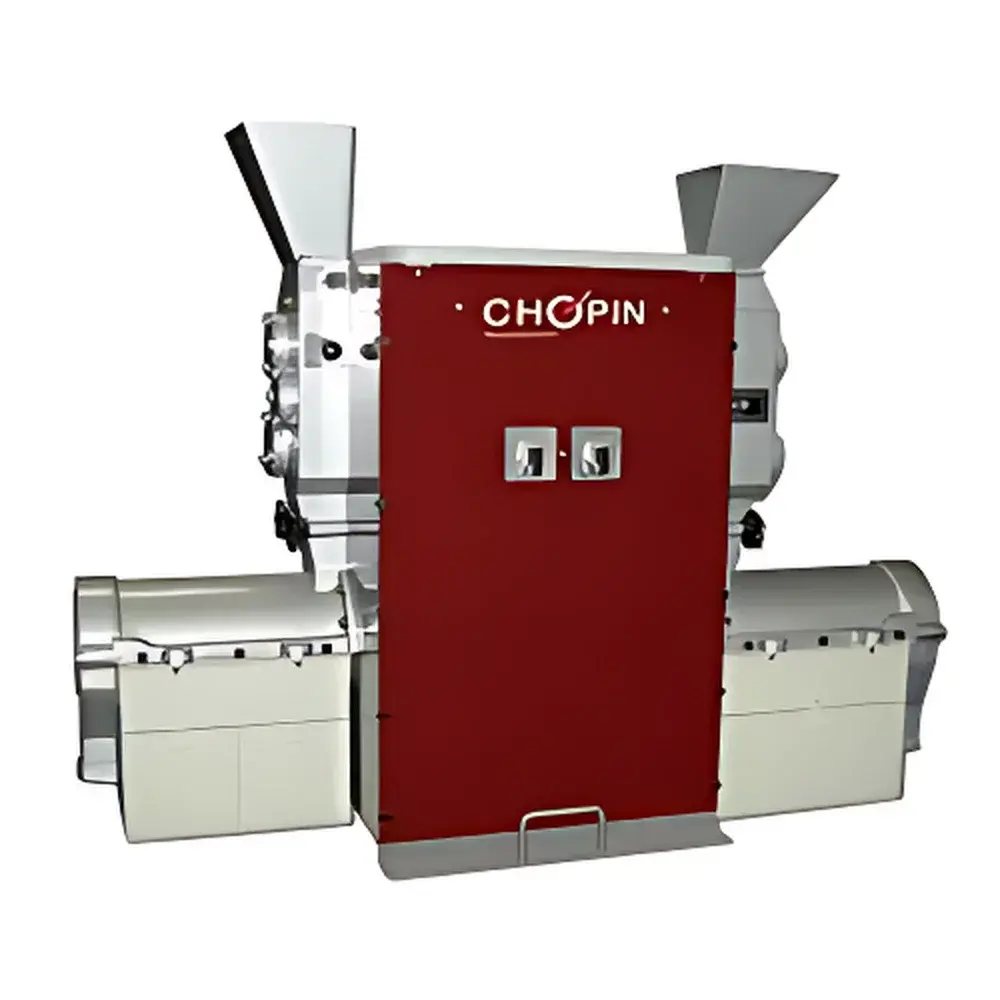
KPM CHOPIN CD1 Laboratory Flour Mill
| Brand | KPM CHOPIN |
|---|---|
| Origin | France |
| Model | CD1 |
| Type | Laboratory-scale roller mill for wheat flour milling simulation |
| Application | Flour yield determination, short-patent milling flow optimization, millability assessment |
| Compliance | Designed per ISO 27990 (Cereal and cereal products — Determination of flour yield), aligned with AACC Method 26–50A and ICC Standard No. 171 |
Overview
The KPM CHOPIN CD1 Laboratory Flour Mill is an engineered benchtop roller mill system designed to replicate industrial short-patent milling flows under controlled, repeatable conditions. It operates on the principle of sequential break and reduction—using calibrated corrugated and smooth rollers—to simulate the physical separation of endosperm from bran and germ during wheat milling. Unlike hammer or disc mills, the CD1 preserves particle morphology and starch integrity, enabling accurate assessment of flour extraction rate (yield), granulometric distribution, and functional flour quality parameters. Its compact architecture supports rapid milling trials with minimal sample requirement (100–500 g per test), making it essential for R&D laboratories, flour mill process engineers, and cereal quality control units seeking to correlate raw wheat characteristics with milled product performance.
Key Features
- Modular roller configuration: Interchangeable break and reduction rollers with adjustable gap (0.05–1.2 mm) and differential speed ratio (1:2.5) to emulate distinct stages of industrial milling.
- Integrated sample collection system: Six independently sealed fractions (bran, shorts, middlings, low-grade flour, high-grade flour, and tailings) captured in standardized stainless-steel containers for gravimetric yield calculation.
- Real-time operational monitoring: Digital display of roller speed (rpm), feed rate (g/min), and motor load—enabling correlation between mechanical energy input and flour yield efficiency.
- Hygienic design: Fully accessible grinding zone with tool-free roller removal; all contact surfaces polished AISI 304 stainless steel compliant with EU Regulation (EC) No 1935/2004 for food contact materials.
- Calibration traceability: Roller surface hardness (HRC 60±2) and parallelism verified per ISO 1101; supplied with factory calibration certificate and annual recalibration protocol.
Sample Compatibility & Compliance
The CD1 accommodates whole wheat kernels (hard red winter, hard red spring, soft white, durum) and pre-cleaned grain samples with moisture content 12.5–14.5% (wb). It is validated for use with ISO 27990-compliant test protocols and supports full compliance with AACC International Method 26–50A (“Determination of Flour Yield Using a Laboratory Mill”) and ICC Standard No. 171 (“Determination of Flour Yield of Wheat”). All output fractions meet requirements for subsequent analysis—including ash content (ISO 2171), protein quantification (ISO 20483), and particle size distribution (ISO 13320 via laser diffraction). The system’s documentation package satisfies GLP audit requirements, including instrument logbooks, operator training records, and maintenance history tracking.
Software & Data Management
While the CD1 operates as a standalone electromechanical system, its digital interface outputs ASCII-formatted data streams (via RS-232 or USB-C) compatible with LIMS integration. Optional KPM CHOPIN MillSoft v3.2 enables automated yield calculation, batch reporting, and statistical comparison across multiple wheat varieties or conditioning treatments. Data files include timestamped metadata (ambient temperature/humidity, kernel moisture, roller settings), supporting 21 CFR Part 11-compliant electronic records when deployed with validated user access controls and audit trail activation. Export formats include CSV and PDF reports aligned with internal QA templates and third-party certification bodies (e.g., SGS, Bureau Veritas).
Applications
- Flour yield optimization: Quantifying impact of wheat variety, tempering time, and roller gap on high-extraction vs. patent flour ratios.
- Milling suitability screening: Assessing kernel hardness (via break roll load profile) and endosperm friability prior to commercial mill trials.
- Process validation: Benchmarking new wheat blends against historical yield baselines to ensure consistency in bakery-grade flour production.
- Regulatory testing: Generating ISO/ICC-compliant yield data for export documentation, origin labeling, and PDO/TSG applications.
- Educational use: Teaching cereal science curricula on milling physics, mass balance principles, and flour fraction functionality.
FAQ
What is the minimum and maximum sample weight the CD1 can process per run?
The CD1 is optimized for 100–500 g of conditioned wheat per test cycle; consistent results require strict adherence to ISO 27990’s 250 g ±5 g recommendation.
Does the CD1 support automated moisture adjustment or grain tempering?
No—the CD1 requires pre-conditioned grain; tempering must be performed externally using validated humidity-controlled cabinets per ISO 5529.
Can the CD1 be used for non-wheat cereals such as rye or spelt?
Yes, with modified roller gap and speed settings; however, yield data are not directly comparable to ISO 27990 wheat standards and require method validation per cereal type.
Is roller recalibration required after every 100 hours of operation?
Roller parallelism and surface wear are verified quarterly or after 200 operating hours—whichever occurs first—as specified in the KPM CHOPIN Maintenance Manual Rev. 4.2.
How does the CD1 ensure reproducibility across operators?
Standardized SOPs, roller gap locking mechanism, and integrated feed rate control eliminate manual variability; inter-operator CV for flour yield is ≤1.8% (n=12, within-lab study per ISO 5725-2).





