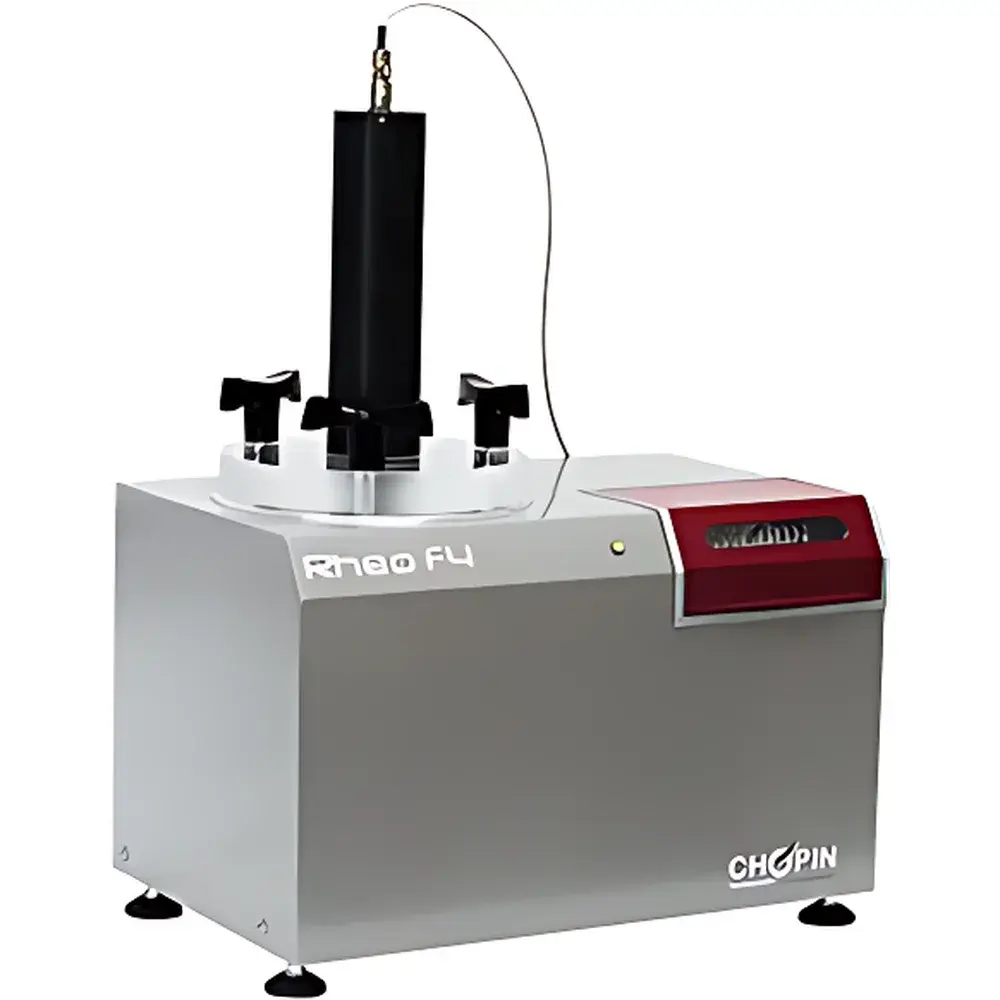
KPM CHOPIN Rheo F4 Fermentation Rheometer
| Brand | KPM CHOPIN |
|---|---|
| Origin | France |
| Model | Rheo F4 |
| Application | Fermentation & Dough Rheology Analysis for Gluten-Free, Whole Wheat, and Pre-Fermented Products |
| Category | Food-Specific Quality Instrumentation |
| Compliance Context | Designed for ISO 21502, AACC Method 54-10A, and ASTM D7908 (Rheological Characterization of Leavened Dough Systems) |
Overview
The KPM CHOPIN Rheo F4 Fermentation Rheometer is an engineered benchtop instrument dedicated to the real-time rheological monitoring of dough fermentation dynamics under controlled temperature and humidity conditions. It operates on the principle of oscillatory rotational rheometry combined with gas pressure sensing, enabling simultaneous quantification of viscoelastic evolution (G′, G″, tan δ) and CO₂ production kinetics during leavening. Unlike conventional farinographs or extensographs, the Rheo F4 captures the full time–temperature–strain response of complex dough matrices—including gluten-free formulations, whole wheat systems with high bran content, and pre-fermented sourdough starters—without requiring sample pre-conditioning or external gas analyzers. Its architecture integrates a precision Peltier-controlled chamber (±0.2 °C stability), a low-inertia torque transducer (resolution: 0.01 mN·m), and a sealed fermentation cup with integrated pressure transducer (range: 0–200 kPa, accuracy: ±0.5 kPa). This enables direct correlation between structural recovery (e.g., network reformation post-deformation) and metabolic activity (CO₂ accumulation rate), supporting mechanistic interpretation of dough behavior across formulation variables.
Key Features
- Fully automated, programmable fermentation protocols with up to 8 independent temperature ramps per test cycle
- Simultaneous dual-signal acquisition: oscillatory shear modulus (G′/G″) at frequencies from 0.1 to 10 Hz and real-time CO₂ partial pressure via calibrated piezoresistive sensor
- Dedicated sample cups with standardized geometry (35 mL volume, 45° conical profile) optimized for reproducible gas headspace-to-dough ratio in accordance with AACC International guidelines
- Integrated humidity control (40–95% RH, ±3% RH accuracy) to prevent surface desiccation during extended tests (up to 240 min)
- Modular calibration suite traceable to NIST-certified torque and pressure standards; includes daily verification routines for zero drift and sensitivity stability
- Rugged aluminum alloy chassis with ESD-safe enclosure, designed for continuous operation in QC laboratories compliant with ISO/IEC 17025 environmental requirements
Sample Compatibility & Compliance
The Rheo F4 accommodates a broad spectrum of food-grade dough systems: gluten-free blends (e.g., rice–tapioca–psyllium composites), whole grain flours with particle size distributions spanning 50–300 µm, chemically leavened batters, and liquid pre-ferments (levains, poolish, biga). Sample mass range: 30–50 g, adjustable via calibrated loading jig. All wetted components are constructed from FDA-compliant 316L stainless steel and PTFE-coated aluminum, facilitating rapid cleaning and validation under GMP hygiene protocols. The system supports audit-ready documentation aligned with 21 CFR Part 11 requirements—including electronic signatures, user access levels (admin/operator/auditor), and immutable audit trails for all method parameters, raw data files, and calibration events. Test reports conform to ISO 21502 (Cereal-based fermented products — Determination of rheological properties during fermentation) and are exportable in PDF/A-2b and CSV formats for LIMS integration.
Software & Data Management
Control and analysis are performed via RheoSoft v4.2—a Windows-based application validated for ICH Q9/Q10 environments. The software provides synchronized visualization of rheological moduli, phase angle, CO₂ pressure derivative (dP/dt), and calculated specific gas production rate (mL CO₂/g dry matter/min). Advanced curve-fitting modules apply Boltzmann-type models to extract characteristic fermentation milestones: lag time (tlag), maximum gas production rate (rmax), and time-to-peak elasticity (tG′max). Raw datasets are stored in HDF5 format with embedded metadata (operator ID, ambient conditions, flour lot number, hydration level). Version-controlled method templates ensure inter-laboratory reproducibility, while optional cloud backup (AWS S3 encrypted bucket) satisfies EU GDPR and FDA data retention mandates (minimum 10-year archival).
Applications
- Formulation optimization of gluten-free bakery products by correlating hydrocolloid type/concentration with elastic recovery kinetics and gas retention capacity
- Evaluation of enzymatic activity (e.g., amylases, transglutaminases) on dough maturation profiles under varying proofing temperatures
- Stability assessment of frozen par-baked doughs after multiple freeze-thaw cycles, tracking changes in linear viscoelastic region (LVER) width and yield stress hysteresis
- QC release testing for industrial sourdough starters, comparing acidification rate (pH-derived proxy) against CO₂ generation and G′ onset
- Research into starch retrogradation effects on crumb structure development during delayed fermentation in whole wheat systems
FAQ
What sample preparation steps are required prior to testing?
No pre-fermentation conditioning or resting is necessary; samples are loaded directly after mixing according to standard AACC 54-10A protocols. Hydration level must be recorded as metadata.
Can the Rheo F4 distinguish between CO₂ produced by yeast versus chemical leaveners?
Yes—via kinetic signature analysis: biological fermentation exhibits sigmoidal dP/dt curves with identifiable lag phases, whereas chemical systems (e.g., sodium bicarbonate + acid) show immediate, non-asymptotic pressure rise.
Is third-party validation data available for method transfer between labs?
KPM CHOPIN provides an inter-laboratory study report (n=6 sites, 3 flour types) demonstrating ≤8.2% RSD for tG′max and ≤5.7% RSD for rmax, compliant with AOAC 2020.01 criteria for collaborative study acceptance.
Does the system support GLP-compliant electronic record archiving?
Yes—RheoSoft v4.2 includes full 21 CFR Part 11 compliance features: digital signatures, role-based permissions, and tamper-evident audit logs with SHA-256 hashing of all critical data objects.
What maintenance intervals are recommended for long-term measurement fidelity?
Torque sensor recalibration every 12 months; pressure transducer verification quarterly; chamber seal integrity check before each batch of frozen dough tests.