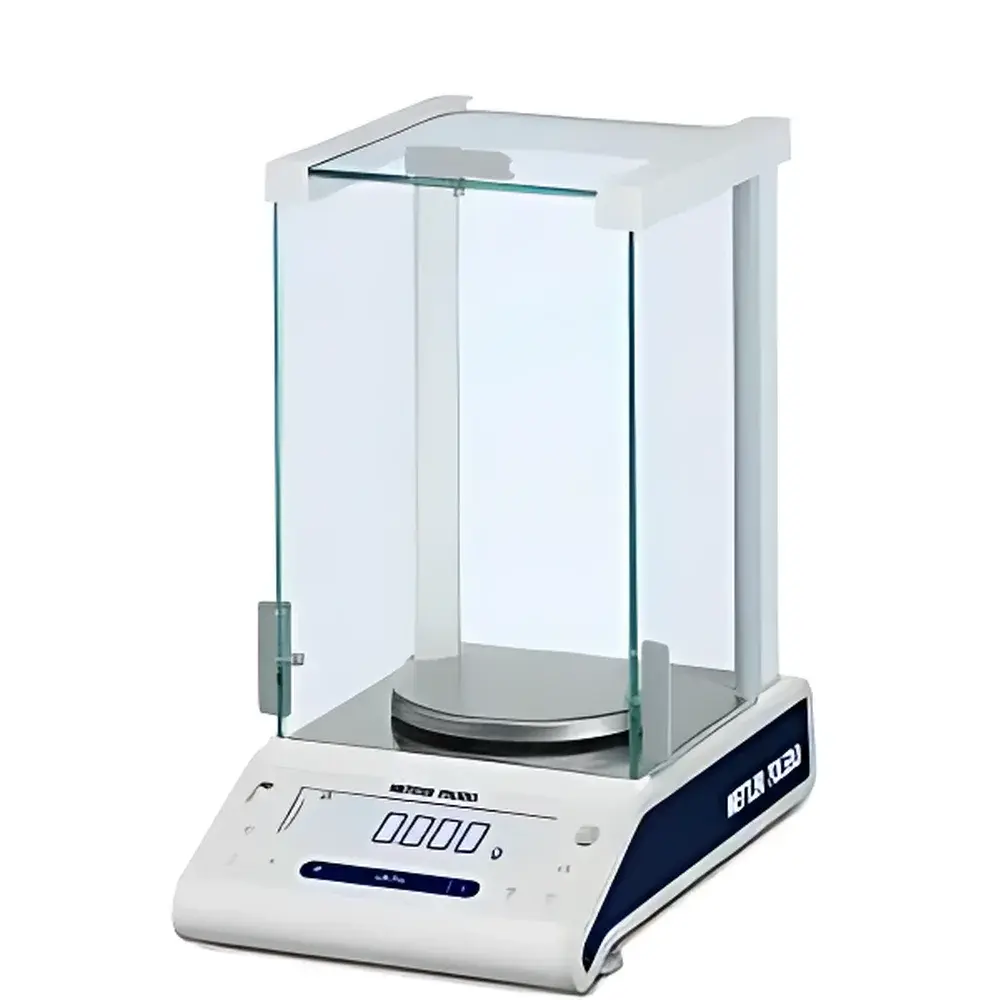
METTLER TOLEDO MS105/MS105DU/MS205DU/MS104S/MS204S/MS304S Analytical Balance
| Brand | METTLER TOLEDO |
|---|---|
| Origin | Switzerland |
| Model Series | MS105 / MS105DU / MS205DU / MS104S / MS204S / MS304S |
| Readability | 0.01 mg / 0.1 mg (model-dependent) |
| Max Capacity | 42 g to 320 g (model-dependent) |
| Repeatability (sd) | 0.02 mg to 0.1 mg |
| Linearity Error | 0.1 mg to 0.3 mg |
| Pan Diameter | Φ80 mm |
| Clearance Above Pan | 225 mm |
| Sensor Technology | MonoBloc® High-Performance Single-Module Load Cell |
| Calibration | Fully Automatic FACT (Frequency Adaptive Calibration Technology) |
| Display | High-Contrast Display (HCD) with SmartTrac™ Dynamic Range Indicator |
| Processor | 280 MIPS CPU, 72 MHz Bus Speed |
| Operating Environment | Temperature-compensated, multi-stage digital filtering, self-diagnostics |
Overview
The METTLER TOLEDO MS series analytical balances represent a benchmark in precision mass measurement for regulated laboratory environments. Engineered for reproducibility and long-term stability, these instruments employ the proprietary MonoBloc® single-module load cell—a monolithic, stress-free sensor architecture that eliminates mechanical hysteresis and delivers exceptional resistance to overload and shock. The core measurement principle relies on electromagnetic force compensation (EMFC), where the gravitational force acting on the sample is precisely counterbalanced by an electromagnetically generated restoring force; this closed-loop system enables direct, drift-free mass determination traceable to SI units. Designed for ISO/IEC 17025-compliant testing laboratories and GxP-regulated workflows—including pharmaceutical QC, reference standard preparation, and analytical method validation—the MS series operates within stringent environmental tolerances and supports full auditability of weighing events.
Key Features
- MonoBloc® high-integrity load cell ensures outstanding repeatability and immunity to mechanical stress, thermal gradients, and mechanical overloads.
- FACT (Fully Automatic Calibration Technology) performs internal calibration automatically—triggered either by time intervals or temperature fluctuations exceeding user-defined thresholds—ensuring continuous metrological traceability without manual intervention.
- SmartTrac™ dynamic range indicator provides real-time graphical feedback of current usage relative to full-scale capacity, enhancing operational awareness and preventing inadvertent overloading.
- High-Contrast Display (HCD) with intuitive iconography and large numeric characters improves readability under varied ambient lighting conditions and reduces operator fatigue during extended sessions.
- Three programmable SmartKeys allow one-touch access to frequently used applications such as percentage weighing, density determination, formulation, and statistics—all configurable via the intuitive menu interface.
- Advanced digital filtering algorithms dynamically adapt to environmental vibrations and air currents, optimizing response time and stability across diverse lab conditions (e.g., fume hoods, shared bench spaces).
- Integrated temperature compensation continuously adjusts gain and offset parameters in real time, mitigating errors induced by ambient thermal drift—a critical capability for uncontrolled or non-climate-stabilized laboratories.
- Comprehensive self-maintenance suite includes keyboard functionality tests, repeatability diagnostics, and internal calibration verification—supporting routine instrument qualification per ASTM E898, USP , and ISO 17025 requirements.
Sample Compatibility & Compliance
The MS series accommodates standard analytical sample vessels—including weighing boats, vials, crucibles, and filter papers—within its Φ80 mm stainless-steel pan and 225 mm vertical clearance. All models comply with international regulatory frameworks: design and firmware conform to FDA 21 CFR Part 11 (with optional electronic signature and audit trail modules), EU Annex 11, and GLP/GMP data integrity principles. Built-in security features include password-protected menu access, parameter lockout, and tamper-evident configuration logs. Each balance ships with factory calibration certificates traceable to national metrology institutes (e.g., METAS, NIST), and supports external calibration using certified weights compliant with OIML R111 Class E2 or better.
Software & Data Management
Data export is supported via RS232, USB Device, and optional Ethernet interfaces. When connected to METTLER TOLEDO’s LabX® software, the MS series enables centralized instrument management, automated report generation (PDF/CSV), electronic signature workflows, and full ALCOA+ compliant data archiving—including metadata capture (operator ID, timestamp, environmental conditions, calibration status). LabX enforces role-based access control, change control logs, and 21 CFR Part 11–compliant audit trails, making it suitable for regulated quality control laboratories subject to FDA, EMA, or PMDA inspections.
Applications
- Pharmaceutical: Active pharmaceutical ingredient (API) assay, reference standard weighing, dissolution tablet sampling, and excipient blending verification.
- Chemical R&D: Stoichiometric reagent dispensing, catalyst loading, and gravimetric titration preparation.
- Materials Science: Powder density analysis, ash content determination, and thin-film mass characterization.
- Environmental Testing: Filter weighing for particulate matter (PM2.5/PM10) analysis per EPA Method 201A and ISO 12103-1.
- Academic Research: Isotope ratio sample preparation, microgram-scale synthesis quantification, and calibration standard certification.
FAQ
What does “1/10d readability” mean, and how does it improve workflow?
It refers to the ability to display results at one-tenth of the nominal readability (e.g., 0.001 mg on a 0.01 mg balance) during stabilization—providing early trend indication without compromising final certified accuracy.
Is FACT calibration compliant with ISO 9001 and ISO/IEC 17025?
Yes—FACT satisfies clause 7.6 of ISO/IEC 17025:2017 regarding equipment calibration and verification, provided scheduled verification against traceable standards is maintained per organizational SOPs.
Can the MS balance be integrated into a LIMS environment?
Yes—via LabX or third-party middleware using ASCII or XML protocols over RS232/USB/Ethernet, enabling bidirectional data exchange with major LIMS platforms including Thermo Fisher SampleManager, LabWare, and STARLIMS.
How often should external calibration be performed?
Frequency depends on risk assessment per ISO/IEC 17025:2017 Clause 6.4.1; typical practice ranges from daily pre-use checks to weekly full-range verification using Class E2 weights, documented with uncertainty budgets.
Does the MS series support Good Weighing Practice (GWP®) Verification?
Yes—when paired with METTLER TOLEDO’s GWP® Recommendation and GWP® Verification software, users receive model-specific uncertainty assessments, tolerance recommendations, and compliance documentation aligned with pharmacopeial and regulatory expectations.