
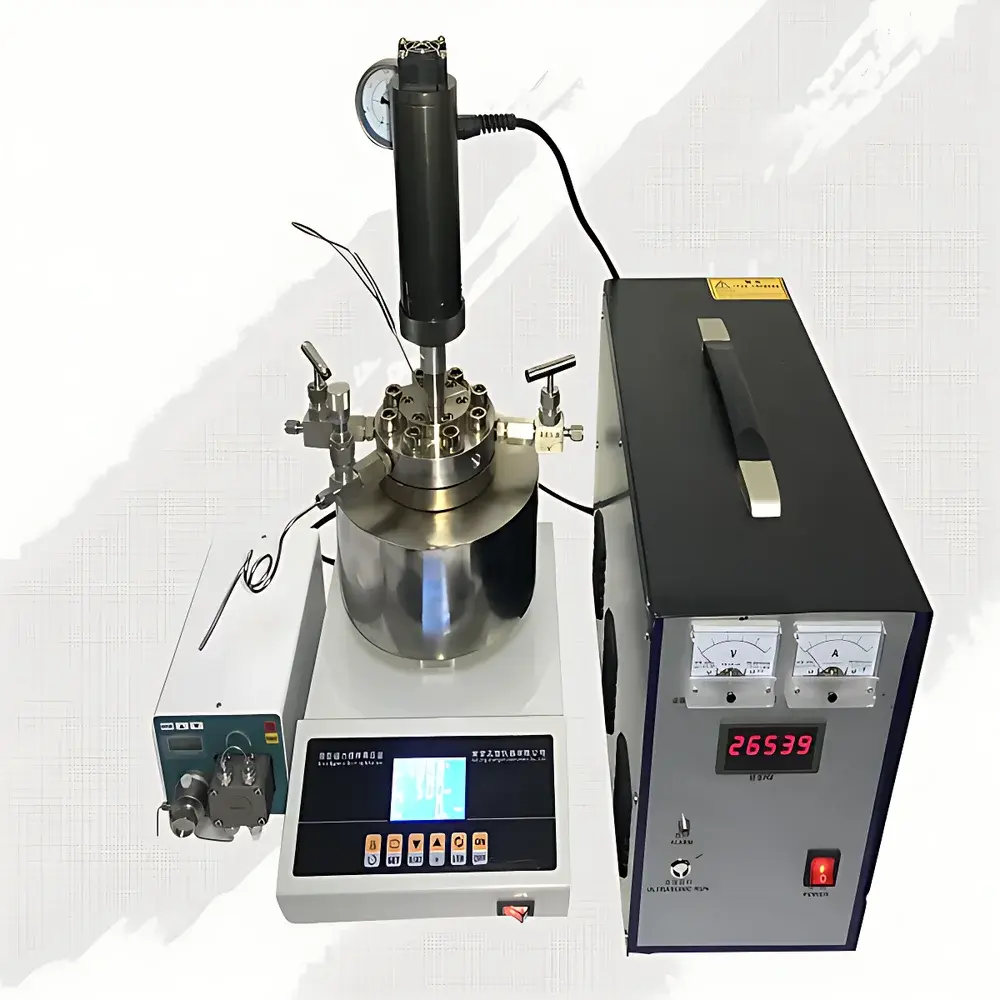
U-KPS Ultrasonic Stainless Steel Mini High-Pressure Reactor
| Brand | Zhengxin Instrument Factory (ZXYIQI) |
|---|---|
| Origin | Jiangsu, China |
| Manufacturer Type | Authorized Distributor |
| Origin Category | Domestic |
| Model | U-KPS |
| Price | USD 9,200 (FOB) |
| Usable Volume | 100 mL |
| Vessel Material | 316L Stainless Steel |
| Operating Pressure Range | 0–40 MPa |
| Vacuum Capability | Up to –0.1 MPa (absolute) |
| Ultrasonic Frequency | 28 kHz |
| Ultrasonic Power Output | Adjustable up to 800 W |
| Temperature Range | Ambient to 400 °C |
| Heating Power | 0–1200 W |
| Stirring Speed | 0–1000 rpm |
| Stirring Motor | Brushless DC, Magnetic Suspension or Shaft-Driven Impeller |
| Control System | PID Dual-Loop Temperature Control with Programmable Ramp/Soak Profiles |
| Safety Features | Overtemperature/Overpressure Auto-Alarm, Rupture Disc (Hastelloy C-276), Thermal Cut-off, Audible & Visual Alert |
| Compliance | Designed per ISO 4877-1 (Laboratory Equipment Safety), ASME BPVC Section VIII Div. 1 (Design Basis for Pressure Vessels), and GLP-Compatible Data Logging Architecture |
Overview
The U-KPS Ultrasonic Stainless Steel Mini High-Pressure Reactor is an integrated benchtop synthesis platform engineered for controlled sonochemical reaction engineering under elevated temperature and pressure conditions. It combines direct immersion ultrasonication—via a titanium alloy sonotrode operating at 28 kHz—with precise thermal regulation (0–400 °C), mechanical agitation (0–1000 rpm), and pressure containment (up to 40 MPa) in a single compact vessel. Unlike conventional reactors relying solely on thermal or mechanical activation, the U-KPS leverages cavitation-induced physical effects—including microturbulence, localized hot-spot formation (>5000 K transient), radical generation, and interfacial emulsification—to accelerate reaction kinetics, improve mass transfer across phase boundaries, and enhance catalyst dispersion in heterogeneous systems. Its monolithic 316L stainless steel construction, dual-seal architecture (soft elastomeric + hard metal gasket), and optimized acoustic coupling minimize energy loss and frequency drift—even during prolonged operation above 200 °C—addressing a critical limitation observed in legacy ultrasonic reactors operating beyond 150 °C.
Key Features
- Direct-coupled ultrasonic transduction: Titanium alloy probe (Grade 5) mounted via flanged top/bottom port with helium-leak-tested static seal; adjustable output (0–800 W) enables fine control over cavitation intensity.
- Robust pressure-rated vessel: Forged 316L body with seamless inner liner; designed and certified to ASME BPVC Section VIII Div. 1 requirements for cyclic loading up to 40 MPa at 400 °C.
- Dual-loop PID temperature control: Independent heating (modular embedded heater, 0–1200 W) and cooling (optional external chiller interface) loops prevent overshoot; ±1 °C accuracy maintained across full range using K-type thermocouple (316L sheath, Φ2.0 mm).
- Intelligent safety architecture: Integrated rupture disc (Hastelloy C-276), real-time pressure monitoring (digital gauge with analog backup), auto-shutdown on T/P exceedance, and audible/visual alarm with LCD event logging.
- Modular stirring system: Brushless DC motor (50 W) supports magnetic suspension or shaft-driven impeller configurations; torque-stable operation from 0–1000 rpm with programmable direction reversal.
- Thermal decoupling design: Removable heating module allows rapid vessel exchange—critical for multi-reaction screening or cross-contamination-sensitive syntheses.
Sample Compatibility & Compliance
The U-KPS accommodates diverse sample chemistries including organometallic precursors, pharmaceutical intermediates, nanomaterial dispersions, and supercritical fluid media. Its inert 316L wetted surfaces resist corrosion from halogenated solvents, strong acids (e.g., HCl, HNO₃ ≤ 6 M), and alkaline aqueous systems. The reactor meets ISO 4877-1 for laboratory equipment mechanical safety and incorporates design elements aligned with FDA 21 CFR Part 11 expectations—namely, electronic audit trail capability (via optional RS485/Modbus interface), user-access-level controls, and tamper-resistant parameter locking. All pressure components undergo hydrostatic testing at 1.5× MAWP prior to shipment. Documentation includes material traceability certificates (MTRs), ASME U-1 stamp documentation, and CE-conformity declaration per PED 2014/68/EU.
Software & Data Management
The U-KPS operates via a dedicated embedded controller with 4.3″ TFT-LCD touchscreen interface supporting multistep program profiles (up to 10 segments per run). Temperature, pressure, ultrasonic power, and stirring speed are logged at user-defined intervals (1–60 s) with timestamped CSV export via USB. Optional PC software (Windows/Linux compatible) provides real-time graphing, comparative run analysis, and GLP-compliant report generation—including operator ID, calibration history, and deviation flags. Data integrity safeguards include write-protected memory, cyclic redundancy check (CRC) validation, and automatic backup on SD card (included). Remote monitoring via Ethernet (TCP/IP) is available with TLS 1.2 encryption for secure network integration.
Applications
- Catalytic C–C coupling (Suzuki, Heck, Sonogashira) under mild thermal conditions enabled by ultrasonic activation of Pd nanoparticles.
- Nanoparticle synthesis (e.g., Au, Ag, ZnO) with narrow size distribution (<15% PDI) via controlled nucleation in high-pressure supercritical CO₂/ethanol mixtures.
- Continuous-flow precursor decomposition for thin-film deposition (e.g., ALD/CVD feedstock generation).
- Extraction optimization of thermolabile phytochemicals (e.g., curcuminoids, anthocyanins) from botanical matrices using subcritical water–ethanol solvent systems.
- High-temperature hydrogenation of unsaturated esters where conventional stirring fails to overcome gas–liquid mass transfer limitations.
- Accelerated aging studies of polymer electrolytes for solid-state batteries under 30 MPa Ar atmosphere and 120 °C.
FAQ
What is the maximum allowable working pressure and temperature for continuous operation?
The U-KPS is rated for continuous operation at 40 MPa and 400 °C. Short-term excursions up to 45 MPa are permitted for ≤15 minutes per cycle, provided all safety interlocks remain active.
Can the ultrasonic probe be installed through the bottom of the reactor?
Yes—dual-port configuration (top and bottom flanges) is standard; bottom-mounting improves cavitation uniformity for sediment-prone suspensions and facilitates inline sampling.
Is third-party calibration certification available?
Factory calibration certificates (NIST-traceable thermocouple and pressure transducer) are included. UKAS-accredited calibration services can be arranged pre-shipment upon request.
Does the system support GMP audit trails?
With optional software license, the U-KPS generates 21 CFR Part 11–compliant electronic records including user authentication logs, parameter change history, and digital signatures for batch release.
What maintenance intervals are recommended for the ultrasonic transducer?
Titanium sonotrodes require visual inspection every 200 operational hours; ultrasonic generator fan filters should be cleaned monthly. Full transducer recalibration is advised annually or after 1000 h of cumulative use.



