
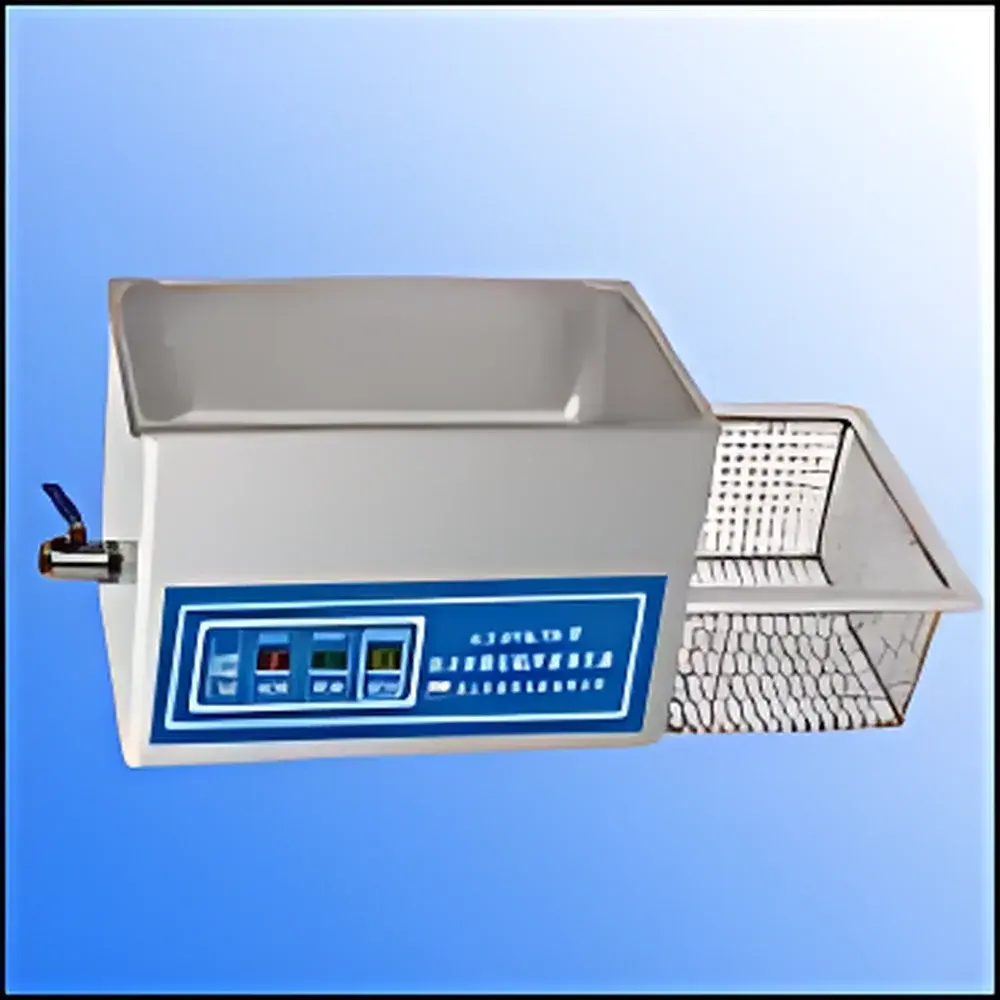
KQ-400KDV Desktop High-Power Digital Ultrasonic Cleaner
| Origin | Shanghai, China |
|---|---|
| Manufacturer Type | Authorized Distributor |
| Origin Category | Domestic (PRC) |
| Model | KQ-400KDV |
| Price | USD 1,980 (FOB Shanghai) |
| Dimensions (L×W×H) | 410 × 350 × 380 mm |
| Tank Internal Dimensions (L×W×H) | 300 × 240 × 180 mm |
| Tank Capacity | 13 L |
| Ultrasonic Frequency | 40 kHz |
| Ultrasonic Power Output | 400 W |
| Heating Power | 600 W |
| Temperature Range | 20–80 °C |
| Timer Range | 1–480 min |
| Sound-Dampening Lid | Yes |
| Drain Valve | Yes |
| Tank Material | 304 Stainless Steel |
| Basket Material | 304 Stainless Steel (argon-welded mesh) |
| Safety Protections | Digital Over-Temperature, Over-Voltage & Over-Current Indication |
Overview
The KQ-400KDV Desktop High-Power Digital Ultrasonic Cleaner is an integrated benchtop system engineered for precision cleaning, degassing, dispersion, emulsification, homogenization, solvent extraction, particle size reduction, and cell lysis in research laboratories, quality control facilities, and academic institutions. It operates on the principle of ultrasonic cavitation: high-frequency (40 kHz) acoustic energy is transmitted through a liquid medium via piezoelectric transducers bonded to the stainless-steel tank bottom, generating controlled microbubbles that collapse violently near submerged surfaces—producing localized shockwaves and intense shear forces sufficient to dislodge contaminants from complex geometries, micro-pores, and delicate substrates without mechanical abrasion. Unlike analog or low-power units, the KQ-400KDV delivers uniform 400 W of acoustic output distributed across multiple 100 W transducers, enabling reproducible cleaning performance across heterogeneous sample loads and viscous media.
Key Features
- Integrated digital control panel with real-time display of set/actual temperature, elapsed time, and ultrasonic activation status—retains user-defined parameters after power cycling.
- Robust 304 stainless-steel tank (300 × 240 × 180 mm internal) formed by deep-drawing and seam-welding for corrosion resistance, structural integrity, and long-term acoustic coupling stability.
- High-efficiency transducer array: four independently mounted 100 W piezoelectric elements provide balanced energy distribution, minimizing standing-wave dead zones and ensuring consistent cavitation density throughout the 13 L working volume.
- Programmable heating system (600 W) with ±1 °C thermal stability over 20–80 °C range; integrated PID algorithm prevents overshoot and supports temperature-sensitive applications such as enzymatic digestion or polymer dissolution.
- Full-cycle timer (1–480 min) with automatic shutdown and audible alert; compatible with extended-duration protocols including overnight solvent extraction or slow-rate degassing.
- Sound-dampening hinged lid with silicone gasket reduces ambient noise to ≤65 dB(A) at 1 m distance—meeting ISO 7779-compliant laboratory acoustic requirements.
- Front-mounted drain valve with PTFE-sealed brass fitting enables safe, residue-free tank evacuation between batches—critical for cross-contamination control in regulated environments.
- Dual-layer safety architecture: hardware-based thermal cutoff (105 °C fail-safe) plus software-monitored over-voltage, over-current, and over-temperature fault detection with LED warning indicators.
Sample Compatibility & Compliance
The KQ-400KDV accommodates a broad spectrum of sample types—including glassware (vials, cuvettes, chromatography columns), metal components (surgical instruments, calibration standards), ceramic substrates, printed circuit boards, optical lenses, and biological specimens (tissue sections, cultured cells in suspension). Its 40 kHz frequency balances penetration depth and surface cleaning efficacy, making it suitable for both macro-scale parts and micro-scale particulates. The unit complies with IEC 61000-6-3 (EMC emission limits) and IEC 61000-6-2 (immunity to electrostatic discharge and RF fields). While not certified for medical device reprocessing per ISO 15883, its design aligns with GLP documentation practices: all operational parameters (time, temperature, power state) are visibly displayed and manually recordable. For GMP-aligned workflows, optional external data loggers may be deployed to capture timestamped parameter histories per FDA 21 CFR Part 11 Annex 11 traceability guidelines.
Software & Data Management
The KQ-400KDV operates via embedded firmware—no PC interface or proprietary software is required. All settings are managed through a tactile membrane keypad with LED feedback. Parameter retention eliminates repeated configuration during multi-batch operations. Though the unit lacks USB/Ethernet connectivity, its deterministic behavior (fixed 40 kHz frequency, calibrated power delivery, repeatable thermal ramp profiles) ensures inter-unit comparability across laboratories. Users may integrate the cleaner into validated SOPs using manual log sheets or LIMS-compatible templates. For audit readiness, the digital display provides immediate verification of active conditions—supporting ISO/IEC 17025 clause 7.7 (result reporting) and ASTM D2603 (ultrasonic cleaning validation methodology).
Applications
- Pre-analytical sample preparation: removal of organic residues from HPLC vials, GC autosampler syringes, and ICP-MS nebulizers.
- Materials science: deburring of sintered metal powders, dispersion of nanomaterials (e.g., graphene oxide, TiO₂ nanoparticles) in aqueous/organic carriers.
- Life sciences: gentle dissociation of adherent cell monolayers, lysis of bacterial cultures prior to DNA extraction, cleaning of microfluidic chips.
- Electronics manufacturing: flux residue removal from PCB assemblies prior to AOI inspection or conformal coating.
- Pharmaceutical QA: cleaning of tablet punches, capsule fillers, and stainless-steel contact parts per USP analytical instrument qualification protocols.
- Academic research: solvent-assisted extraction of plant metabolites, sonochemical synthesis of metal-organic frameworks (MOFs), and ultrasonic-assisted dye degradation kinetics studies.
FAQ
What is the recommended cleaning solution for use with the KQ-400KDV?
Aqueous alkaline detergents (pH 9–11) or low-surface-tension solvents (e.g., isopropanol, ethanol, or terpene-based formulations) are optimal. Avoid halogenated solvents (e.g., chloroform, carbon tetrachloride) due to cavitation-induced decomposition and potential tank corrosion.
Can the KQ-400KDV be used for sterilization?
No. Ultrasonic cleaning removes bioburden but does not achieve sterility assurance levels (SAL ≤10⁻⁶). It serves as a prerequisite step before autoclaving, ethylene oxide treatment, or vaporized hydrogen peroxide decontamination.
Is degassing functionality built-in?
Yes. The 40 kHz frequency and programmable timer support dedicated degassing cycles (typically 5–15 min at 40–50 °C without ultrasonics enabled, followed by brief sonication) to remove dissolved oxygen from solvents used in electrochemistry or photochemical assays.
How often should the stainless-steel tank be descaled?
In hard-water regions, descaling with 5% citric acid solution every 2–3 months prevents calcium carbonate buildup that attenuates acoustic transmission. Rinse thoroughly with DI water post-descale.
Does the unit support continuous operation?
Yes—rated for uninterrupted duty cycles up to 8 hours. Thermal management includes convection-cooled transducers and a thermally isolated base housing to maintain stable output under sustained load.



