
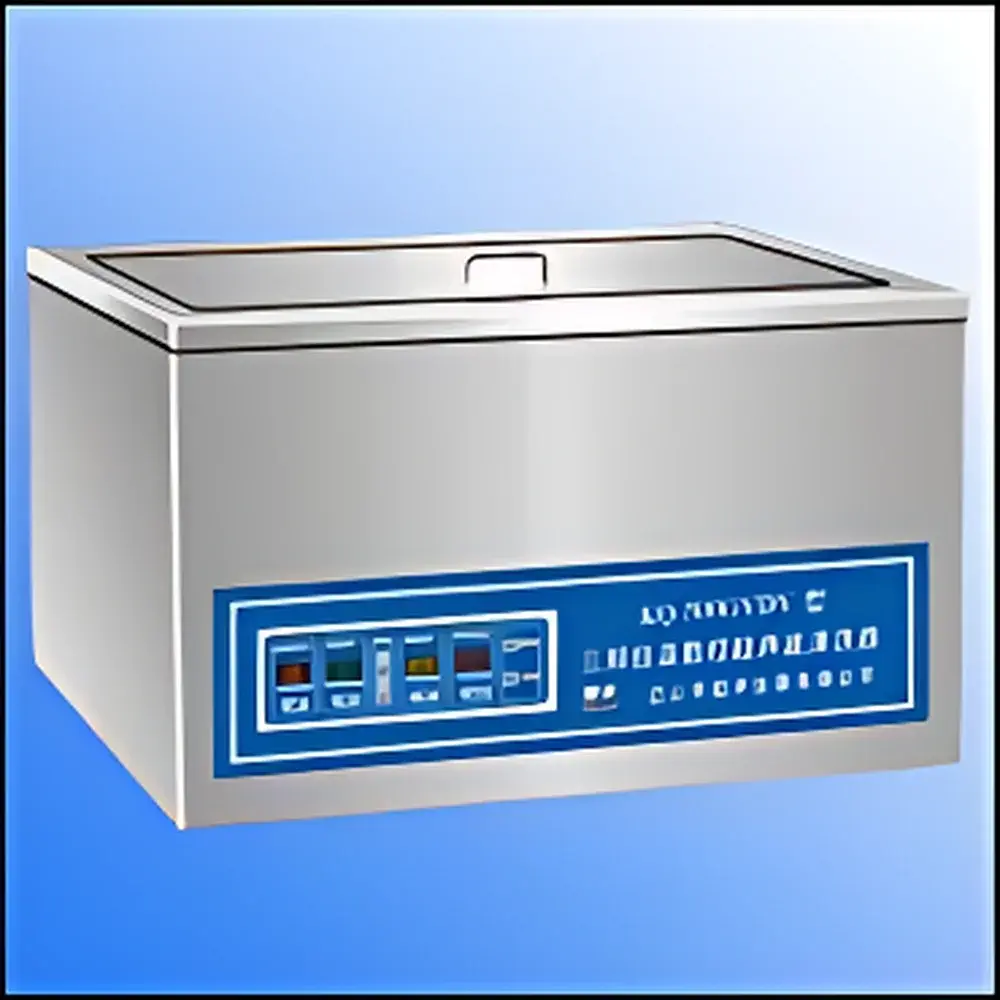
KQ-500GVDV Benchtop Tri-Frequency Programmable Temperature-Controlled Ultrasonic Cleaner
| Origin | Shanghai, China |
|---|---|
| Manufacturer Type | Authorized Distributor |
| Country of Origin | China |
| Model | KQ-500GVDV |
| Dimensions (L×W×H) | 840×410×400 mm |
| Tank Interior Dimensions (L×W×H) | 500×300×180 mm |
| Tank Capacity | 27 L |
| Ultrasonic Frequencies | 28 kHz |
| Power Output | 500 W |
| Adjustable Power Range | 40–100 % |
| Heating Power | 1000 W |
| Cooling Power | 300 W |
| Temperature Control Range | 0–80 °C |
| Timer Range | 1–480 min |
| Transducer Power per Unit | 50 W |
| Frequency Switching Interval | 1–999 s |
| Drain Valve | Stainless Steel Ball Valve |
| Tank Material | Stainless Steel 304 |
| Lid | Acoustically Damped Stainless Steel with Corrosion-Resistant Sealing Gasket |
| Filtration System | Integrated Thermostatically Controlled Circulation Filter |
Overview
The KQ-500GVDV is a benchtop tri-frequency programmable temperature-controlled ultrasonic cleaner engineered for laboratories requiring precise thermal management and multi-mode acoustic energy delivery during cleaning, degassing, emulsification, cell lysis, and sample preparation. Unlike conventional single-frequency ultrasonic systems, the KQ-500GVDV integrates dual transducer arrays operating simultaneously or alternately at 28 kHz and 45 kHz—enabling optimized cavitation dynamics across diverse sample matrices and contaminant types. Its defining innovation lies in active thermal regulation: a closed-loop system dynamically switches between heating (1000 W) and cooling (300 W) modules to maintain solution temperature within ±0.5 °C of the setpoint over extended operation (up to 480 minutes), eliminating thermal drift that compromises reproducibility in sensitive applications such as protein extraction, nanoparticle dispersion, or chromatographic vial cleaning. The unit employs piezoelectric transducers bonded directly to the stainless steel 304 tank base, delivering uniform energy distribution and minimizing standing-wave artifacts.
Key Features
- Tri-frequency operational capability: independent or synchronized control of 28 kHz (high-intensity cleaning) and 45 kHz (fine-particle removal and delicate substrate compatibility)
- Programmable temperature stabilization: real-time PID-controlled heating/cooling cycle ensures stable bath temperature from 0–80 °C, critical for enzymatic reactions, solvent-sensitive samples, or thermolabile compounds
- Dual transducer architecture: ten 50 W transducers (total 500 W nominal output), arranged for symmetrical acoustic field distribution and minimized dead zones
- Intelligent digital interface: microcontroller-based firmware stores up to 10 user-defined protocols with recallable settings for frequency, power (%), temperature, and duration
- Integrated filtration loop: thermostatically regulated recirculation system with fine-mesh stainless steel filter prevents particulate redeposition and extends bath life
- Acoustic containment design: damped stainless steel lid with elastomeric corrosion-resistant gasket reduces ambient noise (<65 dB(A)) and prevents solvent evaporation
- Drain system: front-mounted 316 stainless steel ball valve with drip tray enables rapid, residue-free tank evacuation under GLP-compliant workflow conditions
Sample Compatibility & Compliance
The KQ-500GVDV accommodates a broad range of sample formats—including glassware (vials, flasks, cuvettes), metal components (surgical instruments, calibration standards), polymer substrates (microfluidic chips, PET slides), and biological specimens (tissue sections, cell culture plates)—without compromising structural integrity. Its frequency-selective operation allows optimization for both macro-scale debris removal (28 kHz) and submicron particle detachment (45 kHz). The unit complies with IEC 61000-6-3 (EMC emissions) and IEC 61010-1 (safety requirements for laboratory equipment). While not certified to ISO 13485 or FDA 21 CFR Part 11 out-of-the-box, its audit-ready digital log (timestamped parameter records, operator ID fields, and protocol version tracking) supports validation under GLP and GMP frameworks when integrated into documented SOPs.
Software & Data Management
The embedded control system logs all operational parameters—including actual vs. set temperature, real-time power draw, frequency activation sequence, and elapsed time—with automatic timestamping and non-volatile memory retention (≥10,000 cycles). Data export is supported via USB port in CSV format for traceability and QC reporting. Optional RS-232/RS-485 interfaces enable integration with LIMS or centralized lab automation platforms. Firmware updates are performed via secure bootloader protocol, maintaining data integrity during revision deployment. All user-modifiable settings require password-protected access, satisfying basic ALCOA+ principles (Attributable, Legible, Contemporaneous, Original, Accurate, Complete, Consistent, Enduring, Available).
Applications
- Pre-analytical sample preparation: removal of organic residues from HPLC/GC autosampler vials and syringe filters
- Pharmaceutical QA/QC: cleaning of tablet punches, capsule fillers, and dissolution apparatus components per USP
- Materials science: dispersion of carbon nanotubes, graphene oxide, or metal-organic frameworks in aqueous/organic media
- Life sciences: gentle dissociation of adherent cells, nuclear isolation, and chromatin shearing prior to ChIP-seq
- Electronics manufacturing: flux residue removal from PCB assemblies without thermal stress or solder mask degradation
- Environmental testing: extraction of PAHs and PCBs from soil/sediment matrices using accelerated solvent-assisted sonication
FAQ
What is the maximum continuous operating time?
The timer supports up to 480 minutes (8 hours) of uninterrupted operation with active thermal regulation.
Can the unit operate at only one frequency?
Yes—users may select either 28 kHz or 45 kHz independently, or configure automatic switching at programmable intervals (1–999 seconds).
Is the cooling function effective in ambient temperatures above 30 °C?
The 300 W thermoelectric cooler maintains setpoint accuracy within specification up to 35 °C ambient; for sustained operation >35 °C, supplemental room HVAC is recommended.
Does the filtration system require consumable cartridges?
No—the stainless steel mesh filter is cleanable via ultrasonic regeneration or manual rinsing; no disposable elements are used.
How is calibration verified for temperature and power output?
Temperature sensor linearity is factory-verified against NIST-traceable RTD standards; acoustic power is validated per ASTM E2810-11 using calorimetric methods and documented in the Certificate of Conformance supplied with each unit.



