
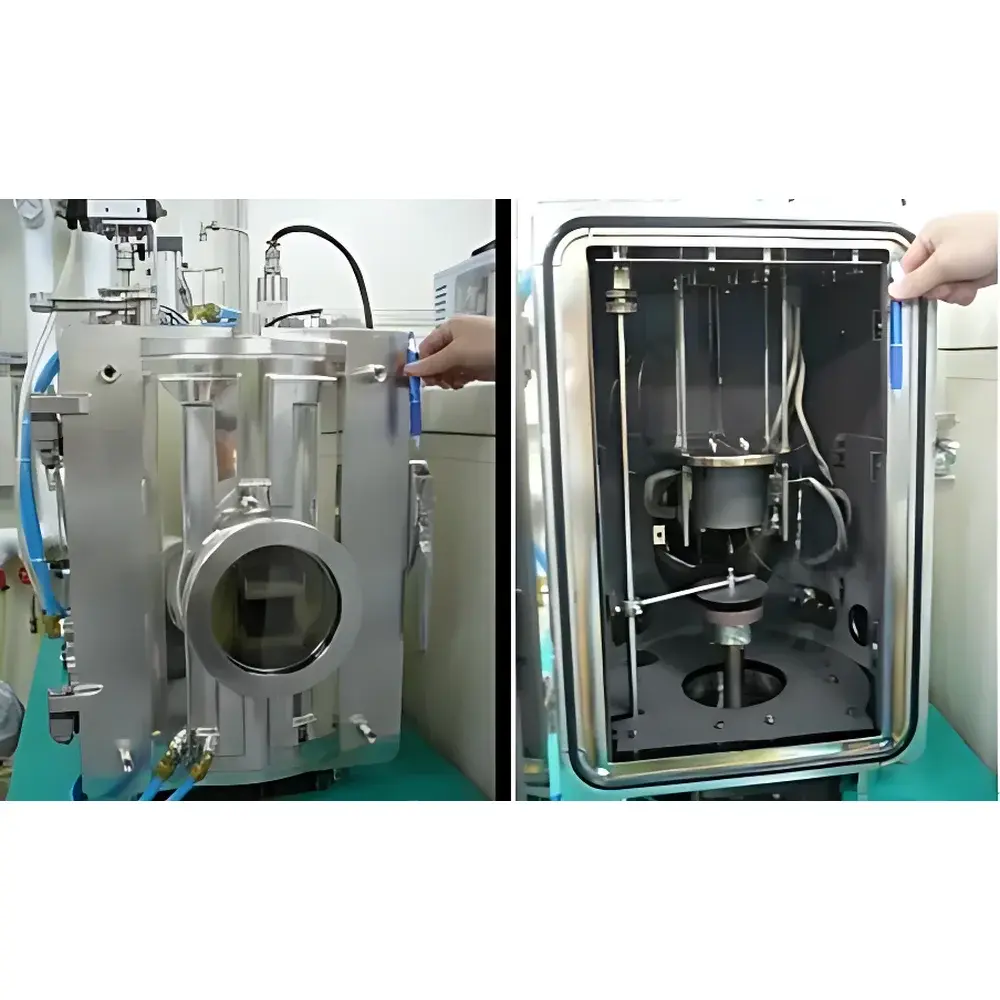
KRi EH200 End-Hall Ion Source for Ion Beam Etching (IBE) Applications
| Brand | Kaufman & Robinson, Inc. (KRi) |
|---|---|
| Origin | USA |
| Model | EH200 |
| Type | End-Hall Ion Source |
| Application | Ion Beam Etching (IBE), Pre-deposition Substrate Cleaning, Ion-Assisted Deposition (IBAD), Ion Beam Sputtering (IBS), Direct Ion Plating (DIP) |
| Operating Gas | Argon (Ar), Oxygen (O₂), Nitrogen (N₂), or mixtures |
| Typical Beam Voltage | 50–1,200 V |
| Typical Beam Current | 0.1–4.0 A |
| Nominal Beam Power | Up to 3.5 kW |
| Ion Beam Diameter (at 10 cm) | ~80–120 mm |
| Cooling | Conduction-cooled (water-cooled optional) |
| Interface | CF-63 or CF-100 flange mount |
| Control | Analog 0–10 V / 4–20 mA or RS-232/RS-485 (with optional digital controller) |
| Compliance | CE-marked |
Overview
The KRi EH200 End-Hall Ion Source is a robust, conduction-cooled ion beam generator engineered for precision ion beam etching (IBE), substrate pre-cleaning, and ion-assisted thin-film processes in ultra-high vacuum (UHV) and high-vacuum environments. Based on the classic End-Hall geometry pioneered by Dr. Harold R. Kaufman in the 1960s and refined over four decades by Kaufman & Robinson, Inc. (KRi), the EH200 operates via magnetically confined electron cyclotron resonance (ECR)-enhanced discharge in a crossed electric and magnetic field configuration. This architecture produces a broad, low-divergence ion beam with high current density (>1 mA/cm² at 10 cm), moderate energy distribution (FWHM ≈ 25–35 eV), and exceptional long-term stability—critical for reproducible surface modification of sensitive substrates including single-crystal semiconductors, superconducting oxides (e.g., FeSeTe), and optical coatings. Unlike gridded ion sources, the EH200 eliminates grid erosion and associated contamination, enabling extended maintenance intervals and stable beam operation across multi-hour process runs.
Key Features
- End-Hall discharge architecture with permanent magnet array and thermally optimized anode/cathode assembly for stable plasma ignition and sustained beam output.
- High ion flux density (>1.2 mA/cm² at 10 cm working distance) with low-energy spread—ideal for gentle yet efficient sputter etching and surface activation without subsurface damage.
- Modular mechanical design: standard CF-63 or CF-100 flange interface enables rapid integration into existing UHV chambers (e.g., custom-built IBE systems, IBAD coaters, or R&D sputter platforms).
- Flexible gas compatibility: optimized for Ar, O₂, N₂, and reactive gas mixtures—supporting both physical sputtering and reactive ion beam etching (RIBE) of metals, chalcogenides, and dielectrics.
- Analog and digital control options: 0–10 V analog input for beam voltage/current regulation; optional KRi DCS-2000 digital controller provides programmable ramping, interlock monitoring, and real-time parameter logging compliant with GLP audit requirements.
- Conduction-cooled construction minimizes thermal drift during prolonged operation; water-cooling upgrade available for >2.5 kW continuous duty cycles.
Sample Compatibility & Compliance
The EH200 is routinely deployed for nanoscale surface engineering of silicon wafers (2-inch and 4-inch), transition metal dichalcogenides (TMDs), high-Tc superconducting films (e.g., PCCO, FeSeTe), and optical interference stacks. Its low-energy, high-flux beam enables uniform etch rates exceeding 20 Å/s on FeSeTe under Ar plasma (110 V, 1.5 A) while preserving stoichiometry and crystallinity—validated via XRD and XPS in academic and national lab settings. The source meets vacuum compatibility standards per ASTM E575-21 (vacuum system cleanliness) and is rated for base pressures ≤5×10⁻⁸ Torr. All wetted materials comply with ASTM F1088-20 (high-purity stainless steel) and are non-magnetic per MIL-STD-1376B. Integration into GMP-compliant coating lines is supported via 21 CFR Part 11–ready digital controllers with electronic signature and audit-trail functionality.
Software & Data Management
KRi’s DCS-2000 Digital Control System supports deterministic process scripting (e.g., timed voltage sweeps, current ramping, gas flow synchronization) and exports timestamped operational logs in CSV format for traceability. Data fields include beam voltage, discharge current, filament emission current, chamber pressure, coolant temperature (if equipped), and interlock status—all synchronized to microsecond resolution. The system supports Modbus TCP integration into SCADA environments and includes built-in safety protocols: over-current shutdown, cathode over-temperature cutoff, and vacuum interlock validation (via active Pirani/Penning gauge inputs). Raw data archives are encrypted and retain full metadata for FDA or ISO 17025 accreditation audits.
Applications
- Ion beam etching (IBE) of complex oxides (FeSeTe, YBCO, LSCO) for device patterning and interface engineering.
- Substrate pre-cleaning prior to e-beam evaporation or sputter deposition—removing native oxides and hydrocarbons without redeposition.
- Ion-assisted deposition (IBAD) of dense, low-stress optical coatings (TiO₂, SiO₂, Ta₂O₅) with enhanced refractive index and environmental stability.
- Ion beam sputtering (IBS) of high-purity targets for metrology-grade reference films.
- Direct ion plating (DIP) of wear-resistant metallic layers on MEMS components and precision optics.
- R&D-scale surface functionalization of 2D materials and topological insulators requiring sub-monolayer precision.
FAQ
What vacuum level is required for stable EH200 operation?
Optimal performance requires a base pressure ≤5×10⁻⁷ Torr, with operating pressure during Ar discharge maintained between 1×10⁻⁴ and 5×10⁻⁴ Torr.
Can the EH200 be used with reactive gases like O₂ or Cl₂?
Yes—O₂ and N₂ are routinely used for reactive IBE; Cl₂ requires specialized corrosion-resistant internal components (optional upgrade).
Is beam uniformity verified across the full extraction area?
Yes—KRi provides Faraday cup mapping reports showing ±5% current density variation over Ø100 mm at 10 cm working distance.
What is the typical lifetime of the cathode filament?
Under nominal Ar conditions (1.2 A discharge current), tungsten-thoriated cathodes achieve >2,000 hours of continuous operation before replacement.
Does KRi provide OEM integration support for custom vacuum systems?
Yes—KRi offers mechanical interface drawings, electrical schematics, and application engineering consultation for turnkey integration into third-party UHV platforms.





