
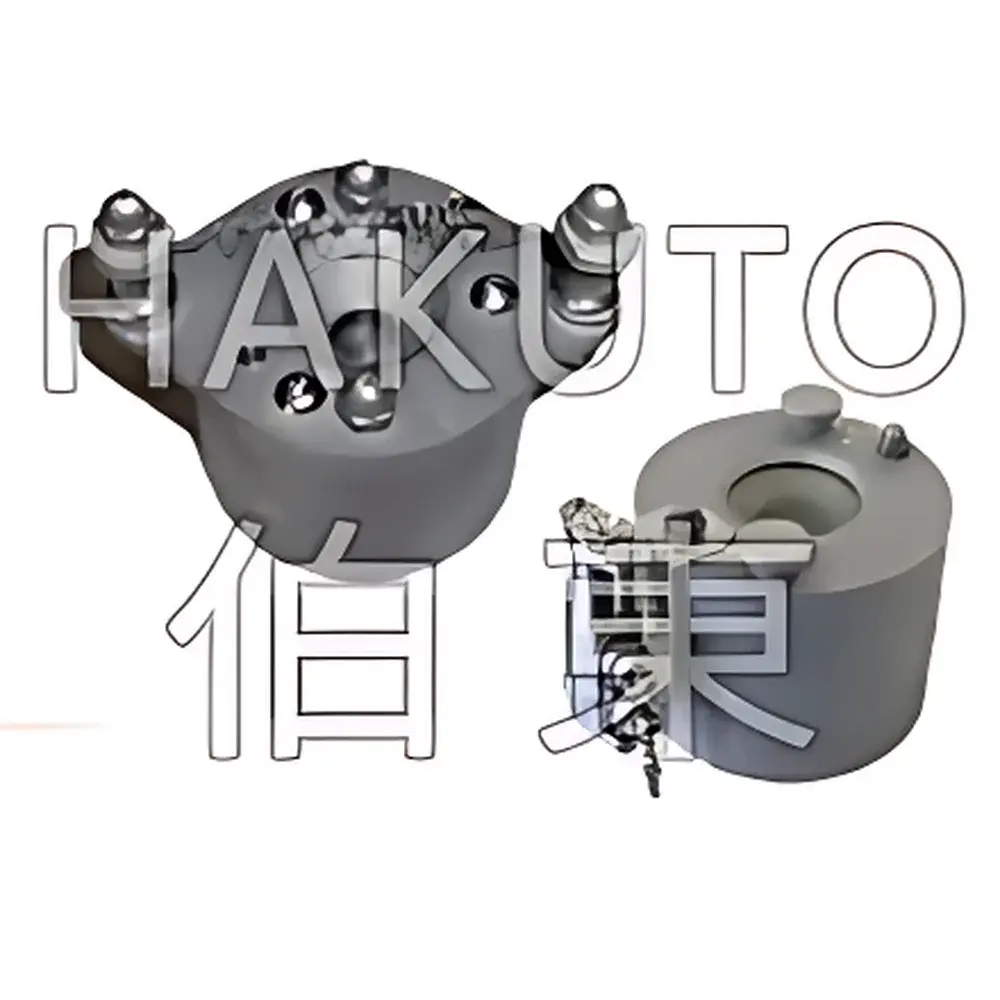
KRI Gridless Hall-Effect Ion Source eH Series
| Brand | Kaufman & Robinson, Inc. (KRI) |
|---|---|
| Origin | USA |
| Model | Gridless eH Series |
| Anode Voltage Range | 50–300 V (varies by model) |
| Beam Current | 5–20 A |
| Beam Divergence Angle | >45° |
| Gas Flow Rate | 2–100 sccm (model-dependent) |
| Physical Dimensions | 3.0″–9.7″ diameter, 3.0″–6.0″ height |
| Cooling | Optional water cooling (standard on eH2000 and above) |
| Neutralizer Options | Filament (F) or Hollow Cathode (HC) |
Overview
The KRI Gridless Hall-Effect Ion Source eH Series is a high-current, low-energy, broad-beam ion source engineered for precision surface modification and thin-film processing in ultra-high vacuum (UHV) and high-vacuum environments. Unlike conventional gridded Kaufman-type ion sources, the eH series employs a gridless Hall-effect discharge architecture—eliminating physical grids that limit lifetime, cause contamination, and constrain beam uniformity. This design leverages crossed electric and magnetic fields to confine electrons and sustain a stable plasma, enabling efficient ionization of inert (Ar, Kr, Xe) and reactive (O₂, N₂, CF₄) gases without thermionic cathodes. The resulting ion beam delivers nanoscale control over surface energy, stoichiometry, and topography—critical for applications demanding atomic-level reproducibility, such as ion-beam-assisted deposition (IBAD), in-situ surface activation, and low-damage etching. Designed for seamless integration into coating systems—including electron-beam evaporation chambers, magnetron sputtering platforms, roll-to-roll web coaters, and load-lock cluster tools—the eH series supports both R&D and production-scale vacuum processes under ISO/IEC 17025-aligned laboratory conditions.
Key Features
- Gridless Hall-effect plasma generation: No grid erosion, no beam distortion, extended operational lifetime (>10,000 hours typical)
- High-current, low-energy operation: Adjustable anode voltage (50–300 V) with beam currents up to 20 A—enabling high deposition rates while minimizing substrate heating and lattice damage
- Broad, highly divergent beam (>45° full angle): Uniform irradiation across large-area substrates (up to 300 mm diameter) without mechanical scanning
- Modular, field-replaceable anode assembly: Rapid maintenance with sub-30-minute swap; no realignment required
- Integrated neutralization architecture: Optional filament (F) or hollow cathode (HC) neutralizers—HC variants support stable O₂-rich operation for oxide film growth and surface oxidation
- Compact, flange-mounted mechanical design: Standard CF or ISO-K vacuum interfaces; water-cooling integrated on eH2000 and larger models for continuous-duty thermal management
- Full system integration package: Includes dedicated DC power supply, mass flow controller (MFC), and neutralizer driver—compliant with SEMI E10 and ISO 14644-1 Class 5 cleanroom installation requirements
Sample Compatibility & Compliance
The eH series operates across a wide range of process gases—including Ar, O₂, N₂, Xe, and gas mixtures—and is compatible with substrates ranging from silicon wafers and optical glasses to flexible polymer films and metallic foils. Its low-energy ion bombardment preserves crystallinity in sensitive semiconductors (e.g., GaN, perovskites) and prevents carbon migration in organic electronics. All models conform to IEC 61000-6-3 (EMC emission limits) and UL 61010-1 safety standards. When operated with validated MFCs and power supplies, the system supports GLP/GMP documentation workflows, including audit trails for voltage, current, gas flow, and runtime—meeting FDA 21 CFR Part 11 data integrity requirements when paired with compliant SCADA software.
Software & Data Management
KRI provides the eH Control Suite—a Windows-based application supporting RS-232, Ethernet, and analog I/O interfaces for remote parameter monitoring and closed-loop regulation. The suite logs timestamped operational data (beam current, anode voltage, neutralizer emission, gas flow) in CSV and SQLite formats, enabling traceability for ISO 9001 internal audits. Integration with LabVIEW™, Python (PyVISA), and EPICS is supported via documented APIs. Optional OPC UA server module enables interoperability with MES platforms (e.g., Siemens Opcenter, Rockwell FactoryTalk) for Industry 4.0-ready vacuum tool orchestration.
Applications
- Ion-beam-assisted deposition (IBAD) during e-beam evaporation or sputtering—enhancing adhesion, density, and refractive index control in optical coatings (e.g., TiO₂, SiO₂, Ta₂O₅)
- In-situ pre-deposition cleaning of substrates prior to magnetron sputtering or ALD—removing hydrocarbons and native oxides without particle generation
- Surface activation of polymers (PC, PET, PI) for improved metallization adhesion in flexible electronics
- Low-damage ion etching (IBE) of multilayer stacks in photonic device fabrication—achieving <0.5 nm RMS roughness on etched facets
- Ion-beam mixing and doping for shallow junction formation in compound semiconductor devices
- Bias-assisted ion-beam sputter deposition (BTIBSD) for stress-controlled metal nitride barrier layers (e.g., TiN, TaN) in advanced interconnects
FAQ
What distinguishes the eH series from traditional gridded Kaufman ion sources?
The eH series replaces electrostatic acceleration grids with a self-consistent Hall-effect plasma configuration—eliminating grid sputtering, reducing metal contamination, and enabling stable operation with reactive gases like O₂ at high current densities.
Can the eH source be used for oxygen-based surface oxidation?
Yes—HC-type neutralizers and O₂-optimized anode materials (eH-xO₂ variants) are available to sustain stable discharge and prevent cathode poisoning during prolonged O₂ operation.
Is water cooling mandatory for all eH models?
Water cooling is standard on eH2000 and eH3000; optional on eH400 and eH1000. Continuous operation above 8 A beam current is recommended only with active cooling.
How is beam uniformity verified and maintained?
KRI supplies Faraday cup mapping protocols and beam profile analysis software. Beam divergence (>45°) and magnetic field homogeneity ensure ±5% current density variation across 200 mm substrates without external correction optics.
Does KRI provide vacuum compatibility documentation for UHV systems?
Yes—each eH model includes outgassing rate data (per ASTM E595), material certifications (ASTM F519, AMS 2750E), and bakeout tolerance specifications (up to 150°C for 24 hours).



