
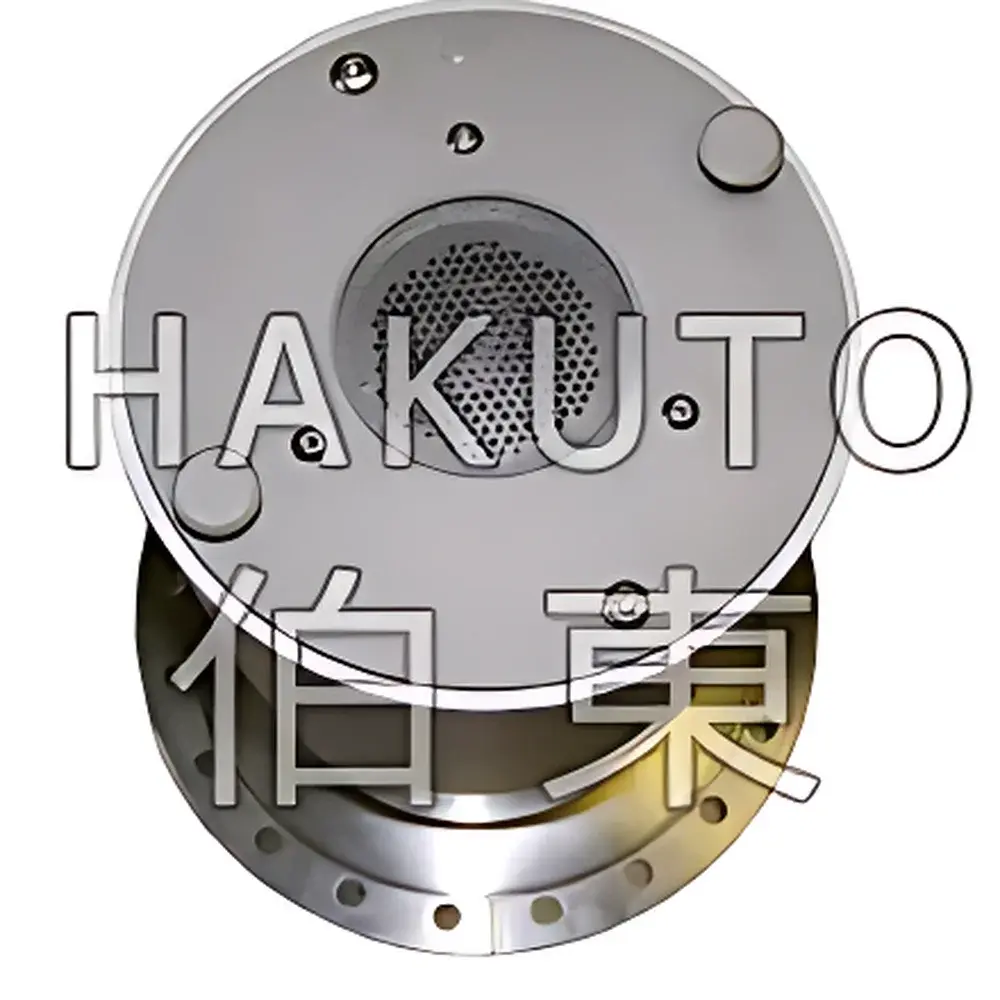
KRI RFICP 40 Radio-Frequency Inductively Coupled Plasma Ion Source
| Brand | Kaufman & Robinson, Inc. (KRI) |
|---|---|
| Origin | USA |
| Model | RFICP 40 |
| Discharge Chamber Anode | RF-coupled |
| Ion Beam Current | >100 mA |
| Ion Kinetic Energy | 100–1200 eV |
| Grid Diameter | 4 cm |
| Beam Modes | Focused, Parallel, Divergent |
| Process Gas Flow | 3–10 sccm |
| Compatible Gases | Ar, Kr, Xe, O₂, N₂, H₂ |
| Operating Pressure | < 0.5 mTorr |
| Dimensions (L × Ø) | 12.7 cm × 13.5 cm |
| Neutralizer | LFN-2000 |
Overview
The KRI RFICP 40 is a compact, high-efficiency radio-frequency inductively coupled plasma (RF-ICP) ion source engineered for integration into small-volume ultra-high vacuum (UHV) and high-vacuum (HV) systems. Unlike thermionic or DC discharge ion sources, the RFICP 40 employs a filament-free, inductively coupled plasma generation mechanism—eliminating cathode degradation and enabling stable, long-duration operation with reactive process gases such as O₂, N₂, and H₂. Its design centers on a robust 4 cm-diameter multi-aperture grid assembly fabricated from molybdenum and graphite, optimized for precise ion extraction and beam collimation. The source operates at RF frequencies (typically 13.56 MHz) to sustain high-density plasma (>10¹¹ cm⁻³) within a sealed quartz discharge chamber, delivering controllable ion energies from 100 eV to 1200 eV and beam currents exceeding 100 mA under standard conditions. This makes the RFICP 40 particularly suited for applications demanding high reproducibility, low contamination, and extended mean time between maintenance (MTBM)—including in-situ surface preparation, ion-assisted deposition (IBAD), and precision ion beam etching (IBE) in R&D and pilot-scale thin-film systems.
Key Features
- Filament-free RF plasma generation ensures compatibility with aggressive and oxidizing process gases without electrode erosion or lifetime limitations.
- Modular mechanical architecture enables rapid installation, alignment, and service—critical for vacuum chamber space constraints and cleanroom-integrated tooling.
- Adjustable base mount allows fine-tuning of source-to-substrate angle and distance, facilitating optimization of etch uniformity and deposition rate profiles across substrates up to 150 mm diameter.
- Triple-mode beam optics (focused, parallel, divergent) are achieved via interchangeable grid configurations and electrostatic lens tuning—supporting both high-resolution patterning and large-area treatment.
- Integrated automatic grid bias regulation maintains consistent plasma sheath conditions during extended runs, extending grid life and ensuring process repeatability over hundreds of hours.
- LFN-2000 low-energy electron neutralizer provides real-time emission current monitoring and closed-loop charge compensation, preserving substrate potential stability and preventing charging-induced defects in insulating films.
Sample Compatibility & Compliance
The RFICP 40 is compatible with a broad range of substrate materials—including silicon wafers, fused silica optics, metallic alloys, polymers, and ceramic substrates—without requiring conductive coatings or biasing. Its low-pressure operation (< 0.5 mTorr) minimizes gas-phase scattering, supporting sub-10 nm feature definition in ion beam etching and atomic-layer-level control in ion-assisted optical coating. The source complies with international vacuum safety standards (ISO 2789:2015, ANSI Z88.2-2015) and meets electromagnetic compatibility requirements per FCC Part 18 and CE/EMC Directive 2014/30/EU. When integrated into automated deposition platforms, the RFICP 40 supports audit-ready operation under GLP and GMP frameworks through optional analog/digital I/O interfaces for recipe-based parameter logging and interlock synchronization.
Software & Data Management
While the RFICP 40 operates via analog voltage inputs (0–10 V) for RF power, grid voltage, and neutralizer current control, it is fully compatible with industry-standard vacuum system controllers—including MKS Instruments’ 925 Series, INFICON’s Transpector, and custom LabVIEW- or Python-based SCADA architectures. Optional digital communication modules (RS-485/Modbus RTU or Ethernet/IP) enable remote parameter setpoint adjustment, real-time beam current/energy telemetry, and timestamped event logging. All operational data—including RF forward/reflected power, neutralizer emission current, and chamber pressure correlation—can be archived in CSV or HDF5 format for traceability, statistical process control (SPC), and FDA 21 CFR Part 11-compliant electronic records when paired with validated software environments.
Applications
- Precleaning: Removal of native oxides, hydrocarbons, and adsorbed water layers prior to epitaxial growth or high-adhesion metallization—achieving sub-monolayer cleanliness verified by XPS and AES.
- Ion Beam Etching (IBE): Anisotropic, maskless patterning of SiO₂, Si₃N₄, and compound semiconductors with etch rates of 5–50 nm/min and selectivity >20:1 vs. photoresist.
- Ion-Assisted Deposition (IBAD): Real-time densification and stress control of TiO₂, Ta₂O₅, and SiO₂ optical stacks—reducing columnar microstructure and improving environmental durability per ISO 9211-3.
- Ion Beam Sputter Deposition (IBSD): High-purity, low-defect metal and dielectric film synthesis with minimized target poisoning and stoichiometric transfer—validated for aerospace-grade optical filters and quantum device encapsulation layers.
- Surface Functionalization: Controlled amorphization, cross-linking, or hydrophilicity enhancement of polymer substrates (e.g., PET, PC, PI) for biomedical sensor interfaces and flexible electronics adhesion promotion.
FAQ
What vacuum level is required for stable RFICP 40 operation?
Stable plasma ignition and beam formation require a base pressure ≤5×10⁻⁶ Torr; optimal continuous operation occurs at 1×10⁻⁴ to 5×10⁻⁴ Torr during gas flow.
Can the RFICP 40 be used with oxygen without grid oxidation?
Yes—the Mo/graphite grid stack and RF-driven plasma confinement minimize direct thermal and chemical attack, enabling >1000-hour O₂ operation at ≤500 eV without measurable grid recession.
Is remote diagnostics supported out of the box?
Standard analog control does not include diagnostics; however, optional digital interface kits provide real-time voltage/current telemetry, fault flagging, and configurable alarm thresholds.
How is beam uniformity characterized and validated?
Uniformity is assessed using Faraday cup array mapping (per ASTM F1592-22) across a 100 mm wafer plane; typical 1σ deviation is ≤±3.5% over central 80% area with parallel-mode configuration.
Does KRI provide application-specific grid sets?
Yes—custom grid geometries (e.g., 3-grid triode, asymmetric aperture arrays) are available for specialized beam shaping, angular distribution control, or high-current density operation upon technical review.



