
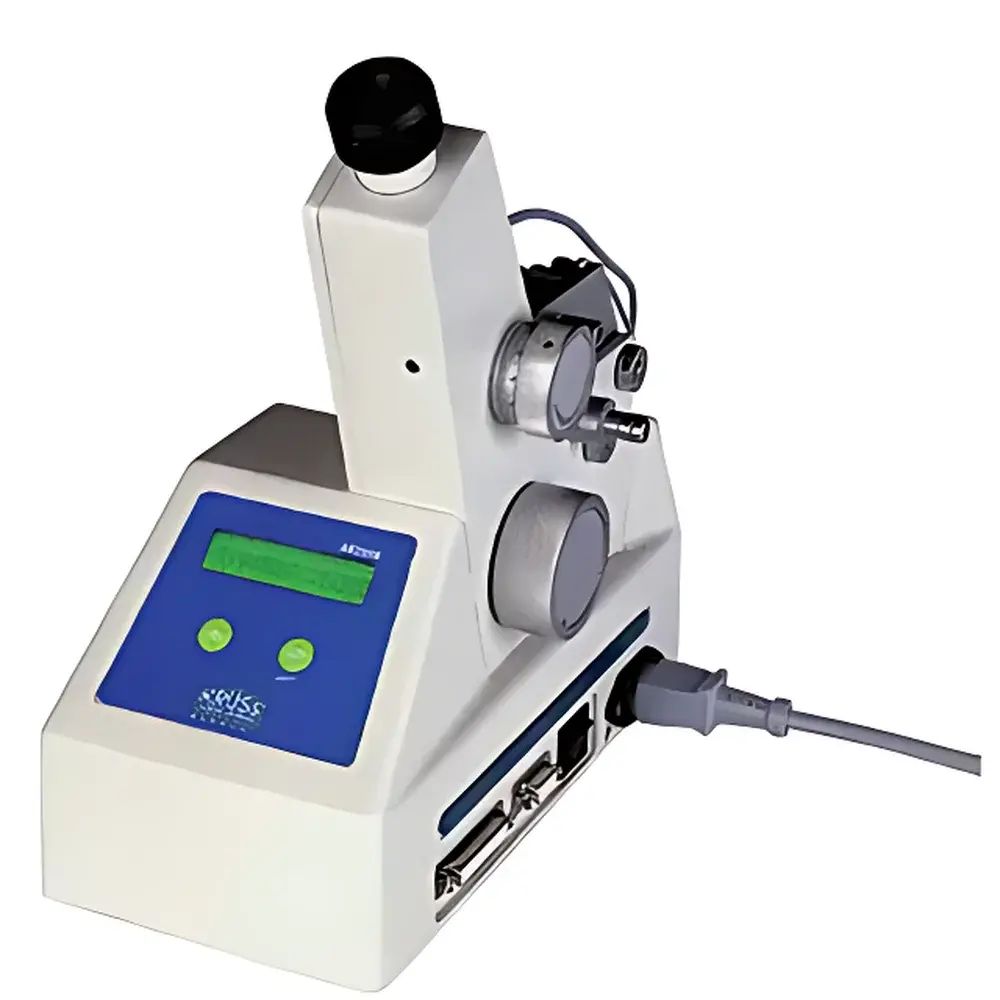
KRUESS AR2008 Digital Abbe Refractometer
| Brand | KRUESS |
|---|---|
| Origin | Germany |
| Model | AR2008 |
| Product Type | Benchtop Refractometer |
| Temperature Control | Yes |
| Digital Display | Yes |
| Refractive Index Range | 1.3000–1.7200 nD |
| Brix Range | 0–95 %Brix |
| Temperature Range | 0–99 °C |
| Refractive Index Accuracy | ±0.0002 nD |
| Brix Accuracy | ±0.1 %Brix |
| Refractive Index Resolution | 0.0001 nD |
| Brix Resolution | 0.1 %Brix |
| Temperature Resolution | 0.1 °C |
| Automatic Temperature Compensation (ATC) | 0–90 °C |
| Interface | RS-232 / RS-422 (9600 baud) |
| Light Source | LED @ 589 nm |
| Power Supply | 110/230 V~, 50/60 Hz, 40 W |
Overview
The KRUESS AR2008 Digital Abbe Refractometer is a precision benchtop instrument engineered for accurate and repeatable measurement of refractive index (nD) and related derived values—including %Brix, %w/w concentration, and temperature-compensated optical density—based on the classical Abbe principle. It employs collimated monochromatic light at the sodium D-line wavelength (589 nm), generated by a stable, long-life LED source, to illuminate the sample-prism interface. Critical measurements rely on the critical angle method: when light transitions from a high-refractive-index glass prism to a lower-index liquid sample, the angle at which total internal reflection occurs is directly correlated to the sample’s refractive index. The AR2008 integrates real-time thermal stabilization via an integrated Peltier-based temperature controller coupled to the measuring prism, ensuring compliance with ISO 21147:2021 (Refractometers — Performance requirements and test methods) and ASTM D1218 (Standard Test Method for Refractive Index of Hydrocarbon Liquids). Its robust aluminum alloy chassis and sealed optical path make it suitable for routine QC use in industrial laboratories where environmental fluctuations, dust, or intermittent vibration may occur.
Key Features
- Precision Abbe optical design with high-stability 589 nm LED illumination, eliminating lamp aging and spectral drift associated with traditional sodium vapor lamps
- Integrated Peltier temperature control system (0–99 °C) with direct prism coupling, enabling active thermal regulation and minimizing thermal lag during sequential measurements
- Automatic Temperature Compensation (ATC) across 0–90 °C, applying correction algorithms compliant with ICUMSA and AOAC guidelines for sugar solutions and aqueous systems
- High-resolution LCD display showing simultaneous readouts of nD, %Brix, and sample temperature—with timestamped logging capability
- Dual serial interfaces (RS-232 and RS-422, 9600 baud) supporting bidirectional communication for GLP-compliant data export to LIMS, Excel, or validated laboratory software
- Factory-calibrated using NIST-traceable reference standards; includes certified glass calibration plate, contact fluid, and dust cover for operational integrity
Sample Compatibility & Compliance
The AR2008 accommodates liquid, semi-liquid, and low-viscosity pasty samples—including aqueous sugar solutions, organic solvents, polymer melts (within viscosity limits), coolants, cutting fluids, and brines—without requiring dilution or filtration under standard operating conditions. Sample volume requirement is ≤1.5 mL per measurement. Its optical geometry complies with DIN EN ISO 2859-1 for sampling plans and supports audit-ready documentation per FDA 21 CFR Part 11 when paired with compliant data acquisition software. The instrument meets CE marking requirements (2014/30/EU EMC Directive and 2014/35/EU Low Voltage Directive) and conforms to IEC 61010-1 safety standards for laboratory electrical equipment.
Software & Data Management
Raw measurement data—including nD, %Brix, temperature, date/time stamp, and operator ID (if configured)—are transmitted in ASCII format via serial protocol. No proprietary software is bundled; however, the AR2008 is fully compatible with third-party platforms supporting RS-232/RS-422 input, including LabVIEW™, MATLAB® Serial Toolbox, and validated GxP-compliant LIMS environments. All data exports include embedded metadata required for traceability under ISO/IEC 17025 and GLP/GMP frameworks. Audit trail functionality must be implemented at the host system level, as the device itself provides unalterable timestamped output without local storage.
Applications
- Quality control of sucrose, fructose, and glucose syrups in food & beverage manufacturing (aligned with ICUMSA Method GS4/8-10)
- Concentration monitoring of process coolants, quenching oils, and metalworking fluids in automotive and aerospace machining lines
- In-process verification of polymer solution concentrations in textile sizing and paper coating formulations
- Raw material verification of glycols, ethylene oxide derivatives, and surfactant blends in fine chemical synthesis
- Wastewater analysis for dissolved solids estimation in municipal and industrial effluent treatment plants
- Batch release testing of pharmaceutical excipients (e.g., propylene glycol, glycerin) per USP Refractometry
FAQ
Does the AR2008 support automatic calibration?
No—the AR2008 requires manual calibration using the supplied NIST-traceable glass standard prior to each analytical session or shift, per ISO 8655-6 and KRUESS calibration protocol.
Is the temperature control system programmable?
Yes—users can set and hold target temperatures between 0 °C and 99 °C in 0.1 °C increments; ramp rate is fixed at 1.5 °C/min for stability optimization.
Can the AR2008 measure non-aqueous samples like hydrocarbons?
Yes—provided the sample wets the prism surface and remains optically clear at 589 nm; refractive index range (1.3000–1.7200 nD) covers most common organic solvents and petrochemicals.
What is the warm-up time before first measurement?
Optimal thermal equilibrium is achieved within 15 minutes after power-on; full specification accuracy is guaranteed only after 20 minutes of continuous operation.
Is the RS-422 interface galvanically isolated?
Yes—RS-422 implementation includes opto-isolation to prevent ground-loop interference in electrically noisy industrial settings.




