
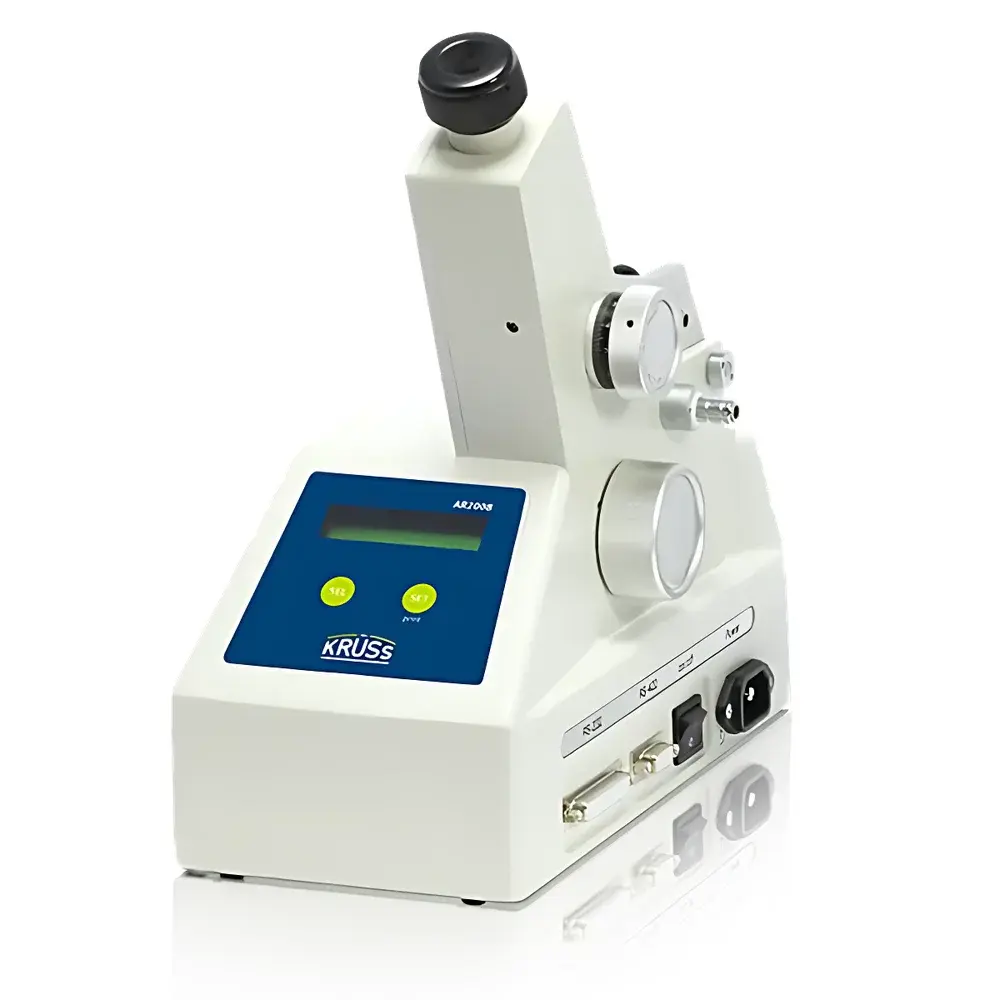
KRUESS AR2008 Digital Abbe Refractometer
| Brand | KRUESS |
|---|---|
| Origin | Germany |
| Model | AR2008 Digital Abbe Refractometer |
| Type | Benchtop Refractometer |
| Temperature Control | Yes |
| Digital Display | Yes |
| Measurement Range | Refractive Index 1.3000–1.7200 nD |
| Brix | 0–95 %Brix |
| Temperature | 0–99 °C |
| Accuracy | Refractive Index ±0.0002 nD |
| Resolution | Refractive Index 0.0001 nD |
| Automatic Temperature Compensation (ATC) | 0–90 °C |
| Interface | RS-232 (9600 baud), RS-422 (9600 baud) |
| Power Supply | 110/230 V, 50/60 Hz, 40 W |
Overview
The KRUESS AR2008 Digital Abbe Refractometer is a precision benchtop instrument engineered for high-reproducibility refractive index and Brix measurements in industrial quality control and laboratory environments. Based on the classical Abbe principle—utilizing total internal reflection at the prism-sample interface—the AR2008 delivers traceable, ISO-compliant optical density quantification across a broad refractive index range (1.3000–1.7200 nD). Its integrated 589 nm LED light source provides stable sodium-D line illumination, ensuring compliance with ASTM D1218, ISO 287, and USP refractometric standards. Designed for continuous operation in regulated settings, the AR2008 supports GLP/GMP workflows through timestamped data logging, audit-ready output formatting, and hardware-level temperature stabilization.
Key Features
- High-resolution digital display showing real-time refractive index (nD), %Brix, and sample temperature—with automatic timestamping (date and time) for full measurement traceability
- Integrated Peltier-based temperature control system (0–99 °C) with ±0.1 °C resolution and active thermal equilibration of the measuring prism
- Optional automatic temperature compensation (ATC) module covering 0–90 °C, enabling direct nD correction per ISO 2114 and DIN 51757
- Rugged aluminum-alloy chassis with dust cover, anti-scratch prism coating, and IP52-rated enclosure for operation in demanding production or field environments
- Dual serial interfaces (RS-232 and RS-422, both 9600 baud) supporting bidirectional communication with LIMS, SCADA, or custom QA software—fully compatible with FDA 21 CFR Part 11 compliant data capture when paired with validated drivers
- Factory-calibrated using NIST-traceable glass reference standards; includes certified calibration plate, contact fluid, and alignment tools for on-site verification
Sample Compatibility & Compliance
The AR2008 accommodates liquid, semi-liquid, and low-viscosity paste samples—including aqueous solutions, syrups, emulsions, hydrocarbon blends, and polymerizable monomers—without requiring dilution or filtration. Its sapphire-coated measuring prism resists chemical corrosion from acids, alkalis, and organic solvents, meeting EN 61000-6-2 EMC requirements and RoHS Directive 2011/65/EU. Instrument validation aligns with IQ/OQ protocols per GAMP5 guidelines; measurement uncertainty budgets are documented per EURACHEM/CITAC Guide CG4. The device is routinely deployed in facilities subject to ISO 9001, ISO/IEC 17025, and ICH Q2(R2) analytical method validation frameworks.
Software & Data Management
Raw measurement data—including nD, %Brix, temperature, acquisition timestamp, and operator ID (when configured)—is transmitted via ASCII-formatted packets over serial interface. KRUESS provides optional PC software (RefractoSoft v3.x) enabling automated report generation (PDF/CSV), statistical process control (SPC) charting, and batch-wise trend analysis. All data exports include embedded metadata required for 21 CFR Part 11 compliance: electronic signatures, audit trails, and immutable record retention. Third-party integration is supported via Modbus RTU mapping for PLC-driven manufacturing lines.
Applications
- Pulp & paper: Monitoring dissolved solids in black liquor and white water circuits
- Beverage & dairy: Quantifying sugar concentration in fruit juices, soft drinks, and whey streams
- Chemical & petrochemical: Verifying glycol concentration in heat-transfer fluids and antifreeze formulations
- Pharmaceutical excipients: Controlling sucrose/maltose content in syrup bases per USP monographs
- Textile finishing: Measuring resin solids in formaldehyde-free crosslinking baths
- Wastewater treatment: Estimating total dissolved solids (TDS) proxy in activated sludge effluents
- Metalworking fluids: Tracking coolant concentration stability during machining operations
FAQ
Does the AR2008 meet international metrological standards for refractometry?
Yes—it conforms to ISO 2114 (temperature correction), ISO 287 (instrument calibration), and ASTM D1218 (petroleum products), with traceability to PTB (Physikalisch-Technische Bundesanstalt) reference materials.
Can the AR2008 be integrated into an automated production line?
Yes—via RS-422 interface with programmable logic controllers (PLCs); it supports Modbus RTU protocol for real-time setpoint feedback and pass/fail signal triggering.
Is user calibration possible without sending the unit to a service center?
Yes—using the supplied NIST-traceable glass calibration plate and contact fluid, users can perform routine verification and adjustment per KRUESS Calibration Procedure CP-AR2008-Rev.4.
What is the typical warm-up time before achieving measurement stability?
Under ambient conditions (23 °C), thermal equilibrium is reached within 15 minutes after power-on; ATC stabilization requires an additional 3–5 minutes post-sample loading.
How does the AR2008 handle viscous or particulate-laden samples?
Samples must be filtered (≤5 µm) prior to measurement; for high-viscosity fluids (>500 mPa·s), extended contact time (≥30 s) is recommended to ensure thermal homogeneity at the prism interface.





