
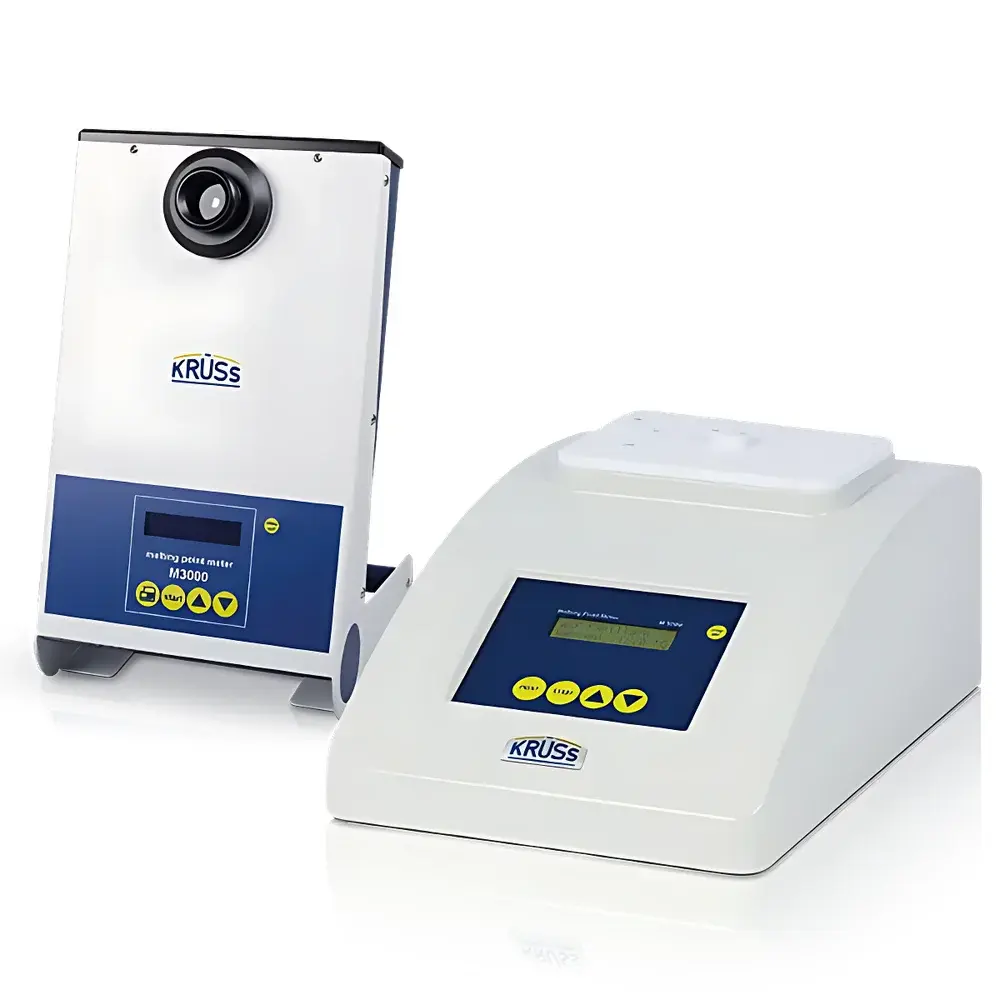
KRUESS M3000 & M5000 Digital Melting Point Apparatus
| Brand | KRUESS |
|---|---|
| Origin | Germany |
| Model | M3000 & M5000 |
| Temperature Range | 25–400 °C |
| Heating Rate | 4 min to 300 °C, 7.5 min to 400 °C |
| Temperature Repeatability | ±0.2 °C |
| Temperature Accuracy | ±0.3 °C (25–200 °C), ±0.5 °C (200–400 °C) |
| Capillary Dimensions | 1.4 mm OD |
| Sample Capacity | 1 capillary per measurement |
| Temperature Resolution | 0.1 °C |
| Optical Magnification | 10× |
| Cooling | Integrated fan-assisted rapid cooling |
| Display | Backlit LCD with real-time temperature and status |
| Interface | RS-232 |
| Power Supply | 90–264 V AC, 40 W |
| Ingress Protection | IP20 |
| Weight | 2.3 kg |
Overview
The KRUESS M3000 and M5000 Digital Melting Point Apparatus are precision thermal analysis instruments engineered for reliable, operator-independent determination of melting point, melting range, and decomposition onset in crystalline organic solids. Based on the classical capillary tube method standardized in pharmacopoeial and industrial quality control protocols—including USP <741>, EP 2.2.17, and ISO 11357-3—the instruments utilize calibrated Peltier-based heating blocks and high-stability platinum resistance thermometers (PT100) to deliver traceable temperature control across a broad operational range (25–400 °C). The M3000 serves as a compact, entry-level platform optimized for routine QC laboratories requiring robustness and regulatory compliance at minimal footprint; the M5000 extends functionality with enhanced thermal uniformity, faster ramp stabilization, and integrated RS-232 connectivity for automated data logging and instrument control within validated environments.
Key Features
- Digital PID temperature regulation with 0.1 °C resolution and real-time feedback loop ensuring stable thermal profiles during both heating and isothermal hold phases
- Optical observation system featuring a 10× illuminated magnifier with adjustable focus, enabling precise visual detection of meniscus formation, collapse, and complete liquefaction
- Integrated forced-air cooling module reducing cooldown time from 400 °C to 50 °C in under 8 minutes—critical for high-throughput sample screening
- Sealed membrane keypad resistant to solvent exposure and routine laboratory cleaning agents, supporting GLP-compliant hygiene practices
- Bilingual operation interface (English/German) with clear error messaging and intuitive navigation—no software installation required
- Compliance-ready design: meets IEC 61010-1 safety standards; supports audit trails when paired with KRUESS KSP1D thermal printer (M5000 variant)
Sample Compatibility & Compliance
The apparatus accepts standard thin-walled glass capillaries (1.4 mm outer diameter, 80 mm length), compatible with widely adopted preparation protocols per USP and Ph. Eur. guidelines. Sample mass is optimized at 1–3 mg, minimizing superheating artifacts and ensuring representative thermal behavior. Both models are routinely employed in pharmaceutical raw material release testing, polymer purity verification, and forensic substance identification. Temperature accuracy and repeatability meet or exceed requirements for GMP Annex 11 and FDA 21 CFR Part 11 compliant workflows when used with documented calibration certificates (traceable to DKD/DAkkS-accredited standards) and controlled environmental conditions (±2 °C, <60% RH).
Software & Data Management
While the M3000 operates as a standalone unit with local display and manual data recording, the M5000 includes an RS-232 serial interface enabling bidirectional communication with external PCs. When connected to KRUESS’ optional KSP1D thermal printer, users generate permanent, timestamped hardcopy reports containing start/end temperatures, observed phase transitions, operator ID, and instrument serial number—satisfying ALCOA+ data integrity principles. For integration into LIMS or ELN systems, ASCII-formatted output can be parsed via standard terminal emulation (e.g., Tera Term) or custom scripts, supporting electronic record retention without proprietary drivers.
Applications
- Pharmaceutical quality control: identity confirmation and purity assessment of APIs and excipients per ICH Q5C and Q6A
- Chemical manufacturing: batch-to-batch consistency verification of intermediates and final products
- Polymer science: characterization of crystallinity, thermal stability, and degradation thresholds in thermoplastics and copolymers
- Academic research: teaching labs for foundational thermal analysis methodology and method validation exercises
- Regulatory submissions: generation of compliant melting point data for dossiers submitted to EMA, PMDA, or Health Canada
FAQ
What capillary dimensions are supported?
Standard capillaries with 1.4 mm outer diameter and 80 mm length are recommended. Alternative diameters (e.g., 0.8 mm) may be used but require revalidation of thermal response characteristics.
Is calibration traceable to national standards?
Yes—KRUESS provides optional DKD/DAkkS-accredited calibration certificates covering the full 25–400 °C range, including uncertainty budgets per ISO/IEC 17025.
Can the instrument be used for decomposition point determination?
Yes, provided visual observation confirms color change, gas evolution, or charring concurrent with endothermic events—though DSC remains the preferred technique for quantitative decomposition thermodynamics.
Does the M3000 support data export?
No—data must be manually recorded. For electronic data capture, the M5000 with RS-232 and KSP1D printer is required.
What maintenance is required?
Annual verification of temperature sensor drift and optical alignment is recommended. No consumables other than capillaries and standard lab solvents are needed.



