
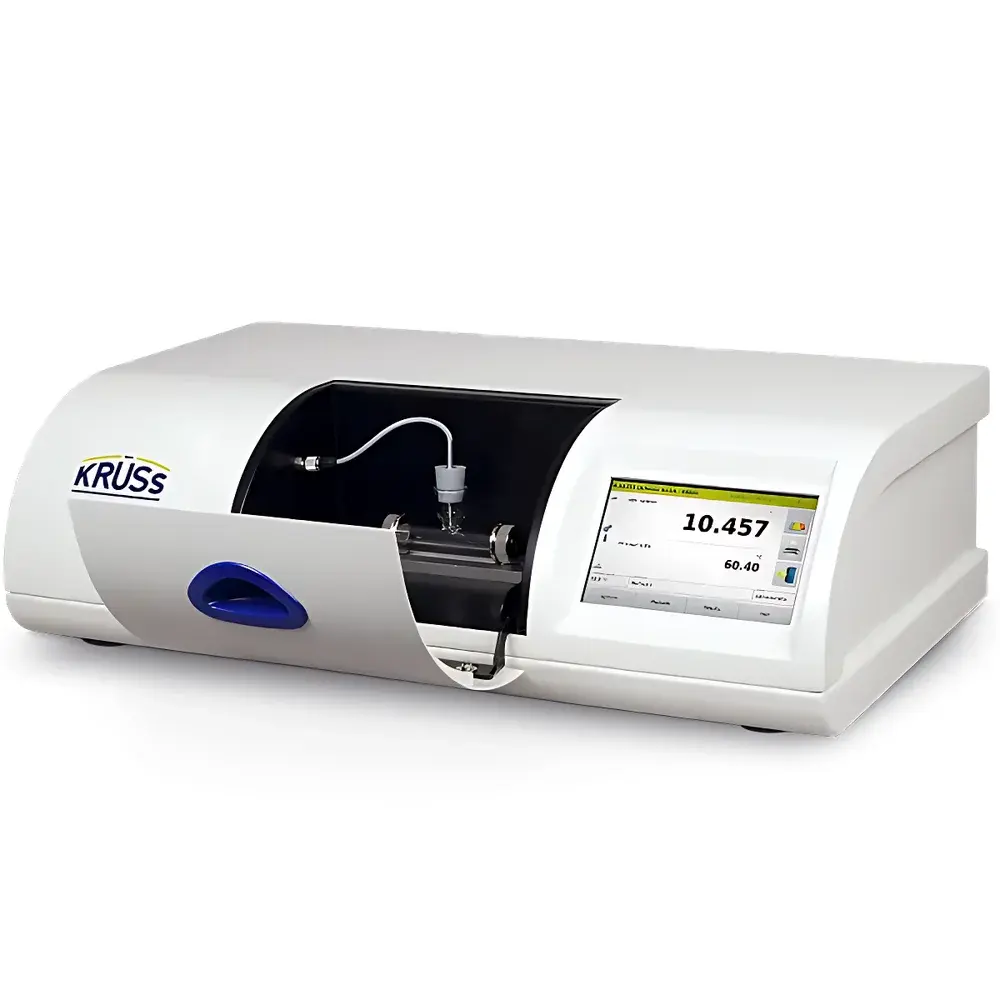
KRUESS PS8000 Automatic Polarimeter
| Brand | KRUESS |
|---|---|
| Origin | Germany |
| Model | PS8000 |
| Product Type | Automatic Polarimeter |
| Temperature Control | Yes (Peltier, -15–40.0 °C, ±0.2 °C accuracy) |
| Display | 5.7″ TFT LCD (320 × 240 px), touchscreen interface |
| Light Source | LED (589 nm sodium D-line, optional alternate wavelengths) |
| Measurement Range | ±259 °Z |
| Resolution | 0.01 °Z |
| Accuracy & Precision | ±0.01 °Z |
| Repeatability | 0.02 °Z |
| Measurement Time (±90°) | 1 s |
| Optical Density Capability | Up to 3.0 OD |
| Sample Cell Length | 220 mm |
| Temperature Sensor Support | PT100 (optional) |
| Data Storage | 999 measurements |
| Interfaces | RS-232, USB, Ethernet |
| Power Supply | 90–250 V, 50/60 Hz |
| Dimensions (W×D×H) | 64.5 × 20.0 × 36.0 cm |
| Weight | 28 kg |
| Compliance | Meets ICUMSA, ISO 21500, and AOAC Official Methods for sugar analysis |
Overview
The KRUESS PS8000 Automatic Polarimeter is a precision optical instrument engineered for high-throughput, traceable polarimetric analysis in regulated industrial environments. It operates on the fundamental principle of optical rotation—measuring the angular displacement of plane-polarized light as it passes through optically active substances—using a stable, narrow-band LED source centered at 589 nm (sodium D-line), with optional wavelength selection for method flexibility. Designed specifically for compliance-critical applications in sugar refining, pharmaceutical manufacturing, and fine chemical synthesis, the PS8000 delivers metrologically sound results traceable to international sugar standards (ICUMSA Method GS2/3-13, ISO 21500). Its robust architecture integrates Peltier-based temperature control (–15 to +40.0 °C, ±0.2 °C stability), enabling strict thermal management essential for reproducible specific rotation determination per USP , EP 2.2.7, and pharmacopoeial guidelines.
Key Features
- High-intensity LED light source with 589 nm nominal output and optional alternate wavelengths—ensures consistent photometric performance and eliminates lamp aging drift common in sodium-vapor sources.
- Peltier-driven thermostatic system with integrated PT100 sensor support—enables precise, rapid thermal equilibration across the full operational range (–15 to +40.0 °C), critical for temperature-dependent rotation measurements per ASTM E1255 and ISO 11281.
- Sub-second measurement cycle (≤1 s for ±90° rotation), optimized for inline or batch QC workflows in sugar production lines and API synthesis monitoring.
- Optical density tolerance up to 3.0 OD—accommodates highly colored or turbid samples (e.g., molasses, caramelized syrups, crude fermentation broths) without signal saturation or manual dilution.
- Touchscreen-driven user interface with 5.7″ TFT display (320 × 240 px)—supports intuitive menu navigation, real-time parameter verification, and on-device calibration validation.
- Comprehensive connectivity suite (RS-232, USB, Ethernet)—facilitates seamless integration into LIMS, MES, and automated lab data systems with configurable ASCII or CSV export protocols.
Sample Compatibility & Compliance
The PS8000 accepts standard 220 mm pathlength cells compatible with industry-standard sugar cuvettes (e.g., 100 mm, 200 mm also supported via adapter kits). Its measurement scale is calibrated in degrees Z (°Z), directly aligned with ICUMSA-defined sucrose concentration units (g/100 mL), and convertible to degrees optical rotation (°) or specific rotation [α] using built-in calculation modules. The instrument supports dual-concentration reference modes (26 g/100 mL, 13 g/100 mL, and 6.5 g/100 mL), allowing direct reporting against multiple process specifications without post-acquisition conversion. All firmware and calibration routines comply with GLP/GMP data integrity requirements—including audit-trail enabled calibration logging, user-access controls, and electronic signature readiness per FDA 21 CFR Part 11 when deployed with validated software extensions.
Software & Data Management
Data acquisition, storage, and reporting are managed via embedded firmware supporting 999 internal measurement records with timestamp, temperature, operator ID, and cell identification metadata. Export functions generate time-stamped, machine-readable files suitable for statistical process control (SPC) platforms. Optional PC-based KRUESS PolarSoft™ (v4.x) extends functionality with advanced features: multi-method sequence programming, trend analysis with control charting (X-bar/R), automated report generation compliant with ISO/IEC 17025 documentation templates, and secure database archiving with role-based access. All software modules undergo periodic verification per ICH Q2(R2) analytical method validation principles.
Applications
- Sugar Industry: Real-time QC of raw juice, syrup, and refined sucrose; determination of invert sugar (glucose + fructose) content via hydrolysis-coupled polarimetry; intermediate monitoring during carbonatation and crystallization.
- Pharmaceuticals: Enantiomeric excess (ee) assessment of chiral APIs; concentration verification of optically active excipients (e.g., L-arginine, D-mannitol); in-process monitoring of asymmetric hydrogenation or enzymatic resolution steps.
- Chemical Manufacturing: Quantitative analysis of chiral intermediates; detection of racemization during storage or thermal processing; validation of stereochemical integrity following purification or derivatization.
- Food & Beverage: Authenticity testing of honey and fruit juices; quantification of added sugars in functional beverages; shelf-life studies tracking optical activity changes in probiotic formulations.
FAQ
Does the PS8000 meet ICUMSA and AOAC sugar analysis requirements?
Yes—the instrument’s optical design, calibration protocol, and °Z reporting mode are fully aligned with ICUMSA Method GS2/3-13 and AOAC Official Method 951.02 for sucrose determination.
Can temperature-controlled measurements be performed without external water baths?
Yes—the integrated Peltier module provides self-contained, programmable thermostating from –15 to +40.0 °C with ±0.2 °C stability, eliminating dependency on auxiliary chillers or circulators.
Is the LED light source replaceable by the user?
No—the LED assembly is factory-aligned and sealed; replacement requires authorized service calibration to maintain photometric traceability and angular accuracy.
What sample handling options are available for continuous operation?
The PS8000 supports optional peristaltic flow cells and soft-tube sample delivery interfaces, enabling unattended batch analysis or integration with automated sampling manifolds.
How is instrument performance verified between calibrations?
Built-in verification uses certified quartz control plates (NIST-traceable) and sucrose reference standards; automated self-check routines validate zero-point stability, sensitivity, and temperature correlation prior to each measurement session.




