
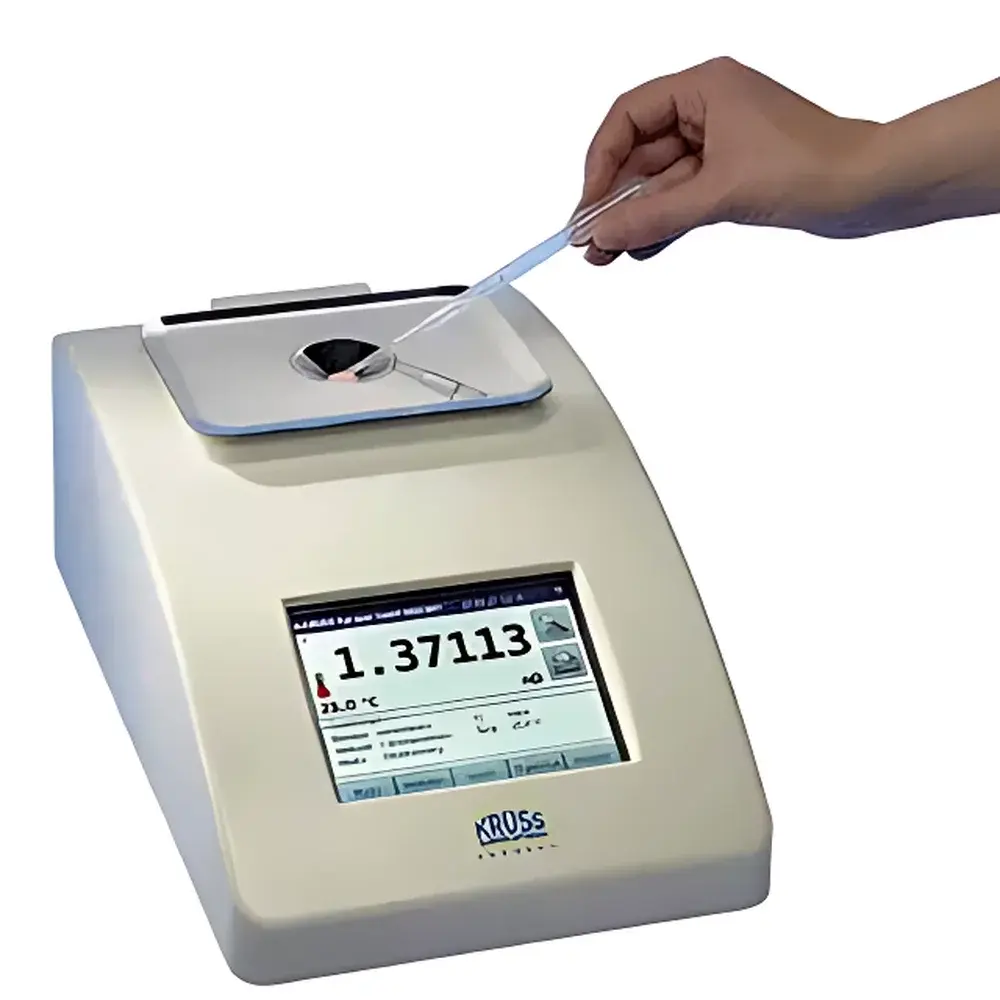
KRUSS DR6000 Series Digital Refractometer
| Brand | KRUSS |
|---|---|
| Origin | Germany |
| Model | DR6000 |
| Type | Benchtop Refractometer |
| Temperature Control | Peltier-based, 5–90 °C (adjustable to ±0.1 °C) |
| Display | 5.7″ TFT touchscreen (320 × 240 px) |
| Measurement Range | 1.3200–1.7000 nD |
| Brix Range | 0–95 % |
| Refractive Index Accuracy | ±0.0001 nD |
| Brix Accuracy | ±0.1 % |
| Refractive Index Resolution | 0.0001 nD |
| Brix Resolution | 0.1 % |
| Prism Material | Sapphire |
| Light Source | LED @ 590 nm (Lifespan >100,000 h) |
| Sample Chamber | Stainless steel |
| IP Rating | IP65 (sample compartment) |
| Interfaces | RS-232, USB, Ethernet |
| Data Storage | Embedded SQL database (99 user-defined methods, 999 measurement records) |
| Compliance | GLP, FDA 21 CFR Part 11 (with optional user management), ICUMSA-compliant temperature compensation |
Overview
The KRUSS DR6000 Series Digital Refractometer is a precision benchtop instrument engineered for high-accuracy, temperature-controlled refractive index and %Brix measurements across industrial quality control and R&D laboratories. Based on the fundamental principle of total internal reflection at the prism-sample interface, the DR6000 employs a monochromatic 590 nm LED light source and sapphire prism to determine the critical angle of refraction—converted in real time to refractive index (nD) and concentration units (e.g., %Brix, % glucose, % fructose). Unlike traditional Abbe refractometers or analog instruments, the DR6000 eliminates operator subjectivity through automated optical detection and digital signal processing. Its integrated Peltier thermoelectric module enables rapid, stable temperature regulation from 5 °C to 90 °C with ±0.1 °C setpoint accuracy and ≤0.05 °C short-term stability—critical for compliance with ISO 21745, ASTM D1218, and ICUMSA Method GS4/3-12. The system supports both single-point and multi-point temperature compensation, including user-defined three-point ICUMSA curves for sugar industry applications.
Key Features
- High-resolution sapphire prism with chemical resistance and scratch durability—ensuring long-term optical integrity and minimal drift
- Embedded Peltier temperature control (standard on T- and FT-models) enabling precise thermal equilibration without external water baths or manual calibration loops
- 5.7-inch capacitive touchscreen interface with intuitive icon-driven navigation—no keyboard or external PC required for routine operation
- Integrated SQL database storing up to 99 user-defined measurement methods and 999 full traceable records—including timestamp, operator ID, sample ID, temperature, and raw nD/Brix values
- RS-232, USB, and Ethernet connectivity supporting direct printing, data export to CSV/XLS via USB flash drive, and remote diagnostics via secure network access
- IP65-rated stainless-steel sample chamber compliant with wet-process environments in food, beverage, and wastewater treatment facilities
- Automated cleaning-free sequential measurement: residual film removal is unnecessary between samples due to optimized prism surface geometry and LED illumination uniformity
Sample Compatibility & Compliance
The DR6000 accommodates a broad range of liquid and semi-liquid samples—including turbid suspensions, colored syrups, viscous polymer solutions, and aggressive solvents—without requiring filtration or dilution. Its optical design is insensitive to light scattering or absorption, making it suitable for opaque fruit pulps, dye solutions, and emulsified coolants. All models meet GLP requirements for audit-ready documentation, and optional user access control (administrator/operator/guest roles) ensures adherence to FDA 21 CFR Part 11 when enabled. Calibration is supported by four factory-traceable reference points (distilled water, sucrose standards, glycerol, and ethylene glycol), plus one user-definable point for proprietary matrices. Temperature compensation follows ICUMSA, AOAC, and USP conventions, with configurable interpolation algorithms for non-linear concentration–temperature relationships.
Software & Data Management
Data integrity is enforced through built-in electronic signatures, automatic audit trails, and immutable record timestamps—all stored within the onboard SQL database. Export workflows support regulatory submission formats: measurement logs can be filtered by date range, operator, method, or result threshold and exported as UTF-8–encoded CSV or Excel-compatible XLS files. Network-enabled models allow centralized configuration management via KRUSS LabControl software (Windows/Linux), enabling firmware updates, method synchronization across multiple instruments, and remote error logging. For integration into LIMS or MES platforms, the DR6000 supports Modbus TCP and ASCII command protocols over Ethernet—eliminating middleware dependencies. Optional PDF report generation includes embedded calibration certificates, uncertainty budgets per GUM (JCGM 100:2008), and graphical trend overlays.
Applications
The DR6000 Series serves as a primary concentration analyzer in regulated manufacturing environments where repeatability, traceability, and environmental robustness are mandatory. In the beverage sector, it verifies sugar content in soft drinks and fruit juices per AOAC 932.12. In pulp and paper mills, it monitors dissolved solids in black liquor and white water circuits. Chemical plants rely on its stability for monitoring glycol concentrations in heat transfer fluids and acid strength in pickling baths. Food processors use it for inline QC of jams, sauces, and dairy concentrates—especially where color interference invalidates spectrophotometric alternatives. Additional validated use cases include: coolant concentration in metalworking lines (ASTM D1120), ethanol–water blends in distilleries, brine density in desalination pre-treatment, and polymerization degree assessment in synthetic resin synthesis.
FAQ
Does the DR6000 require daily recalibration?
No—factory calibration remains stable for ≥6 months under normal operating conditions. A single-point verification with distilled water (nD = 1.3330 at 20 °C) is recommended before each shift.
Can the DR6000 measure non-aqueous solvents like acetone or THF?
Yes, provided the sample temperature is maintained within the instrument’s operational range (10–80 °C) and the refractive index falls within 1.3200–1.7000 nD. Sapphire prism compatibility ensures resistance to organic solvent attack.
Is temperature compensation mandatory for %Brix readings?
Yes—%Brix is defined at 20 °C per ICUMSA. The DR6000 applies real-time correction using either built-in polynomial tables or user-loaded three-point ICUMSA curves.
What is the minimum sample volume required?
Only 0.5 mL is needed to fully cover the sapphire prism surface. No flow cell is required for standard operation, though optional high-throughput modules (DR6000-F/FT) support continuous 0.3–3 mL/min flow rates.
How is data security ensured during network transmission?
Ethernet communication uses TLS 1.2 encryption for remote diagnostics and firmware updates. Local USB exports are unencrypted but support password-protected ZIP archives when configured via LabControl software.



