
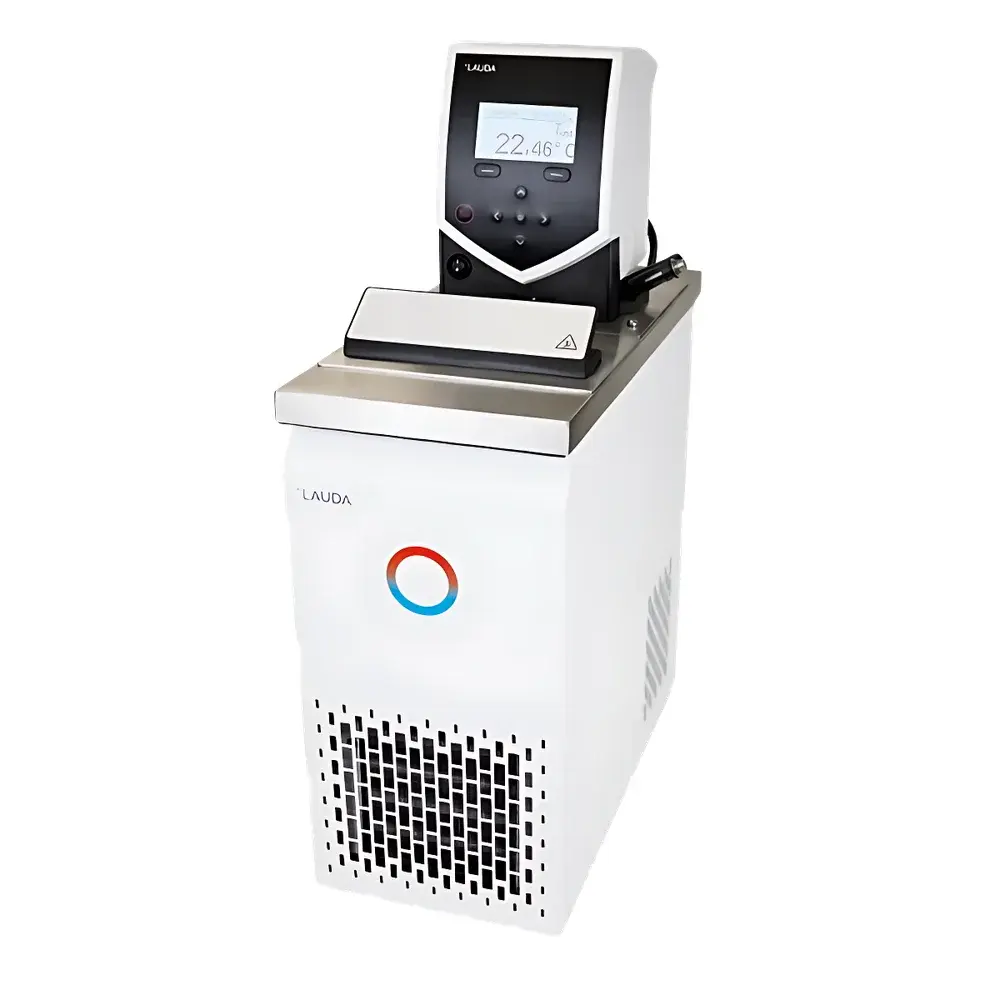
LAUDA ECO RE 420 S Refrigerated Circulating Bath with External Loop
| Brand | LAUDA |
|---|---|
| Origin | Germany |
| Model | RE 420 S |
| Bath Volume | 4.0 L |
| Temperature Range | −20 to 200 °C |
| Temperature Stability | ±0.02 °C |
| Cooling Power | 180–700 W |
| Pump Flow Rate | up to 22 L/min at 0.6 bar |
| Heating Power | 2.0 kW |
| Max. Power Consumption | 2.2 kW |
| Bath Dimensions (W×D×H) | 130 × 105 × 160 mm |
| Unit Dimensions (W×D×H) | 180 × 396 × 555 mm |
| Weight | 22 kg |
| Refrigerant | R-134a (GWP 1430), 0.063 kg |
| Interface | USB standard, optional RS232/485, Ethernet, Profibus, analog/digital I/O modules |
| Controller | PID-based digital controller with programmable ramp/soak profile (1 program, 20 segments) |
| Safety Class | III (suitable for flammable and non-flammable liquids) |
| Display | Monochrome graphic LCD (LAUDA Silver) |
Overview
The LAUDA ECO RE 420 S is a high-precision, refrigerated circulating bath engineered for demanding laboratory applications requiring stable thermal control across an exceptionally wide operating range—from −20 °C to +200 °C. Designed and manufactured in Germany, this unit integrates a compact stainless-steel bath (4.0 L capacity) with a fully sealed, adaptive cooling system and a robust dual-mode (heating/cooling) thermal management architecture. Its core function relies on forced convection via an integrated Vario pump delivering up to 22 L/min at 0.6 bar, enabling precise temperature regulation both within the bath chamber and—via external loop connection—to peripheral equipment such as viscometers, spectrophotometer cells, reactor jackets, or calorimeters. The device employs a microprocessor-based PID controller with real-time feedback, ensuring ±0.02 °C temperature stability under dynamic load conditions. Unlike conventional thermostats, the RE 420 S implements LAUDA’s proprietary SmartCool technology: an intelligent thermal load-matching algorithm that continuously modulates compressor output and fan speed to minimize energy consumption while maintaining setpoint fidelity—even during rapid ramping or prolonged dwell phases.
Key Features
- LAUDA Silver controller with monochrome graphic LCD displaying simultaneous setpoint and actual temperature, plus status indicators for pump, cooling, heating, and alarm states
- Vario pump with six adjustable flow levels—enabling fine-tuned circulation control without physical access to the bath vessel
- Integrated programmable timer with single-sequence capability (1 program, up to 20 ramp/soak segments) for unattended thermal profiling
- Safety Class III certification per DIN EN 61010-1, permitting safe operation with flammable solvents including ethanol, acetone, and xylene
- Dual-port external loop interface (13 mm push-fit connectors included) supporting both supply and return lines with minimal dead volume
- Front-access drain valve and rear-mounted fluid outlet for rapid, spill-free heat-transfer fluid replacement
- USB port standard; expandable via optional interface modules (RS232/485, Ethernet, Profibus DP, analog 0–10 V / 4–20 mA, digital I/O, Pt100/LiBus for remote master-slave integration)
- Stainless-steel bath with 130 × 105 mm opening and 140 mm usable depth—optimized for compatibility with standard immersion probes and jacketed glassware
- Energy-efficient design featuring low-GWP refrigerant R-134a (0.063 kg charge) and air-cooled condenser with optimized fin geometry
- Tmax overtemperature protection with user-configurable limit and audible/visual alarm escalation
Sample Compatibility & Compliance
The RE 420 S supports a broad spectrum of heat-transfer media—including water, water-glycol mixtures, silicone oils, and specialized low-viscosity synthetic fluids—within its validated operational envelope. Its Class III safety rating confirms suitability for use with organic solvents commonly employed in extraction, synthesis, and analytical sample preparation workflows. From a regulatory standpoint, the unit complies with key international standards including DIN EN 61010-1 (safety requirements for electrical equipment), EMC Directive 2014/30/EU, and RoHS 2011/65/EU. While not inherently 21 CFR Part 11 compliant, the optional Ethernet and RS485 modules enable integration into validated environments when paired with audit-trail-capable SCADA or LIMS platforms. All firmware revisions undergo traceable version control, and calibration data (including sensor offset verification) can be exported via USB for GLP/GMP documentation.
Software & Data Management
The embedded controller stores all operational parameters—including temperature logs, pump status, error codes, and program execution history—in non-volatile memory. Raw data export is supported via USB mass storage mode (no proprietary software required), generating timestamped CSV files compatible with Excel, MATLAB, or statistical process control (SPC) tools. Optional communication modules allow bidirectional command-and-control using ASCII-based protocols (e.g., “TEMP?” to query current value; “SET 37.5” to update setpoint). When connected to a network-enabled host system, the RE 420 S supports Modbus TCP mapping for seamless integration into industrial automation frameworks. Firmware updates are delivered via signed binary files distributed through LAUDA’s secure customer portal—ensuring integrity and version traceability.
Applications
- Calibration of thermocouples, RTDs, and infrared sensors against NIST-traceable references
- Thermal conditioning of optical components in spectroscopy and interferometry setups
- Viscosity measurement support for rotational rheometers and capillary viscometers requiring precise bath-jacket temperature control
- Stability testing of pharmaceutical formulations per ICH Q1A(R2) guidelines (e.g., 25 °C/60% RH accelerated studies using external humidity chambers coupled via coolant loops)
- Reaction calorimetry where exothermic profiles must be compensated by active heat removal
- Material testing of polymers and composites under controlled thermal cycling (−20 °C ↔ 150 °C)
- Environmental simulation for electronics reliability screening (e.g., thermal shock pre-conditioning)
FAQ
What is the minimum and maximum recommended fill volume for the bath?
The stainless-steel bath operates optimally between 3.3 L (minimum) and 4.0 L (maximum) of heat-transfer fluid. Underfilling risks dry-run damage to the heater and inaccurate temperature sensing; overfilling may impede circulation and compromise stability.
Can the RE 420 S maintain 200 °C while actively cooling?
No. At elevated temperatures (>100 °C), the refrigeration circuit is automatically disabled for safety and component longevity. Cooling functionality is active only below ~90 °C, depending on ambient conditions and load.
Is external temperature feedback supported?
Yes—via optional Pt100/LiBus module, enabling cascade control where the unit regulates bath temperature based on a remote probe placed inside a reactor or test chamber.
How often does the refrigerant require servicing?
Under normal operation and proper maintenance (e.g., avoiding contamination, periodic condenser cleaning), the sealed R-134a system requires no scheduled refrigerant replenishment over its service life.
Does the unit meet ISO/IEC 17025 requirements for accredited labs?
While the hardware itself is not certified, its metrological performance (±0.02 °C stability, traceable calibration options, and data logging capabilities) supports compliance when incorporated into a lab’s documented uncertainty budget and equipment qualification protocol.



