
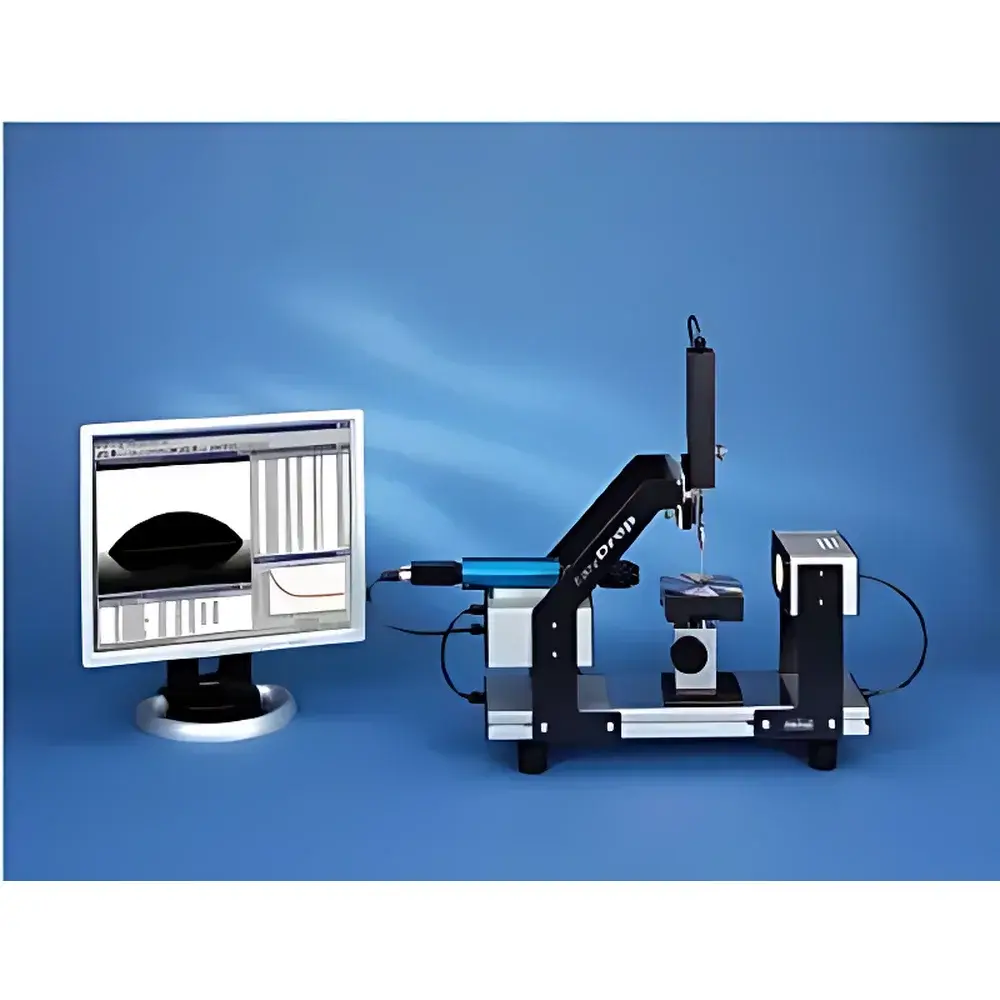
Krüss DSA20 Standard Contact Angle Analyzer
| Origin | Germany |
|---|---|
| Manufacturer Type | Authorized Distributor |
| Origin Category | Imported Instrument |
| Model | DSA20 |
| Pricing | Available Upon Request |
Overview
The Krüss DSA20 Standard Contact Angle Analyzer is a precision-engineered optical tensiometer designed for quantitative characterization of solid–liquid interfacial interactions. Based on the sessile drop method—complemented by pendant drop and tilting plate techniques—the system delivers high-reproducibility contact angle measurements across the full angular range (1°–180°), enabling rigorous assessment of wettability, surface heterogeneity, and dynamic interfacial behavior. Its modular architecture integrates a high-stability mechanical frame, temperature-controllable sample stage, and optimized optical path to ensure consistent image acquisition under variable environmental conditions. The instrument adheres to core principles outlined in ISO 19403-2 (contact angle measurement), ASTM D7334 (surface energy of solid surfaces), and ISO 14782 (determination of contact angle), supporting traceable, audit-ready data generation for R&D, quality control, and regulatory submissions.
Key Features
- Optical subsystem featuring a continuously variable 6× zoom lens with parfocal alignment, delivering uniform resolution across magnification ranges without refocusing.
- High-speed scientific CCD camera capturing up to 311 frames per second at 752 × 580 pixel resolution, enabling precise temporal tracking of advancing/receding contact angles during dynamic wetting experiments.
- Motorized, software-controlled dosing system with sub-microliter dispensing accuracy; compatible with both automated sequential deposition and manual micro-syringe operation.
- Manually adjustable XYZ sample stage (travel range: X ±25 mm, Y ±25 mm, Z ±15 mm) accommodating samples up to 300 × 220 × 50 mm (L × W × H), with optional thermal enclosures for isothermal or gradient temperature studies (−10 °C to +120 °C).
- Dedicated illumination module using stabilized halogen light source with diffused coaxial optics to minimize glare and shadow artifacts on reflective or textured surfaces.
- Compact footprint (500 × 160 × 290 mm) engineered for integration into fume hoods, gloveboxes, or space-constrained analytical laboratories.
Sample Compatibility & Compliance
The DSA20 supports heterogeneous sample geometries—including films, fibers, powders (via compressed pellets), porous membranes, and coated substrates—without requiring vacuum or conductive coating. Surface roughness, chemical anisotropy, and topographical defects are accommodated via adaptive baseline detection algorithms within the evaluation software. All measurement workflows comply with GLP documentation standards, including electronic signature support, user access control, and audit trail logging per FDA 21 CFR Part 11 requirements. Optional calibration verification kits (certified glass standards with nominal contact angles of 30°, 60°, and 110°) facilitate routine performance qualification in accordance with ISO/IEC 17025 laboratory accreditation protocols.
Software & Data Management
Krüss ADVANCE software provides unified control of hardware modules and advanced image analysis routines. It implements Young–Laplace fitting for pendant drop surface tension calculation (0.01–2000 mN/m, resolution 0.01 mN/m), polynomial and ellipse-based contour fitting for sessile drops, and real-time contact angle hysteresis quantification. Data export conforms to ASTM E1447-compliant CSV and PDF report formats, with embedded metadata (timestamp, operator ID, instrument serial number, environmental log). Batch processing mode enables unattended multi-sample analysis, while scripting interfaces (Python API) allow integration into automated QA/QC pipelines or LIMS environments.
Applications
- Surface treatment validation (plasma, corona, flame, silanization) in automotive, medical device, and packaging manufacturing.
- Quality assurance of hydrophobic/hydrophilic coatings on optical lenses, surgical implants, and filtration media.
- Formulation development of agrochemicals, inks, and adhesives where substrate wettability dictates film uniformity and adhesion strength.
- Characterization of biomaterials (e.g., tissue scaffolds, dental composites) under physiological temperature and humidity conditions.
- Fundamental research in colloid and interface science, including surfactant adsorption kinetics and contact line pinning dynamics.
FAQ
What is the minimum droplet volume resolvable by the DSA20?
The system reliably analyzes droplets as small as 0.1 µL using the motorized dosing unit; manual syringe operation allows further reduction depending on needle gauge and operator skill.
Can the DSA20 measure advancing and receding contact angles automatically?
Yes—via programmable liquid addition/removal cycles synchronized with high-speed imaging, enabling contact angle hysteresis analysis without manual intervention.
Is temperature control integrated or optional?
A thermostatic sample stage is standard; Peltier-based or fluid-circulated temperature control modules are available as factory-installed options.
Does the software support GMP-compliant data integrity practices?
ADVANCE v3.5+ includes full 21 CFR Part 11 compliance features: role-based permissions, electronic signatures, immutable audit trails, and secure data archiving.
How is calibration verified on-site?
Users perform periodic verification using Krüss-certified reference slides traceable to NIST standards; calibration reports include uncertainty budgets aligned with ISO/IEC 17025 Annex A.3.



