
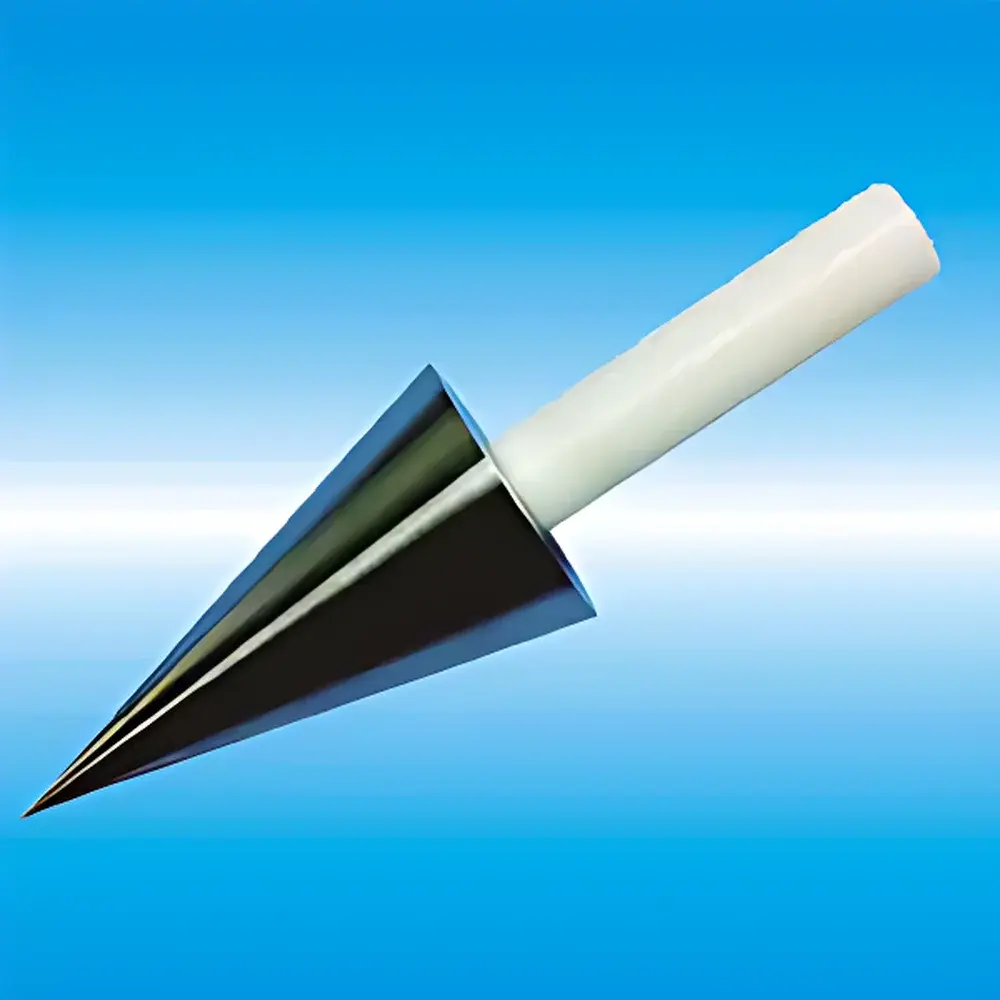
KS-A17 Conical Probe for Non-Destructive Material Integrity Assessment
| Brand | Insment (Shanghai) |
|---|---|
| Origin | Shanghai, China |
| Model | KS-A17 |
| Manufacturer Type | Authorized Distributor & ODM Partner |
| Compliance Context | Designed to Support UL 1278–Compliant Fire Resistance Testing Protocols |
| Application Domain | Structural Integrity Verification in Flame-Retardant Material Evaluation |
Overview
The KS-A17 Conical Probe is a precision-engineered mechanical contact sensor designed for non-destructive assessment of surface integrity, penetration resistance, and thermal barrier consistency in flame-retardant polymeric materials, composites, and insulating substrates. Unlike optical or ultrasonic NDT methods, the KS-A17 operates on a controlled quasi-static indentation principle: its standardized conical geometry (included angle 60°, tip radius ≤ 0.1 mm) applies calibrated axial force while monitoring displacement response—enabling quantitative correlation with char layer cohesion, intumescent expansion stability, and substrate adhesion under pre-ignition thermal stress. It is not a standalone instrument but an integral probe module engineered for integration into UL 1278-compliant vertical burn test fixtures (e.g., ASTM D3801, IEC 60695-11-10), where it performs real-time mechanical interrogation before, during, and immediately after flame exposure. Its design adheres to dimensional traceability requirements specified in UL’s internal probe calibration guidelines for fire performance validation systems.
Key Features
- Stainless steel 316L probe body with hardened tungsten carbide tip—optimized for wear resistance against abrasive char residues and repeated thermal cycling (−10 °C to +250 °C operational range)
- Conical geometry conforming to UL 1278 Annex B dimensional tolerances: apex angle 60.0° ± 0.5°, tip radius 0.08–0.12 mm, total length 42.0 ± 0.2 mm
- Threaded M4 × 0.7 mounting interface compatible with standard load-cell adapters used in UL-compliant burn test rigs
- No embedded electronics—designed for passive coupling with external force-displacement transducers (e.g., 0–50 N load cells, 0.1 µm resolution LVDTs)
- CE-marked mechanical components; RoHS 3 compliant material declaration available upon request
Sample Compatibility & Compliance
The KS-A17 is validated for use with rigid and semi-rigid specimens per UL 1278 Section 5.1: thickness 1.6 mm to 13 mm, width ≥ 12.7 mm, length ≥ 127 mm. It supports evaluation of thermosets (epoxy, phenolic), halogen-free flame-retardant polyolefins, silicone elastomers, and mineral-filled PVC compounds. While the probe itself carries no regulatory certification, its dimensional and material specifications are aligned with the mechanical interface requirements referenced in UL 1278 (2023 Edition), ASTM D635 (Standard Test Method for Rate of Burning and/or Extent and Time of Burning of Self-Supporting Plastics), and IEC 60695-11-10 (Fire hazard testing — Test flames — 50 W horizontal and vertical flame test). It is routinely deployed in laboratories operating under ISO/IEC 17025:2017 accreditation scopes covering flammability testing.
Software & Data Management
As a purely mechanical probe, the KS-A17 does not include firmware or embedded software. However, it is interoperable with industry-standard data acquisition platforms including National Instruments LabVIEW-based custom test sequences, Keysight PathWave, and MATLAB-driven real-time force–displacement logging systems. When integrated into UL 1278-compliant test stations, probe output data (force vs. depth) is typically time-stamped and synchronized with thermocouple readings, flame duration triggers, and camera capture events. Full audit trails—including probe calibration history, operator ID, and environmental chamber conditions—are maintained in accordance with GLP principles and FDA 21 CFR Part 11–compliant electronic record systems used by accredited third-party labs (e.g., UL, TÜV Rheinland).
Applications
- Quantifying char layer mechanical stability during UL 1278 vertical burn sequence (pre-flame baseline, mid-burn deformation, post-extinguishment recovery)
- Differentiating between cohesive failure (cracking within char) and adhesive failure (delamination at substrate interface) in intumescent coatings
- Correlating probe penetration depth with limiting oxygen index (LOI) values across halogenated vs. phosphorus-based FR formulations
- Supporting root cause analysis in failure investigations involving premature drip, flaming droplet formation, or backside ignition
- Validating batch-to-batch consistency of flame-retardant masterbatches in extrusion QC workflows
FAQ
Is the KS-A17 probe certified to UL 1278?
No—the probe is a component-level tool, not a certified test system. UL 1278 certification applies to the complete test apparatus (burner, specimen holder, exhaust hood, instrumentation). The KS-A17 meets dimensional and material specifications referenced in UL 1278 Annex B for optional mechanical probing.
Can it be used outside UL 1278 testing?
Yes—its geometry and material allow adaptation to ASTM D2583 (Barcol hardness), ISO 2039-1 (ball indentation), or custom-developed indentation protocols for fire-safe material R&D—but such use requires independent method validation.
What calibration documentation is provided?
A manufacturer’s dimensional inspection report (per ISO 17025-accredited CMM verification) and material certificate (EN 10204 3.1) are supplied with each probe batch. Field recalibration is performed using NIST-traceable gauge blocks and force standards.
Does Insment provide integration support?
Yes—Insment offers mechanical interface drawings, mounting torque specifications, and compatibility guidance for common load-cell/LVDT OEMs (e.g., HBM, TE Connectivity, MTI Instruments), but does not supply or configure DAQ hardware or software.



