
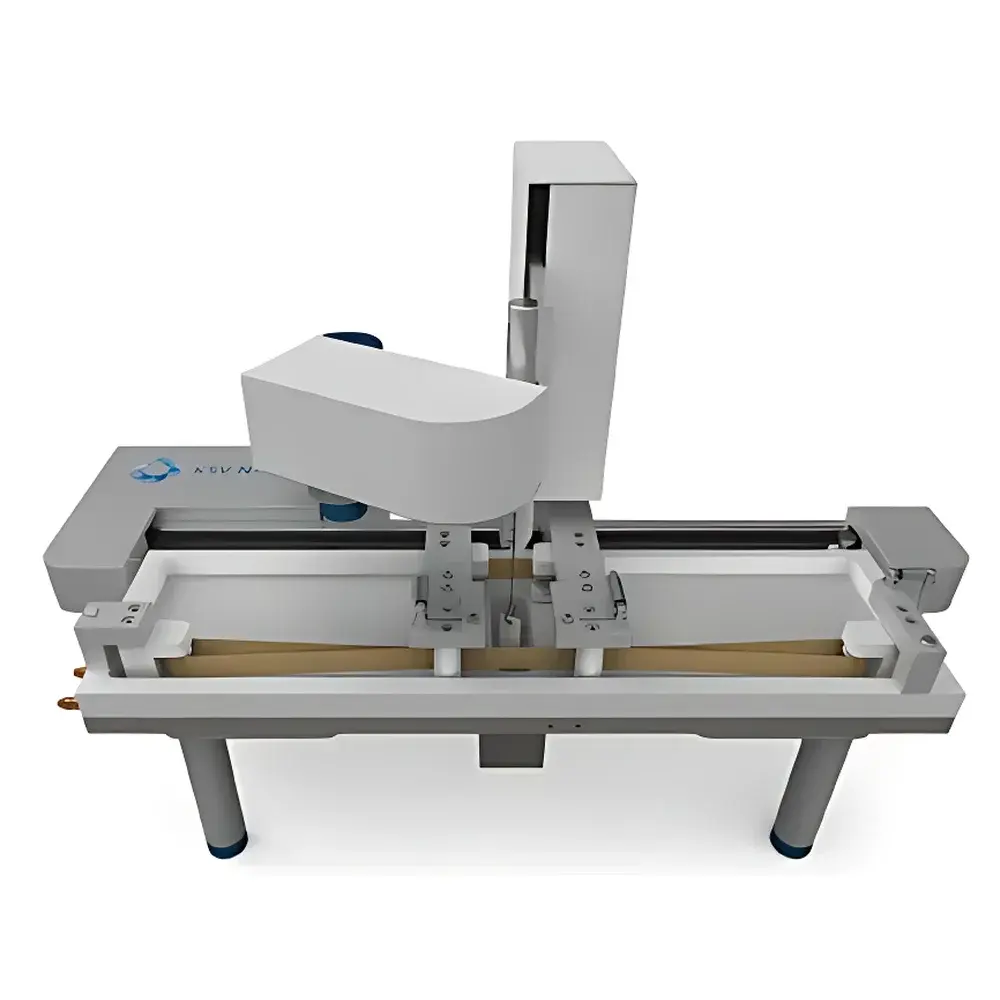
KSV NIMA Ribbon-Type Langmuir-Blodgett Trough Analyzer
| Brand | KSV NIMA |
|---|---|
| Origin | Finland |
| Manufacturer Type | Original Equipment Manufacturer (OEM) |
| Import Category | Imported Instrument |
| Model | Ribbon-Type LB Trough |
| Price Range | USD 1,400 – 2,800 |
Overview
The KSV NIMA Ribbon-Type Langmuir-Blodgett (LB) Trough Analyzer is a precision-engineered surface science instrument designed for the controlled formation, compression, and quantitative characterization of monolayers at air–water or liquid–liquid interfaces. Unlike conventional barrier-driven Langmuir troughs, this system employs a continuous, vertically immersed PTFE ribbon as the compressing element—enabling uniform lateral confinement, minimized edge effects, and significantly enhanced surface pressure stability up to 300 mN/m (with Pt plate) or 1000 mN/m (with Pt rod). The ribbon mechanism eliminates mechanical hysteresis and barrier-induced film disruption, supporting high-fidelity isotherm acquisition, reproducible LB transfer, and reliable in situ coupling with complementary surface-sensitive techniques. Its modular architecture integrates seamlessly into advanced interfacial laboratories focused on biomimetic membranes, functional nanomaterials, responsive surfactants, and molecular self-assembly under thermodynamically controlled conditions.
Key Features
- Ribbon-based compression system: Eliminates sliding-barrier artifacts; ensures symmetric, laminar monolayer compression with sub-micron positional repeatability.
- Modular trough design: Interchangeable PTFE trough bodies (solid-sintered, pore-free) with quick-release mounting; compatible with standard KSV NIMA Langmuir and LB configurations.
- High-resolution surface pressure measurement: Wilhelmy plate sensor (Pt, 19.62 × 10 mm) compliant with EN 14370:2004; resolution 0.1 μN/m; full-scale range 0–300 mN/m (plate) or 0–1000 mN/m (rod).
- Three-axis adjustable microbalance: XYZ positioning (360° rotation, 110 mm X, 45 mm Y/Z), enabling precise alignment with optical axes and substrate immersion paths.
- Integrated subphase thermal control interface: Direct coupling to external recirculating chillers/heaters via aluminum baseplate; supports temperature-regulated studies from 5 °C to 60 °C.
- Dual-mode operation: Independent Langmuir isotherm acquisition and vertical LB deposition (up/down stroke); programmable dipping speed (0.1–108 mm/min), max stroke 80 mm, max substrate size 52 × 63 mm (2-inch format).
- Open-frame ergonomics: Tool-free trough mounting/dismounting; built-in ports for pH probes, stirrers, syringe injectors, and electrical feedthroughs.
Sample Compatibility & Compliance
The system accommodates a broad spectrum of amphiphilic and interfacial-active species—including phospholipids, peptides, polymers, graphene oxide dispersions, metal–organic frameworks (MOFs), quantum dots, and colloidal nanoparticles—on aqueous or non-aqueous subphases. Its PTFE trough construction complies with ISO 14644-1 (cleanroom compatibility) and avoids leachable contaminants common in bonded or adhesive-sealed systems. Surface pressure calibration adheres to ASTM D971 and ISO 6889 standards. For regulated environments (e.g., pharmaceutical QC or GLP-compliant research), optional audit-trail-enabled software modules support 21 CFR Part 11 compliance when paired with validated PC configurations and electronic signature protocols.
Software & Data Management
Control and analysis are performed via KSV NIMA’s proprietary TroughMaster™ software (Windows-based), featuring real-time isotherm plotting, multi-curve overlay, automated compression/expansion cycles, and export to CSV, Excel, and Origin-compatible formats. The platform supports synchronized triggering of external instruments (e.g., PM-IRRAS, BAM, ISR) via TTL/USB I/O. All raw sensor data—including time-stamped surface pressure, barrier position, temperature, and motor status—is logged with metadata tagging (operator ID, sample ID, protocol version). Data integrity is preserved through checksum validation and optional encrypted local storage. Integration with laboratory information management systems (LIMS) is achievable via RESTful API extensions upon request.
Applications
- Biomimetic membrane studies: Quantitative analysis of lipid–protein interactions, peptide insertion kinetics, drug–membrane partitioning, and phase separation in ternary lipid mixtures.
- Functional nanomaterial assembly: Controlled Langmuir deposition of CNTs, graphene derivatives, and perovskite nanosheets for optoelectronic thin films.
- Interfacial reaction monitoring: In situ tracking of surface-initiated polymerization, antigen–antibody binding, enzyme catalysis, and photocatalytic processes at fluid interfaces.
- Colloid and surfactant science: Critical micelle concentration (CMC) determination, mixed monolayer thermodynamics, foam and emulsion stability modeling.
- Mechanical characterization: Combined use with KSV NIMA’s Interface Shear Rheometer (ISR) enables simultaneous surface pressure and interfacial viscoelastic modulus (G′, G″) measurement during compression.
- Hybrid characterization workflows: Direct integration with BAM for real-time domain imaging, PM-IRRAS for molecular orientation mapping, QCM-D for mass/viscoelasticity correlation, and XRR for electron density profiling post-transfer.
FAQ
Can the ribbon-type trough be retrofitted onto existing KSV NIMA Langmuir or LB systems?
Yes. All KSV NIMA Langmuir and LB trough frames accept ribbon-type trough bodies via standardized mounting interfaces; no hardware modification is required.
What subphase volume does the ribbon configuration accommodate?
Total subphase capacity is 387 mL; the active area above the ribbon midline holds 226 mL, ensuring stable hydrostatic conditions during compression.
Is temperature control included or optional?
The system includes threaded ports and thermal coupling surfaces for external recirculating baths; the chiller/heater unit is sold separately.
Which Wilhelmy probe options are certified to international standards?
The standard Pt plate (19.62 × 10 mm) conforms to EN 14370:2004; alternative probes (Pt rod, paper plate, liquid/liquid plate) are available for specialized interfacial systems.
How is level calibration performed?
Precision leveling is achieved via three adjustable stainless-steel leveling feet; removal of feet is possible to accommodate inverted optical setups such as confocal or fluorescence microscopy.



