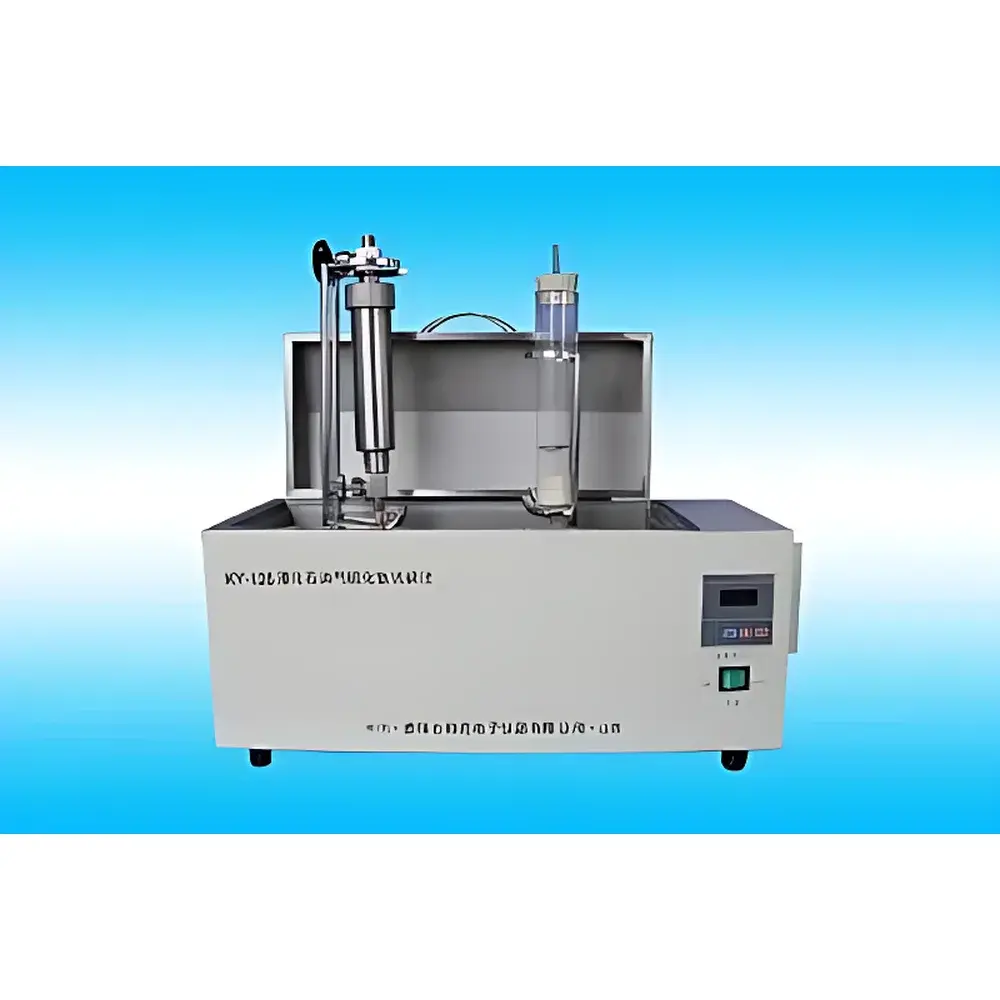
KY-0125 Hydrogen Sulfide Analyzer for Liquefied Petroleum Gas (Lead Acetate Method)
| Brand | Keyuan Instruments |
|---|---|
| Origin | Jiangsu, China |
| Manufacturer Type | Direct Manufacturer |
| Country of Origin | China |
| Model | KY-0125 |
| Price | Upon Request |
| Applicable Standard | ASTM D2420, SH/T 0125 |
| Heating Method | Electric Tubular Heater |
| Temperature Control | Digital PID Controller with PT100 Sensor |
| Flow Regulation | Adjustable Needle Valve with Flowmeter |
| Total Power | 1000 W |
| Power Supply | AC 220 V, 50 Hz |
| Detection Limit | 4 mg/m³ H₂S |
| Interference Profile | Methyl mercaptan causes transient yellow staining on lead acetate paper (<5 min fade) |
Overview
The KY-0125 Hydrogen Sulfide Analyzer for Liquefied Petroleum Gas (LPG) is a dedicated, standardized laboratory instrument engineered for qualitative and semi-quantitative detection of hydrogen sulfide (H₂S) in LPG streams using the lead acetate impregnated test strip method. It operates on the principle of selective chemical colorimetric reaction: gaseous H₂S reacts with lead acetate on a treated paper strip to form insoluble black lead sulfide (PbS), producing a persistent dark discoloration. This method—codified in ASTM D2420 and Chinese petroleum standard SH/T 0125—provides rapid field-deployable verification of H₂S presence at or above 4 mg/m³, meeting refinery, terminal, and custody-transfer quality control requirements where real-time screening precedes confirmatory GC–SCD or UV fluorescence analysis.
Key Features
- Compliant glass reaction chamber designed per ASTM D2420 dimensional and material specifications, featuring an integrated borosilicate glass hook for secure test strip suspension during gas exposure.
- Integrated electric tubular heating bath maintains precise thermal stabilization of LPG sample vaporization—critical for consistent phase transition and reproducible gas-phase delivery to the test zone.
- Digital PID temperature controller with PT100 platinum resistance sensor ensures ±0.5 °C stability across the operational range (typically 40–60 °C), minimizing condensation artifacts and enhancing inter-laboratory repeatability.
- Calibrated needle valve and inline flowmeter enable accurate volumetric flow regulation (typically 100–500 mL/min), ensuring controlled residence time of gas over the test strip and adherence to standard exposure duration protocols.
- Stainless steel 500 mL sampling cylinder included—designed for safe, non-contaminating LPG transfer under pressure; equipped with dual-valve configuration and pressure-rated sealing for Class I, Division 1 environments.
- Robust industrial-grade chassis with grounded AC 220 V / 50 Hz input and 1000 W total system power budget supports continuous operation in QC laboratories compliant with IEC 61000-6-3 EMC standards.
Sample Compatibility & Compliance
The KY-0125 is validated exclusively for liquefied petroleum gas (propane/butane blends) and related hydrocarbon gas matrices meeting ASTM D1835 and GB 11174 specifications. It does not support natural gas, refinery fuel gas, or sour syngas without prior validation. Methyl mercaptan yields a transient yellow stain that fades within five minutes and is explicitly excluded from positive interpretation per ASTM D2420 Section 7.2; all other common LPG sulfur species—including thiophenes, sulfides, and disulfides—exhibit no detectable reaction under standard operating conditions. The instrument conforms to ISO/IEC 17025 general requirements for competence of testing and calibration laboratories when operated within documented SOPs, and its mechanical design aligns with CE machinery directive principles (2006/42/EC) for lab equipment safety.
Software & Data Management
As a benchtop analog endpoint detection system, the KY-0125 operates without embedded firmware or digital data output. All operational parameters—temperature setpoint, flow rate, exposure duration, and visual observation results—are recorded manually in laboratory notebooks or LIMS-integrated electronic batch records. For GLP- and GMP-regulated environments, users implement supplementary documentation controls including: dated operator signatures, instrument calibration logs (temperature sensor verification traceable to NIST-certified references), and periodic reagent lot traceability for lead acetate strips. While no native software is provided, the instrument’s deterministic physical output supports full auditability under FDA 21 CFR Part 11 when paired with compliant electronic record systems.
Applications
- Routine quality assurance screening of inbound LPG cargoes at import terminals prior to unloading and blending.
- Verification of amine treaters’ efficiency in downstream refining units by comparing pre- and post-treatment samples.
- Field-based troubleshooting of odorant carryover or H₂S breakthrough in pipeline distribution networks.
- Educational demonstration of gas-phase colorimetric detection principles in petroleum engineering curricula.
- Supporting ISO 8573-1 compressed air purity classification workflows where LPG-derived instrument air requires H₂S clearance.
FAQ
Does the KY-0125 provide quantitative H₂S concentration values?
No—it delivers presence/absence detection at ≥4 mg/m³ based on fixed-exposure visual assessment per ASTM D2420. Quantification requires complementary methods such as gas chromatography with sulfur chemiluminescence detection (GC–SCD).
Can this analyzer be used for natural gas or biogas?
Not without method validation. Matrix-specific interferences (e.g., CO₂-induced strip degradation, siloxane fouling) are not characterized for non-LPG streams.
How often must the lead acetate test strips be replaced?
Strips are single-use consumables. Shelf life is 12 months unopened (desiccated, 2–8 °C); opened vials require use within 72 hours under ambient dry storage.
Is third-party calibration certification available?
Yes—Keyuan Instruments provides optional factory calibration reports traceable to national metrology institutes for the PT100 sensor and flowmeter, issued with NIST-traceable reference standards.
What maintenance is required for long-term reliability?
Quarterly inspection of heater element continuity, annual replacement of silicone O-rings in the sampling interface, and biannual verification of needle valve linearity using certified gas flow calibrators.