
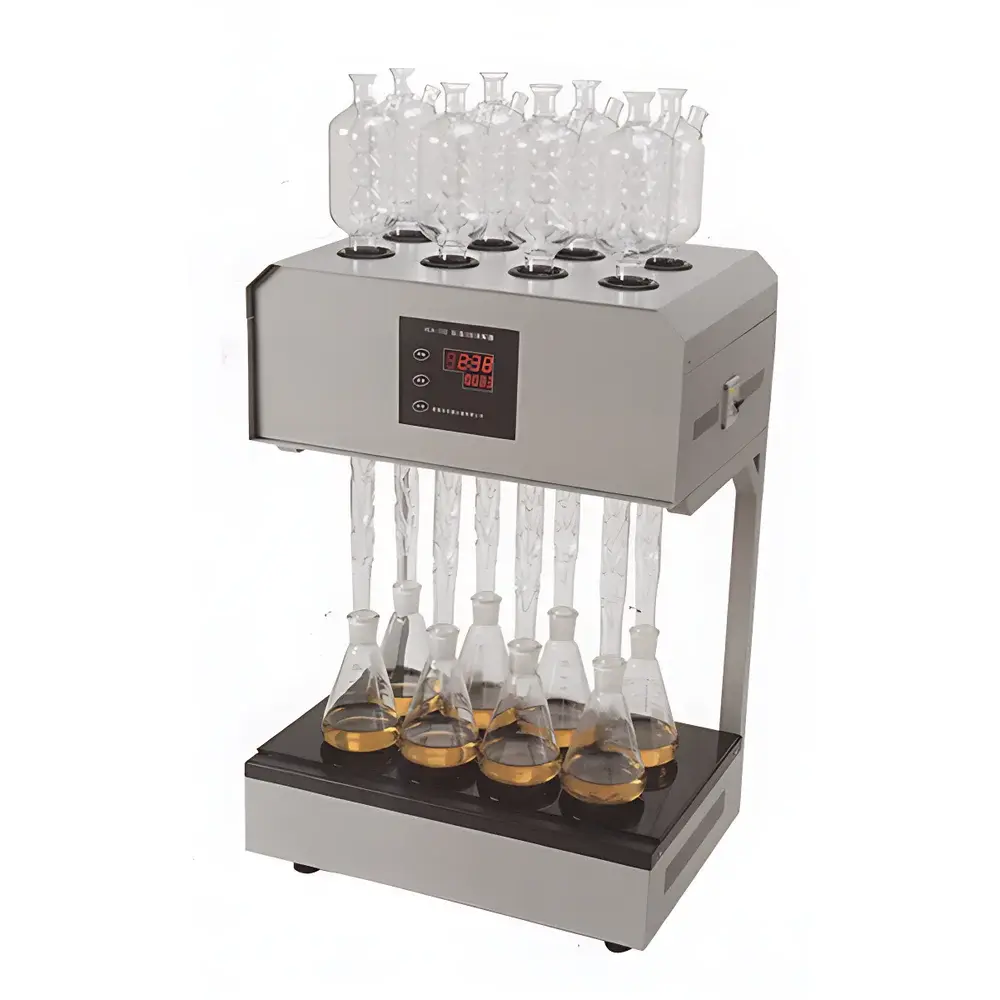
KY-100 Standard COD Digestion System (8-Position)
| Brand | Keyuan Instruments |
|---|---|
| Origin | Jiangsu, China |
| Manufacturer Type | Direct Manufacturer |
| Country of Origin | China |
| Model | KY-100(8) |
| Digestion Method | Reflux Digestion |
| Heating Module | Microcrystalline Glass Plate with Inorganic High-Temperature Insulation |
| Batch Capacity | 8 samples |
| Temperature Range | Ambient to 180 °C |
| Temperature Accuracy | ±1 °C |
| Digestion Vessel | 250 mL conical flask (24/29 standard taper) |
| Timer Accuracy | ±15 s/h |
| Power Supply | AC 220 V, 50 Hz |
| Max. Heating Power | ≤1600 W |
| Ramp Time to 180 °C | <20 min |
| Digestion Time Setting Range | 10 min – 150 min |
| Sample Matrix | Aqueous liquid only |
| COD Measurement Range | 0–700 mg/L (direct) |
| Precision | RSD ≤5.0% for 500 mg/L potassium hydrogen phthalate standard |
| Compliance | HJ 828–2017 (replacing GB 11914–1989) |
Overview
The KY-100 Standard COD Digestion System (8-Position) is a laboratory-grade reflux digestion apparatus engineered for precise, reproducible chemical oxygen demand (COD) determination in aqueous environmental samples per the Chinese national standard HJ 828–2017. This method is fully aligned with the dichromate oxidation principle defined in ISO 6060 and equivalent to EPA Method 410.1, ensuring compatibility with international regulatory frameworks for wastewater and surface water monitoring. The system implements controlled thermal reflux at sustained micro-boiling conditions (typically 150–180 °C) for a user-defined duration (10 min to 150 min), enabling complete oxidation of organic matter by acidic potassium dichromate under catalytic silver sulfate conditions. Unlike conventional water-cooled reflux setups, the KY-100 integrates an air-cooling module with borosilicate glass “spiked” condensers—eliminating reliance on continuous tap water flow while maintaining condensation efficiency and operator safety.
Key Features
- Eight-position digestion platform accommodating standard 250 mL conical flasks with 24/29 ground-glass joints—ensuring secure, leak-resistant reflux assembly per HJ 828–2017 protocol.
- Microcrystalline glass heating plate combined with inorganic high-temperature insulation material—providing uniform thermal distribution, rapid ramp-up (<20 min to 180 °C), and surface resistance to accidental reagent spills.
- Digital microprocessor-based timer with ±15 s/h accuracy and audible end-of-cycle alert—supporting programmable digestion durations from 10 minutes to 150 minutes.
- Air-cooled condensation system using spiked (not spherical) borosilicate glass reflux condensers—enhancing vapor return efficiency and eliminating water consumption and associated infrastructure requirements.
- Thermal stability control delivering ±1 °C temperature accuracy across all positions—critical for inter-laboratory comparability and method validation compliance.
- Energy-efficient design with selectable power output (≤1600 W max) and automatic shutdown upon timer completion—reducing standby energy use and mitigating overheating risk.
Sample Compatibility & Compliance
The KY-100 is validated exclusively for liquid aqueous matrices, including domestic sewage, industrial effluents, surface water, and treated wastewater. It supports direct measurement in the 0–700 mg/L COD range; higher concentrations (up to 10,000 mg/L) are accommodated via standardized dilution per HJ 828–2017 Section 7.3. The instrument fulfills all instrumental requirements stipulated in Clause 6.2 (Digestion Apparatus) of HJ 828–2017 and is functionally equivalent to the reflux assembly described in ISO 6060:1989. Its operational parameters—including temperature stability, timing fidelity, and condenser geometry—are traceable to national metrological verification protocols. While not certified to GLP or FDA 21 CFR Part 11 out-of-the-box, the system supports audit-ready documentation when integrated into laboratory quality management systems adhering to CNAS-CL01 (equivalent to ISO/IEC 17025).
Software & Data Management
The KY-100 operates as a standalone hardware platform without embedded software or data logging capability. All timing and thermal parameters are set manually via front-panel controls. Users are expected to record digestion start/end times, sample IDs, reagent lot numbers, and analytical results in external laboratory notebooks or LIMS-compatible spreadsheets. For laboratories requiring electronic records, integration with third-party data acquisition modules (e.g., USB-connected digital timers with CSV export) is feasible. No firmware updates or cloud connectivity are provided; calibration and performance verification rely on routine thermocouple validation and reference standard analysis (e.g., potassium hydrogen phthalate, 500 mg/L) conducted per internal SOPs.
Applications
- Regulatory wastewater discharge monitoring per local ecological bureaus’ reporting requirements under China’s Water Pollution Prevention and Control Law.
- Environmental impact assessment (EIA) studies requiring pre- and post-treatment COD profiling of industrial effluents.
- Research and development of novel wastewater treatment processes, where consistent, repeatable digestion conditions are essential for kinetic modeling.
- Quality control in municipal wastewater treatment plants performing daily influent/effluent screening.
- Educational laboratories teaching standard methods for oxidizable organic load quantification in environmental chemistry curricula.
FAQ
Does the KY-100 comply with HJ 828–2017 for regulatory reporting?
Yes—the instrument satisfies all physical and operational specifications for reflux digestion apparatus outlined in Clause 6.2 of HJ 828–2017, including condenser type, heating uniformity, temperature control, and timing accuracy.
Can I use standard 250 mL Erlenmeyer flasks with this system?
Only 24/29 standard-taper 250 mL conical flasks are compatible; non-standard or non-ground-glass vessels will compromise reflux integrity and violate method requirements.
Is calibration required before each use?
No routine calibration is mandated, but periodic verification using a calibrated thermometer (NIST-traceable) inserted into a representative digestion vessel is recommended at least weekly.
What maintenance does the air-cooling system require?
The fan unit requires biannual inspection for dust accumulation; no lubrication or filter replacement is specified—fan life exceeds 20,000 hours under normal lab conditions.
Can the KY-100 be used for chloride interference correction protocols?
Yes—its stable thermal profile and precise timing support both standard and chloride-compensated digestion procedures (e.g., mercury-free alternatives per HJ 828–2017 Annex B), provided appropriate reagent formulations and blank corrections are applied.







