
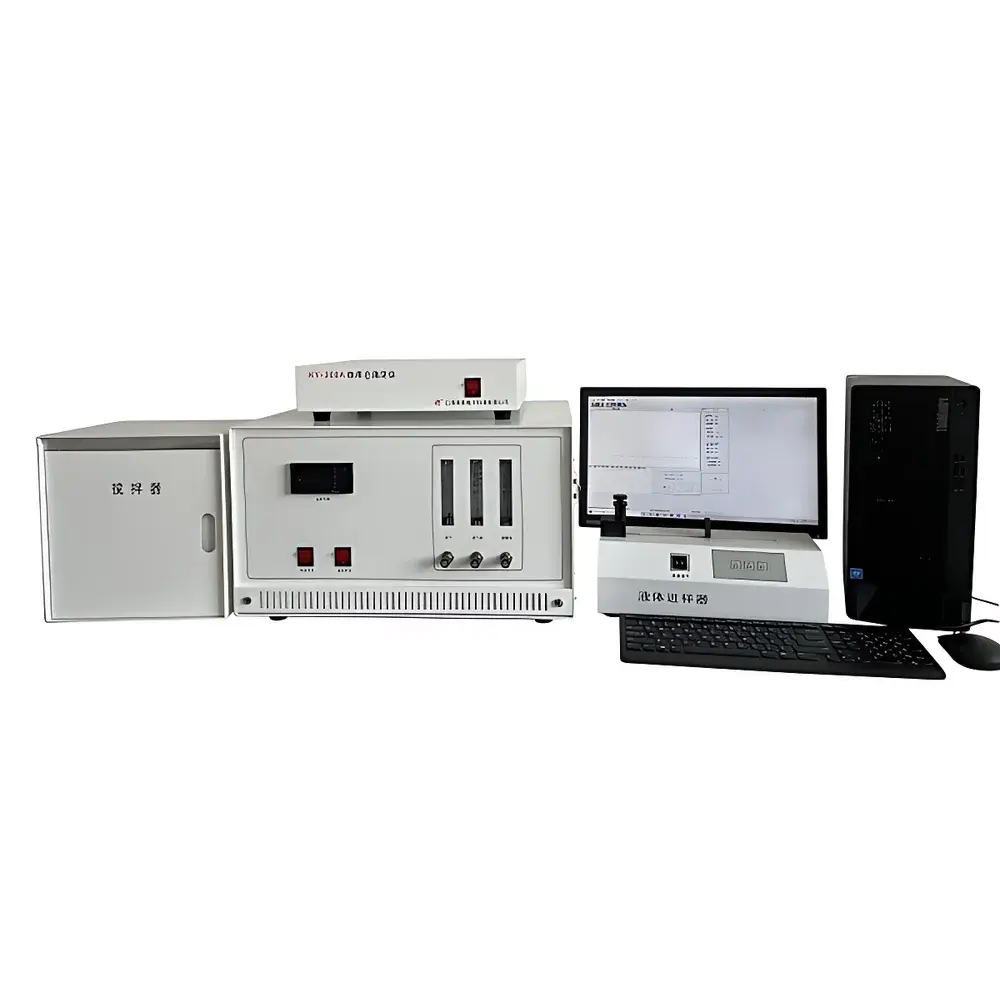
Kyoyuan KY-200 Microcoulometric Sulfur and Chlorine Analyzer
| Brand | Kyoyuan |
|---|---|
| Origin | Jiangsu, China |
| Manufacturer Type | Direct Manufacturer |
| Country of Origin | China |
| Model | KY-200 |
| Price | Upon Request |
| Principle | Microcoulometric Titration (ASTM D5808 / SH/T 0253 / GB/T 11061.4) |
| Sample Forms | Liquid, Solid, Gas (with optional injectors) |
| Detection Range | S: 0.1–10,000 mg/L |
| Cl | 0.2–10,000 mg/L |
| Detection Limit | S: 0.1 mg/L |
| Cl | 0.2 mg/L |
| Repeatability | As per ASTM/SH/GB standards (Cv ≤3% at >10 mg/L) |
| Temperature Control | Ambient to 1100 °C, ±1 °C |
| Power Requirement | 1500 W |
| Carrier Gases | Industrial-grade N₂ and O₂ |
| Cooling | Fan-cooled pyrolysis furnace with auto-start/stop logic |
Overview
The Kyoyuan KY-200 Microcoulometric Sulfur and Chlorine Analyzer is a precision electrochemical instrument engineered for quantitative determination of total sulfur and total chlorine in hydrocarbon-based matrices using the microcoulometric titration principle. Based on Faraday’s law of electrolysis, the analyzer oxidizes sample-bound sulfur or chlorine compounds under controlled high-temperature combustion (up to 1100 °C) in a dual-gas (N₂/O₂) environment. Sulfur species are converted quantitatively to SO₂, while chlorine species yield HCl gas. These gaseous analytes are swept into a dual-mode titration cell where electrogenerated titrants—iodine (I₂) for sulfur and silver ions (Ag⁺) for chlorine—react stoichiometrically with the incoming analyte. The integrated coulometer measures the charge (in coulombs) consumed during electrolysis, enabling direct mass calculation of sulfur or chlorine content without external calibration curves. Designed for compliance with internationally recognized test methods—including ASTM D5808, SH/T 0253, GB/T 11061.4, SH/T 0222, GB/T 3208, and GB/T 18612—the KY-200 delivers trace-level detection (0.1 mg/L S, 0.2 mg/L Cl) with high reproducibility across liquid, solid, and gaseous samples.
Key Features
- Dual-analyte capability: Simultaneous or independent quantification of sulfur and chlorine via software-selectable titration modes (I₂ or Ag⁺ generation)
- Digitally stabilized coulometric cell: Low-noise potentiostat architecture ensures baseline stability and minimizes drift during extended analyses
- Programmable high-temperature pyrolysis furnace: Precisely regulated from ambient to 1100 °C (±1 °C), optimized for complete conversion of refractory organosulfur and organochlorine compounds
- Intelligent thermal management: Fan-cooled reactor housing with automatic start/stop logic based on real-time temperature feedback—eliminates manual intervention and improves system longevity
- Modular sample introduction: Compatible with liquid autosamplers (1–100 µL), solid boat injectors (up to 100 mg), and gas sampling loops (for LPG, natural gas, or refinery off-gas)
- Embedded control firmware: Real-time monitoring of cell potential, electrolysis current, gas flow rates, and furnace status—all accessible via front-panel LCD or remote PC interface
Sample Compatibility & Compliance
The KY-200 supports analysis of diverse sample types relevant to petroleum refining, petrochemical manufacturing, environmental monitoring, and quality assurance laboratories. Validated matrices include gasoline, diesel, jet fuel, lubricating oils, crude oil, liquefied petroleum gas (LPG), natural gas condensates, catalysts, polymer additives, and wastewater effluents. Its measurement protocol adheres strictly to regulatory and industrial standards: ASTM D5808 (organic chloride in aromatics), SH/T 0253 (total sulfur in light distillates), GB/T 11061.4 (total sulfur in natural gas), SH/T 0222 (LPG sulfur), GB/T 3208 (benzene-series sulfur), and GB/T 18612 (organic chlorine in crude oil). Instrument design incorporates electrical safety (IEC 61010-1), electromagnetic compatibility (EN 61326-1), and operational traceability features aligned with GLP and pre-GMP environments.
Software & Data Management
The KY-200 operates under Kyoyuan’s proprietary Analytical Control Suite (ACS v4.x), a Windows-based application providing full sequence control, real-time signal visualization, and audit-ready data handling. Software functions include method storage (user-defined temperature ramps, gas flows, integration windows), automatic peak detection and charge integration, linear/nonlinear calibration curve fitting (multi-point or single-point), and uncertainty estimation per ISO/IEC 17025 guidelines. All raw data—cell voltage, current, time stamps, and calculated concentrations—are saved in encrypted binary format with metadata tagging (operator ID, sample ID, instrument serial number, environmental conditions). Export options include CSV, PDF reports, and XML for LIMS integration. Electronic signatures, user access levels, and 21 CFR Part 11–compliant audit trails (including modification history and deletion logs) are available as optional licensed modules.
Applications
- Refinery process control: Monitoring sulfur removal efficiency in hydrotreaters and monitoring chlorine ingress in FCC feedstocks
- Fuel certification: Verification of ultra-low-sulfur diesel (ULSD, ≤10 mg/kg) and jet fuel (Jet A-1, ≤1000 mg/kg) compliance
- Environmental testing: Quantification of organochlorine pesticides, PCB congeners, and chlorinated solvents in soil extracts and aqueous samples
- Research & development: Reaction pathway studies involving sulfur/chlorine-containing intermediates in catalytic cracking or alkylation processes
- Quality control in specialty chemicals: Verification of halogen-free specifications in electronic-grade solvents and polymer precursors
- Regulatory submission support: Generating validated data packages for EPA Method 1664, ISO 8217, and EN 590 compliance documentation
FAQ
What sample forms can the KY-200 analyze?
Liquid samples (neat or diluted), solids (powders, granules, catalysts), and gases (LPG, natural gas, syngas) — each requiring dedicated injection hardware.
Is calibration required before every analysis?
No. The instrument applies absolute quantification via Faraday’s law; only periodic verification with certified reference materials (e.g., DBT for sulfur, chlorobenzene for chlorine) is recommended per ASTM D5808 Section 8.
Can the same titration cell be used for both sulfur and chlorine analysis?
Yes. The dual-mode cell is chemically inert and configurable via software-driven electrode polarity reversal and electrolyte selection (LiBr/acetone for Cl⁻; KI/acetonitrile for SO₂).
What gas purity is required for reliable operation?
Industrial-grade nitrogen (99.99% pure) and oxygen (99.5% pure) are sufficient; no ultra-high-purity gases are necessary due to integrated gas purification traps.
How does the system handle high-concentration samples (>5000 mg/L)?
Automatic dilution is not built-in, but the software supports post-run dilution factor input; users typically perform offline dilution using certified diluents and reanalyze.
Is remote diagnostics supported?
Yes. With optional Ethernet module and ACS Remote Access license, engineers can perform live parameter review, firmware updates, and troubleshooting via secure TLS-encrypted connection.






