
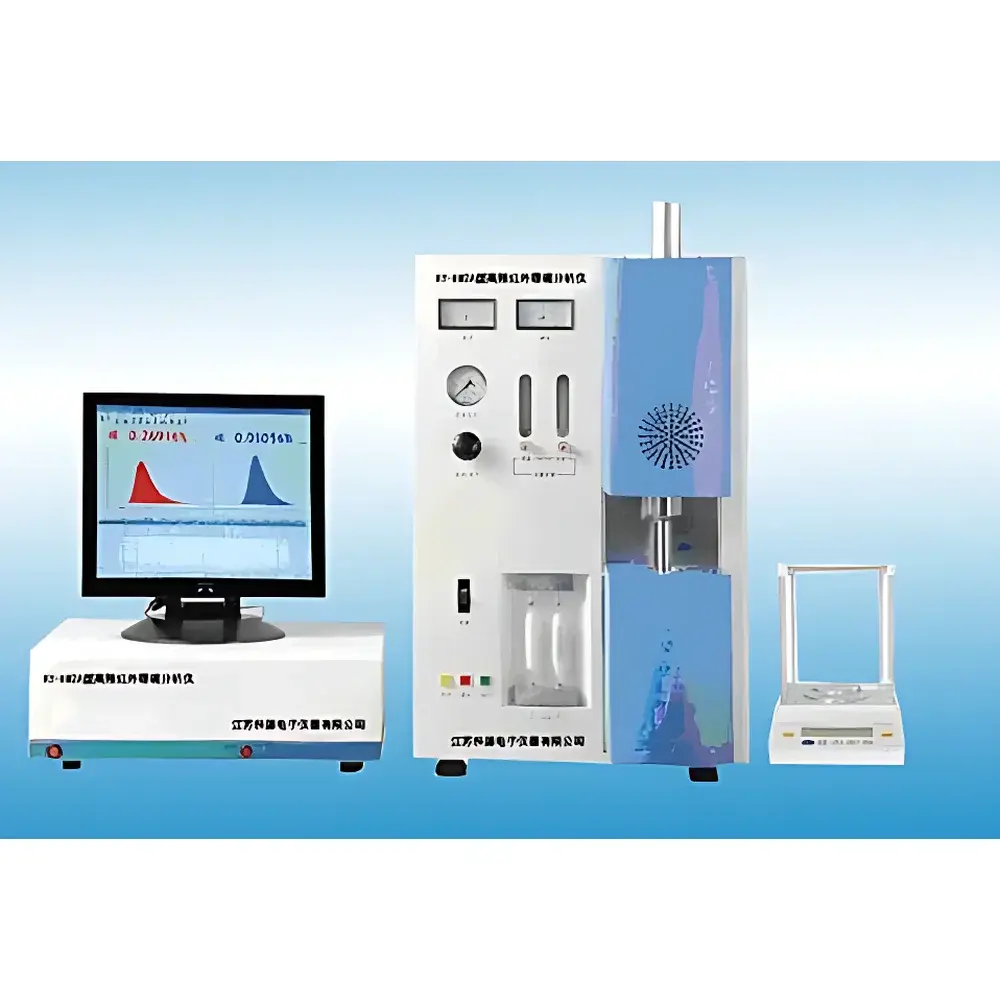
KY-HW2A High-Frequency Infrared Carbon-Sulfur Analyzer
| Brand | Keyuan Instruments |
|---|---|
| Origin | Jiangsu, China |
| Manufacturer Type | Direct Manufacturer |
| Product Origin | Domestic (China) |
| Model | KY-HW2A |
| Price Range | USD 14,000–42,000 (FOB) |
| Measurement Principle | Non-Dispersive Infrared (NDIR) Absorption |
| Combustion System | High-Frequency Induction Furnace (2200 W, 20 MHz) |
| Carbon Range | 0.0005–6.0000 wt% (extendable to 99.999%) |
| Sulfur Range | 0.0005–0.3500 wt% (extendable to 99.999%) |
| Sample Mass (steel standard) | 0.5 g typical |
| Sensitivity | 0.1 ppm for both C and S |
| Precision | Compliant with ISO 9556 (carbon) and ISO 4935 (sulfur) |
| Analysis Time | Adjustable 20–100 s (standard: 35 s) |
| Duty Cycle | Continuous 24 h operation |
| Dust Filter Pore Size | 0.4 µm metallic sintered filter |
| Optical Coupling | Agilent 1521/2521 high-speed fiber-optic interface |
| Detector | High-stability pyroelectric infrared detector with gold-plated analysis cell |
| Light Source | Custom platinum-based IR emitter |
| ADC Resolution | 24-bit ADS1224 |
| Control Architecture | Dual-CPU modular design (Atmega162 lower-level controller) |
| Communication Interface | USB 2.0 |
| Power Supply | Industrial-grade linear regulated module |
Overview
The KY-HW2A High-Frequency Infrared Carbon-Sulfur Analyzer is a fully integrated elemental combustion analyzer engineered for precise, simultaneous quantification of total carbon (C) and sulfur (S) in solid inorganic and metallurgical samples. It operates on the principle of high-frequency induction combustion coupled with non-dispersive infrared (NDIR) spectroscopy — a reference method standardized under ISO 9556 and ISO 4935. During analysis, a precisely weighed sample (typically 0.5 g of steel standard) is combusted in an oxygen-rich atmosphere within a 2200 W, 20 MHz high-frequency induction furnace. The evolved CO₂ and SO₂ gases are swept through a dust-removal system, dried, and directed into dual-channel NDIR detection cells. Each gas exhibits characteristic absorption bands in the mid-infrared region (e.g., CO₂ at 4.26 µm, SO₂ at 7.35 µm), enabling selective, interference-resistant quantification via calibrated Beer-Lambert law modeling. The system’s architecture eliminates electromagnetic coupling between the furnace and detector through optical fiber (Agilent 1521/2521) and multi-stage galvanic isolation, ensuring signal integrity even during extended 24-hour unattended operation.
Key Features
- High-frequency induction furnace with real-time current/voltage/power regulation — optimized for heterogeneous sample matrices including ferrous alloys, non-ferrous metals, cement, ores, coke, catalysts, and foundry core sands
- 0.4 µm sintered metal dust filter and automated high-pressure ash ejection system — minimizes carryover and maintains long-term baseline stability
- Heated furnace head design — enhances SO₂ conversion efficiency and improves sulfur recovery in refractory or low-sulfur materials
- Dual-channel NDIR detection using gold-plated analysis cells and thermally stable pyroelectric detectors — delivers 0.1 ppm sensitivity for both carbon and sulfur
- Modular dual-CPU control architecture: Atmega162 microcontroller handles real-time combustion sequencing and sensor acquisition; host PC manages method execution, calibration, and reporting
- 24-bit high-resolution ADC (ADS1224) and USB 2.0 communication — ensures sub-microvolt signal fidelity and deterministic data transfer latency
- Industrial linear power supply and custom platinum IR source — guarantee spectral output consistency and thermal drift < 0.02% over 8 h
Sample Compatibility & Compliance
The KY-HW2A supports solid, non-volatile samples across metallurgy, mining, construction, and catalysis sectors. Validated matrices include carbon steels, stainless steels, cast irons, aluminum and copper alloys, limestone, blast furnace slags, petroleum coke, and ceramic precursors. All analytical protocols align with international regulatory frameworks: carbon results meet ISO 9556 (Steel — Determination of total carbon content — Infrared absorption method after combustion in high-frequency induction furnace), while sulfur determinations satisfy ISO 4935 (Steel — Determination of sulfur content — Infrared absorption method after combustion in high-frequency induction furnace). The system supports audit-ready data handling compliant with GLP and GMP requirements, including electronic signature-capable method templates, calibration log archiving, and user-access-controlled parameter locking.
Software & Data Management
The analyzer is operated via Windows-based KyAnalyst software, supporting method-driven workflow automation, multi-point calibration curve generation (linear and quadratic), and automatic blank subtraction. Raw absorbance spectra, time-resolved gas evolution profiles, and diagnostic logs (furnace temperature ramp, O₂ flow stability, detector voltage drift) are stored in vendor-neutral CSV and XML formats. Audit trail functionality records all user actions — including calibration edits, sample re-runs, and instrument configuration changes — with timestamps and operator IDs. Data export modules support direct integration with LIMS platforms via ODBC and HL7-compatible interfaces. Software validation documentation (IQ/OQ/PQ protocols) is available upon request for regulated laboratory environments.
Applications
- Quality control of incoming raw materials (scrap, pig iron, ferroalloys) in integrated steel mills
- Final product certification for ASTM A29/A108 and EN 10027 grade compliance
- Sulfur speciation studies in desulfurization catalysts and flue gas scrubber residues
- Carbon content verification in graphite electrodes and refractory ceramics
- Trace sulfur monitoring in high-purity copper used for semiconductor interconnects
- Research-scale stoichiometric analysis of novel battery cathode precursors (e.g., LiFePO₄, NMC)
FAQ
What standards does the KY-HW2A comply with for carbon and sulfur measurement?
It conforms to ISO 9556 for carbon and ISO 4935 for sulfur — both specifying high-frequency induction combustion followed by infrared detection.
Can the instrument analyze liquid or powder samples directly?
No — it is designed exclusively for solid, non-volatile specimens. Powders must be pelletized or mixed with tungsten flux; liquids require prior evaporation and residue combustion.
Is the system compatible with 21 CFR Part 11 requirements?
While the base configuration supports electronic signatures and audit trails, full 21 CFR Part 11 compliance requires optional validation packages and role-based access control modules.
What maintenance intervals are recommended for the dust filter and IR source?
The 0.4 µm sintered metal filter should be inspected after every 500 analyses and cleaned ultrasonically; the platinum IR source has a rated lifetime of ≥10,000 hours under normal operating conditions.
Does the analyzer support external gas calibration standards?
Yes — certified CO₂ and SO₂ span gases (NIST-traceable) can be introduced via the auxiliary gas inlet for daily performance verification and drift correction.




