
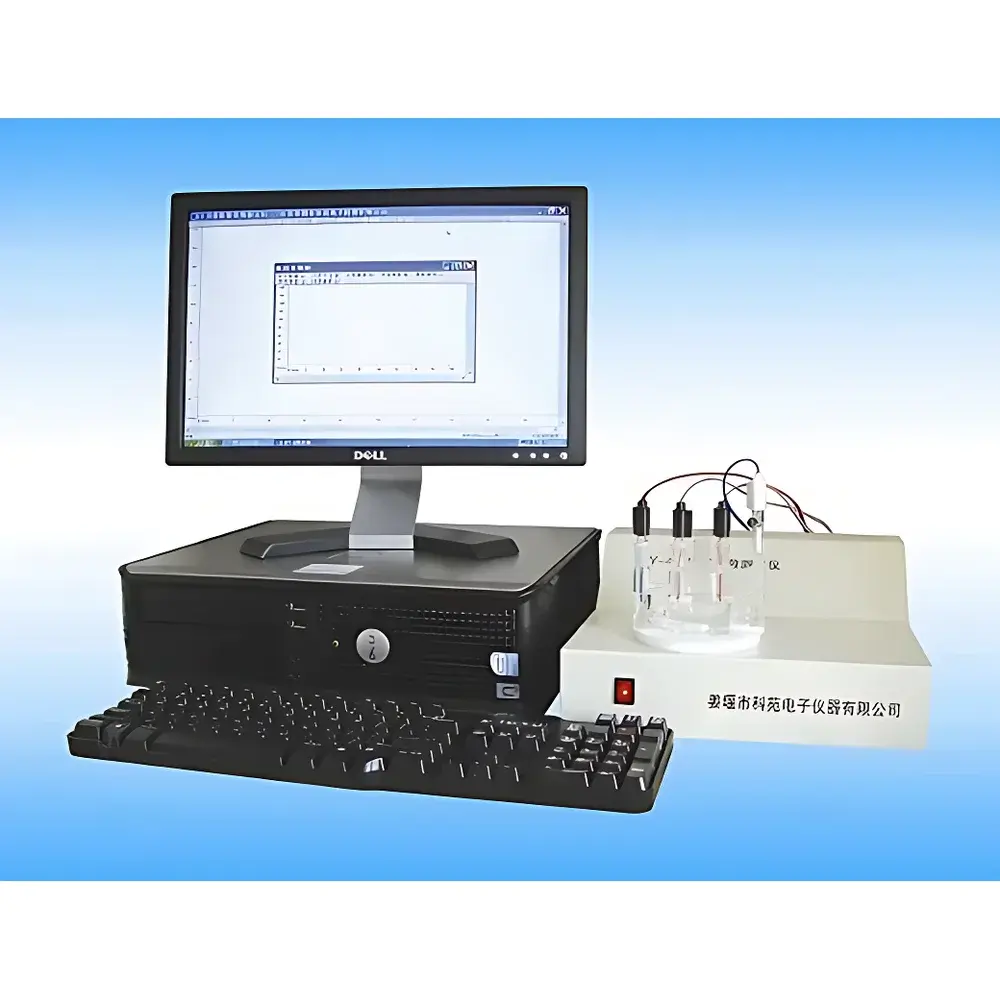
Kyuan KY-4Br Microcomputer-Based Bromine Number and Bromine Index Analyzer
| Origin | Jiangsu, China |
|---|---|
| Manufacturer Type | Authorized Distributor |
| Origin Category | Domestic (China) |
| Model | KY-4Br |
| Pricing | Upon Request |
| Measurement Principle | Coulometric Titration (Microcoulometry) |
| Sample Type | Liquid Hydrocarbons |
| Method Standard Compliance | SH/T 0630–1996, SH/T 1551–2018, GB/T 11136–1989(2004), SH/T 1767–2008(2015), GB/T 1815–1997, ASTM D1492 |
| Detection Range | Bromine Number: 0–300 g Br/100 g oil |
| Bromine Index | 1–1000 mg Br/100 g oil |
| Resolution | 0.01 mg Br |
| Detection Limit | 0.1 mg Br |
| Accuracy | ±5% (for bromine index ≥1 mg Br/100 g oil) |
| Bias Voltage Range | 0–500 mV |
| Endpoint Detection | Dual Platinum Electrode Potentiometric Detection |
| Electrolytic Cell Volume | 150 mL |
| Stirring Mechanism | Magnetic Stirrer |
| Power Supply | 220 V, 50 Hz |
| Power Consumption | 20 W |
| Net Weight | ~1.6 kg |
Overview
The Kyuan KY-4Br Microcomputer-Based Bromine Number and Bromine Index Analyzer is a dedicated coulometric titration system engineered for precise, trace-level quantification of unsaturation in liquid petroleum hydrocarbons. It operates on the fundamental principle of microcoulometric titration: bromine is generated *in situ* via controlled electrolysis of a bromide-containing electrolyte within a sealed titration cell; the electrogenerated bromine reacts stoichiometrically with carbon–carbon double bonds (C=C) in the injected sample. The instrument continuously monitors the potential across dual platinum indicator electrodes; when all reactive unsaturation is consumed, a sharp potential shift signals endpoint detection. Total charge passed (Q, in coulombs) is integrated in real time and converted to bromine mass using Faraday’s law (1 mole Br₂ ≡ 2 × 96,485 C). Final results—bromine number (g Br₂/100 g sample) or bromine index (mg Br₂/100 g sample)—are calculated and reported automatically. This method delivers high reproducibility, minimal reagent consumption, and direct traceability to fundamental electrochemical constants.
Key Features
- Potentiometric endpoint detection using dual platinum electrodes ensures stable, drift-free signal acquisition and high measurement repeatability (RSD < 3% at mid-range concentrations).
- Non-toxic, benzene-free electrolyte formulation eliminates occupational health hazards and simplifies laboratory safety compliance without compromising analytical sensitivity.
- Proprietary sintered glass frit replaces conventional ion-selective membranes—eliminating membrane failure, clogging, and associated calibration drift or false endpoints.
- Serial RS-232 interface enables full bidirectional communication with host PC; all operational parameters (bias voltage, gain, integration time), endpoint logic, and real-time current/voltage monitoring are software-controllable.
- Integrated magnetic stirring ensures homogeneous mixing and rapid mass transfer, critical for achieving sub-minute analysis times (typical cycle: ≤ 60 s per sample).
- Ultra-low reagent consumption: average electrolyte usage < 1 mL per analysis; minimal sample requirement (≤ 10 µL for bromine number; ≤ 50 µL for bromine index) reduces cost and waste generation.
- High-resolution digital conversion (0.01 mg Br) and low detection limit (0.1 mg Br) support regulatory-grade testing of highly saturated base oils and premium distillates.
Sample Compatibility & Compliance
The KY-4Br is validated for routine analysis of refined liquid hydrocarbon streams including gasoline, kerosene, diesel fuel, lubricating oil fractions, and light/heavy aromatic cuts (e.g., BTX, C9–C10 aromatics). Its design adheres strictly to internationally recognized standard test methods: SH/T 0630–1996 and SH/T 1551–2018 (China Petrochemical Industry Standards), GB/T 11136–1989(2004) and GB/T 1815–1997 (Chinese National Standards), and ASTM D1492 (Standard Test Method for Bromine Index of Aromatic Hydrocarbons by Coulometric Titration). While not inherently 21 CFR Part 11 compliant, its data logging architecture supports audit-ready operation when deployed under documented GLP/GMP procedures—including timestamped raw current/time traces, endpoint confirmation logs, and user-accessible calibration history.
Software & Data Management
Bundled Windows-based control software provides complete instrument orchestration: automated method loading, real-time electrochemical waveform display (current vs. time), dynamic endpoint recognition with adjustable hysteresis, and automatic result calculation per defined standards. All measurements are stored with metadata (operator ID, sample ID, date/time, method version, cell status). Export formats include CSV and PDF reports with embedded chromatogram-like titration curves. Data integrity is reinforced via password-protected user roles, electronic signature prompts for critical actions (e.g., calibration update), and immutable audit trails recording parameter changes and result modifications—facilitating internal QA review and external regulatory inspection readiness.
Applications
- Quality control of naphtha hydrotreating efficiency by tracking residual olefin content pre- and post-treatment.
- Specification verification of jet fuel (ASTM D1655) and diesel (ASTM D975) for bromine index compliance (< 5–10 mg Br/100 g).
- Monitoring saturation levels in white oil and medicinal mineral oil production (USP/EP monographs).
- Research-scale evaluation of catalyst selectivity in selective hydrogenation of diolefins in cracked gasoline streams.
- Batch release testing of aromatic solvents (e.g., xylene, cumene) where trace unsaturation impacts polymerization inhibitor performance.
FAQ
What sample volume is required for bromine index analysis?
Typical injection volume is ≤ 50 µL for bromine index determination; ≤ 10 µL suffices for higher-concentration bromine number assays.
Is the instrument compatible with ASTM D1492?
Yes—the KY-4Br implements coulometric bromine generation and potentiometric endpoint detection per the core requirements of ASTM D1492, and is routinely used for compliance testing in third-party labs serving North American clients.
How often must the electrolyte be replaced?
Under normal use (20–30 samples/day), the 150 mL electrolyte reservoir remains stable for ≥ 7 days; replacement is indicated by rising baseline current or inconsistent endpoint response.
Can the system be integrated into a LIMS environment?
Raw data export (CSV) and structured report generation enable seamless LIMS ingestion via standard file-transfer protocols; API-level integration requires custom middleware development.
What maintenance is required for long-term reliability?
Daily: rinse electrodes with acetone/methanol; weekly: inspect frit integrity and clean cell cavity; quarterly: verify bias voltage accuracy with certified reference solutions (e.g., 100 mg Br/100 g standard).





