
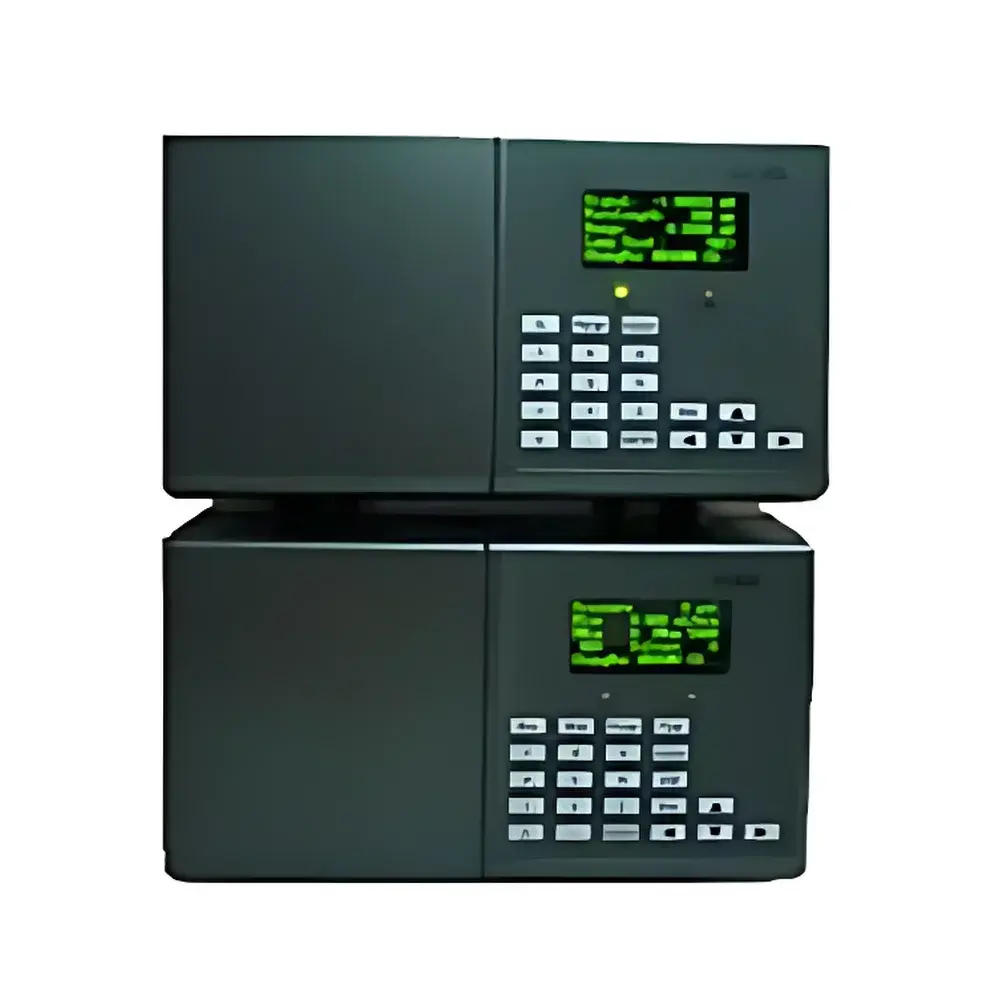
Kyocera AA-510 Amino Acid Analyzer
| Brand | Kyocera |
|---|---|
| Origin | Beijing, China |
| Manufacturer Type | Authorized Distributor |
| Product Category | Domestic |
| Model | AA-510 |
| Price | Upon Request |
| Detector | AA-510D with Digital Output (RS-232/USB), 254 nm UV Detection, Baseline Noise ≤2×10⁻⁵ AU, Drift ≤4×10⁻⁵ AU/h (MeOH, 1 mL/min), LOD ≤1 ng/mL (Naphthalene/MeOH), Deuterium Lamp (Imported German) |
| Pump | AA-510P Dual-Piston High-Pressure Isocratic/Gradient Pump, Flow Range 0.001–10.000 mL/min (0.001 mL/min increments), Accuracy ≤±1% @ 1.000 mL/min / 8.5 MPa / H₂O / RT, RSD ≤0.25%, Max Pressure 42 MPa (6000 psi), Pressure Pulsation <0.1 MPa @ 1 mL/min / 5–10 MPa |
| Software | Dual-Channel Chromatography Data System (CDS) for Windows OS, Real-Time Baseline Monitoring, Auto Peak Recognition (solvent, tailing, front/back shoulder, serrated), Manual Integration Tools, Quantitation Methods (external/internal standard, normalization, group-based, exponential), Export to Excel/Word, Image Export to Photoshop/CorelDRAW, Reintegration & Archiving, Sampling Rate up to 40 Hz |
| Dimensions & Power | 360 × 260 × 170 mm, 5.9 kg, AC 110/220 V, 50/60 Hz, 60 W |
Overview
The Kyocera AA-510 Amino Acid Analyzer is a dedicated high-performance liquid chromatography (HPLC) system engineered specifically for quantitative and qualitative analysis of free amino acids in complex biological and industrial matrices. It implements post-column derivatization with ninhydrin or ortho-phthalaldehyde (OPA), followed by UV–Vis detection at 254 nm—compliant with established pharmacopeial and food safety protocols including USP , AOAC 982.30, and ISO 13903. Unlike generic HPLC platforms requiring extensive method development, the AA-510 integrates purpose-built hardware, pre-validated separation columns (e.g., cation-exchange resins with sulfonate functionalization), and application-specific software modules optimized for 20+ proteinogenic and non-proteinogenic amino acids—including cysteine, taurine, hydroxyproline, and γ-aminobutyric acid (GABA). Its architecture adheres to fundamental chromatographic principles: precise flow delivery ensures retention time reproducibility (RSD <0.25% across full 0.001–10.000 mL/min range), while the digitally stabilized UV detector minimizes baseline artifacts critical for low-abundance analyte quantification in feed, dairy, meat, and infant formula samples.
Key Features
- AA-510D UV-Vis detector with imported German deuterium lamp and digital output interface (RS-232/USB), eliminating analog-to-digital conversion losses and reducing baseline noise to ≤2×10⁻⁵ AU and drift to ≤4×10⁻⁵ AU/h under standardized methanol conditions.
- AA-510P dual-piston reciprocating pump featuring patented “floating piston seal” technology, enabling automatic purge and self-cleaning functions—extending seal lifetime and maintaining pressure stability (<0.1 MPa pulsation) across full flow range up to 42 MPa (6000 psi).
- Integrated thermal management in optical path and flow cell, ensuring rapid equilibration (<30 min warm-up) and minimal wavelength shift (<0.1 nm) over extended operation—critical for long-gradient runs in feedstuff analysis.
- OLED display with high-contrast rendering and real-time parameter feedback (pressure, flow, lamp status, error codes), supporting GLP-compliant operator interaction without external PC dependency.
- Hardware-level safety protocols including over-pressure cutoff, lamp-failure detection, and solvent leak monitoring—fully documented in instrument log files for audit readiness.
Sample Compatibility & Compliance
The AA-510 accommodates diverse sample types after appropriate pretreatment: acid-hydrolyzed tissue digests (6M HCl, 110°C, 22 h), enzymatic hydrolysates (e.g., protease-treated milk proteins), derivatized plant extracts, and clarified fermentation broths. Sample introduction is compatible with standard 10–100 µL loop injectors and autosamplers meeting ISO 15195 requirements for clinical laboratory instrumentation. The system conforms to electromagnetic compatibility (EMC) standards IEC 61326-1 and electrical safety standard IEC 61010-1. All firmware and software modules support ALCOA+ data integrity principles: electronic signatures, audit trails (user action, timestamp, parameter change), and immutable raw data storage—enabling compliance with FDA 21 CFR Part 11 when deployed in regulated environments such as contract testing laboratories serving FDA-regulated food or nutraceutical clients.
Software & Data Management
The Kyocera Chromatography Data System (CDS) is a dual-channel, Windows-native application supporting Windows 7 through 11 (32/64-bit). It provides real-time baseline stabilization via dynamic threshold adjustment prior to injection, automatic peak classification (solvent front, tailing, front shoulder, co-elution artifacts), and adaptive integration window expansion during gradient elution. Quantitative workflows include internal standard calibration (e.g., norleucine), response factor tables per amino acid, and batch processing with QC flagging (e.g., %RSD >5% triggers review). Raw chromatograms (.kyd) are stored with embedded metadata (instrument ID, method file hash, operator ID, environmental logs). Export formats include CSV (for LIMS ingestion), PDF reports with embedded spectral overlays, and EMF vector graphics compatible with regulatory submission packages. Re-processing is fully traceable: every manual integration edit generates a new audit-trail entry with before/after overlay comparison.
Applications
The AA-510 is routinely deployed in quality control laboratories across agri-food supply chains: verification of lysine/methionine enrichment in compound animal feeds (per GB/T 18246–2019); authenticity assessment of hydrolyzed vegetable protein (HVP) vs. hydrolyzed fish protein in sauces; nutritional labeling compliance for essential amino acid profiles in infant formulas (aligned with Codex Stan 72–1981); and residue monitoring of D-amino acids in fermented dairy products as indicators of microbial spoilage. In research settings, it supports metabolic phenotyping in rodent models—quantifying plasma taurine shifts following dietary sulfur amino acid restriction. Its robustness in high-salt mobile phases (e.g., lithium citrate buffers) and resistance to column fouling from phospholipid-rich extracts make it suitable for tissue homogenate analysis without offline solid-phase cleanup in many cases.
FAQ
Does the AA-510 support gradient elution for improved resolution of polar amino acids?
Yes—the AA-510P pump supports binary gradient mixing with programmable solvent composition ramps, enabling optimized separation of acidic (aspartic acid, glutamic acid) and basic (arginine, histidine) residues within a single run.
Is method transfer possible from legacy amino acid analyzers (e.g., Hitachi L-8900 or Biochrom 30+)?
Method parameters (column dimensions, buffer pH, temperature, flow rate) are directly translatable; Kyocera provides migration templates and retention time alignment tools within the CDS software.
What maintenance intervals are recommended for the deuterium lamp and pump seals?
Deuterium lamp lifetime exceeds 2000 hours under normal use; pump seal replacement is advised every 6 months or after 5000 injections—both intervals are tracked automatically and logged in the instrument’s service history.
Can the system be integrated into a laboratory information management system (LIMS)?
Yes—via configurable ODBC drivers and ASCII/CSV export protocols compliant with ASTM E1467 and ISO/IEC 17025 Annex A.2 data exchange requirements.
Is validation documentation (IQ/OQ/PQ protocols) available?
Kyocera supplies vendor-qualified IQ/OQ checklists and PQ test procedures aligned with USP Analytical Instrument Qualification, including system suitability criteria for resolution (Rs ≥2.0 between serine/threonine), tailing factor (<2.0), and precision (RSD ≤1.5% for replicate injections).





