
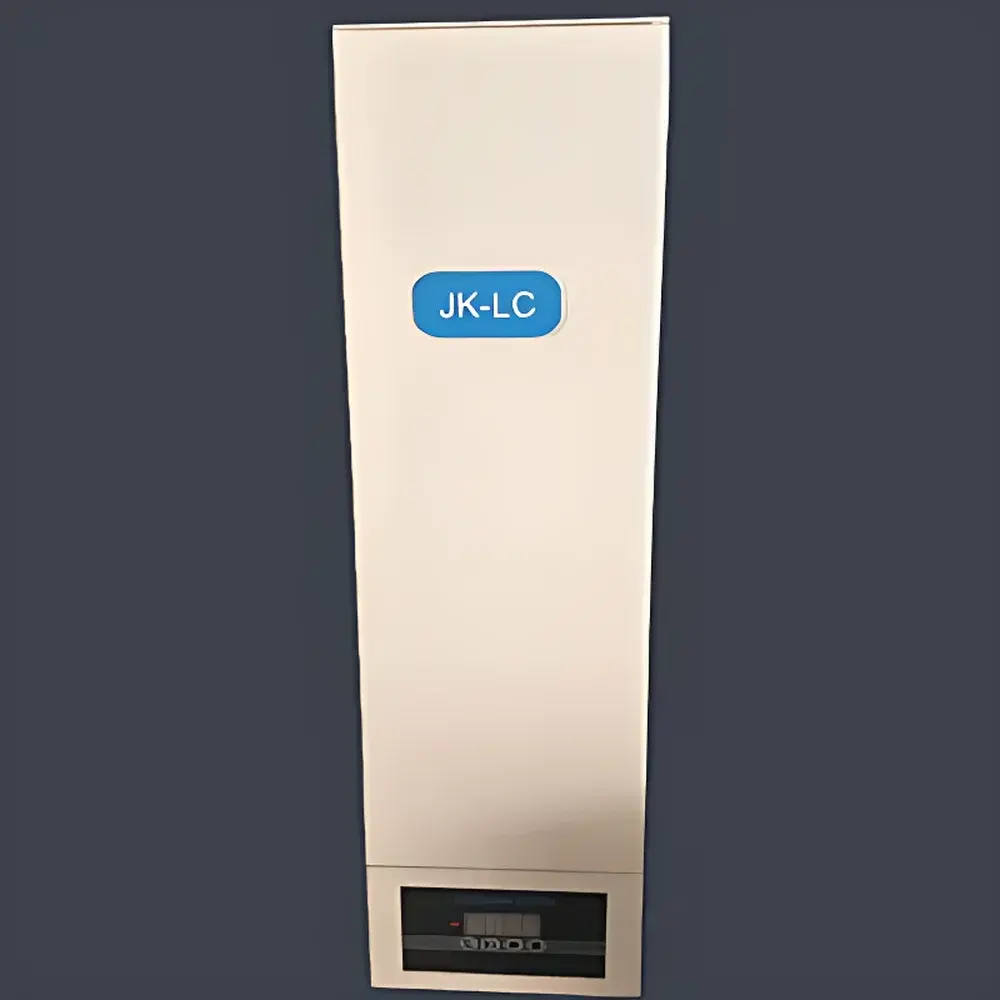
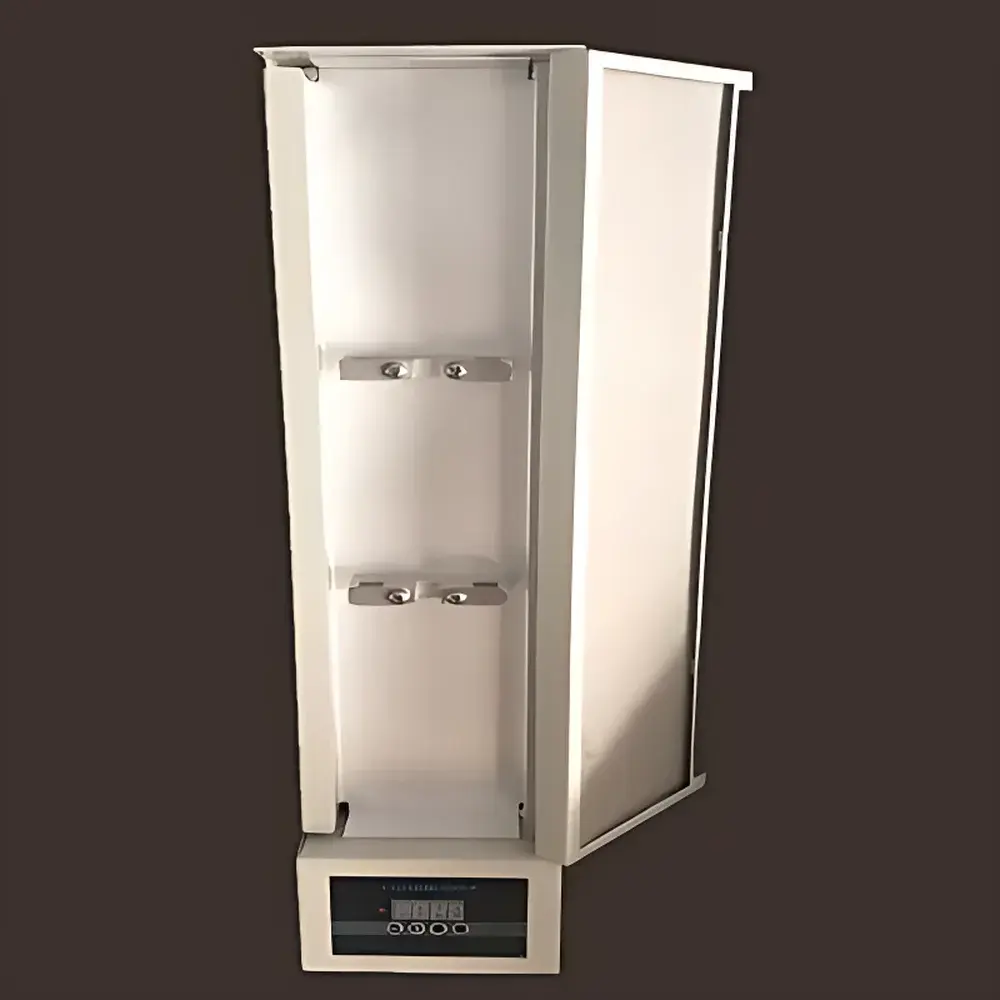
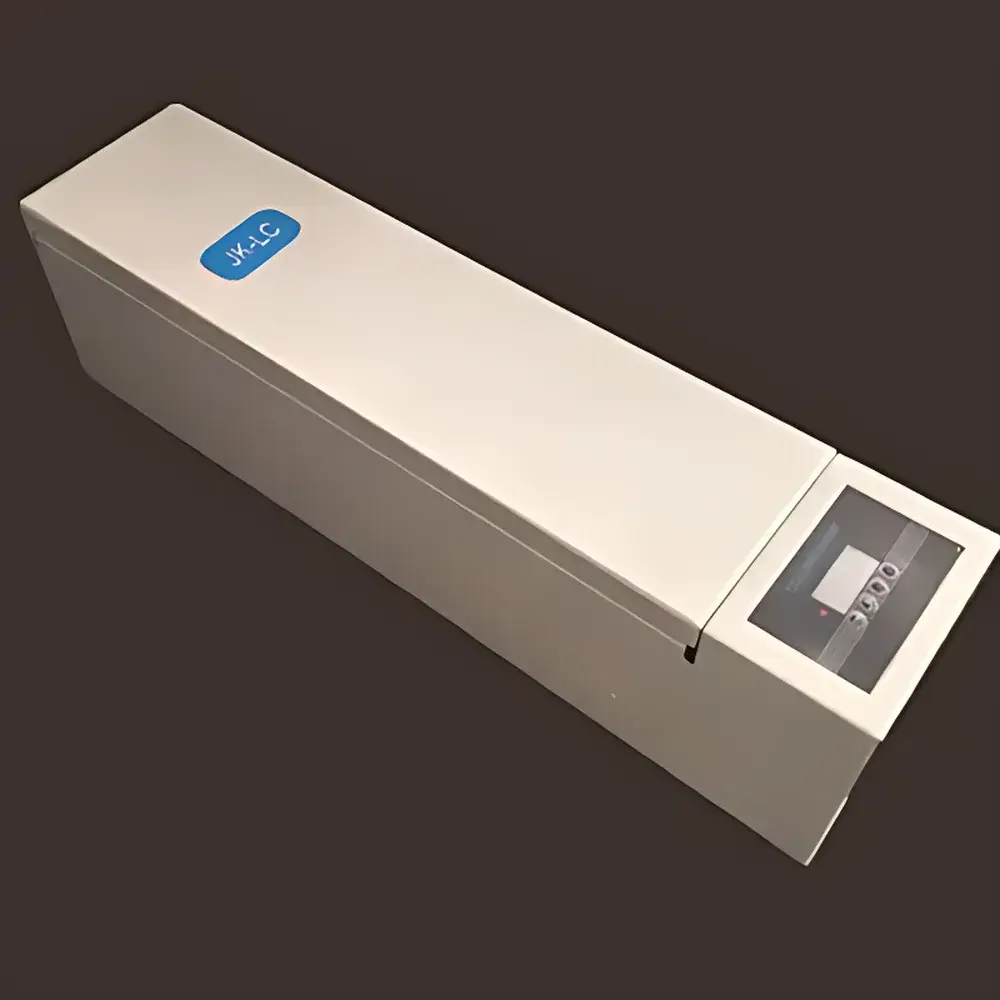
Kyocera JK-LC HPLC Column Oven
| Brand | Kyocera |
|---|---|
| Origin | Beijing, China |
| Manufacturer Type | Authorized Distributor |
| Country of Origin | China |
| Model | JK-LC |
| Price Range | USD 700–1,400 (FOB) |
| Temperature Control | Heating-only (no refrigeration) |
| Temperature Range | Ambient to 100 °C |
| Temperature Stability | ±0.1 °C |
| Temperature Uniformity | ±0.1 °C (at 50 °C) |
| Repeatability | ±0.1 °C |
| Chamber Dimensions | 350 mm × 45 mm × 40 mm (L × W × H) |
| Power Supply | 220 V AC, 50 Hz |
| Display | Dual-line LED |
| Control Interface | Touch-sensitive membrane switches |
| Safety Features | Over-temperature alarm + auto cut-off |
| Mounting | Magnetic lid retention |
| Viewing Window | Integrated tempered glass viewport |
| Column Capacity | 1–2 standard HPLC columns (up to 250 mm length) |
Overview
The Kyocera JK-LC HPLC Column Oven is a precision-engineered thermal management module designed for high-performance liquid chromatography (HPLC) and ultra-high-performance liquid chromatography (UHPLC) systems. It maintains consistent column temperature—critical for retention time stability, peak shape reproducibility, and method robustness—by employing resistive heating controlled via a PID algorithm with adaptive self-tuning capability. Unlike ambient-compensated or fan-assisted enclosures, the JK-LC utilizes a thermally insulated chamber with a high-sensitivity platinum RTD sensor (PT100-class equivalent), enabling real-time feedback and sub-degree thermal regulation across its full operating range (ambient +5 °C to 100 °C). Its heating-only architecture reflects typical operational requirements in regulated pharmaceutical QC labs and academic separation science facilities where column temperatures are routinely elevated above ambient but rarely require active cooling.
Key Features
- PID-based digital temperature control with auto-tuning functionality ensures rapid stabilization and minimal overshoot during setpoint changes.
- Dual-line LED display provides simultaneous readout of set temperature and actual chamber temperature, enhancing operator situational awareness.
- Touch-sensitive membrane keypad enables intuitive parameter entry without mechanical wear or contamination risk—ideal for glove-compatible operation in cleanroom or GMP environments.
- Magnetically secured chamber lid allows tool-free access while maintaining thermal integrity and mechanical alignment during repeated column installation/removal cycles.
- Tempered glass viewport enables non-invasive visual monitoring of column connections, frit integrity, and mobile phase flow behavior without opening the chamber or interrupting analysis.
- Compact footprint (350 mm × 45 mm × 40 mm internal cavity) accommodates standard 150–250 mm analytical columns (e.g., 4.6 mm ID) and supports dual-column configurations for method development or gradient transfer workflows.
- Configurable orientation—vertical or horizontal mounting—enables seamless integration with stacked HPLC modules or benchtop LC-MS interfaces without spatial conflict.
Sample Compatibility & Compliance
The JK-LC oven is compatible with all commercially available stainless steel, PEEK, and fused-silica HPLC columns rated for ≤100 °C and ≤600 bar. It meets mechanical and electrical safety requirements per IEC 61010-1:2010 (Safety Requirements for Electrical Equipment for Measurement, Control, and Laboratory Use). While not certified to ISO/IEC 17025 as a standalone measurement device, its thermal performance characteristics—including ±0.1 °C stability and repeatability—support method validation under USP , EP 2.2.46, and ASTM D7986 for chromatographic temperature-controlled modules. The unit operates without refrigerants or compressors, eliminating maintenance dependencies associated with thermoelectric or vapor-compression cooling systems.
Software & Data Management
The JK-LC operates as a standalone hardware module with no embedded firmware connectivity (e.g., no USB, RS-232, or Ethernet ports). Temperature settings and status are managed exclusively via front-panel interface. For laboratories requiring audit-trail compliance (e.g., FDA 21 CFR Part 11), external data loggers (e.g., calibrated thermistor arrays connected to validated DAQ systems) may be deployed to record chamber temperature profiles alongside chromatographic data acquisition timestamps. This architecture aligns with GLP/GMP principles that prioritize deterministic, low-complexity hardware for critical process parameters—reducing software validation burden while preserving traceability through manual logbooks or LIMS-integrated environmental monitoring records.
Applications
- Routine QC testing in pharmaceutical manufacturing, where column temperature consistency directly impacts system suitability criteria (e.g., tailing factor, resolution, %RSD of retention time).
- Method development for reversed-phase, HILIC, and ion-pair chromatography—where systematic temperature gradients aid selectivity optimization.
- Stability-indicating assays requiring strict thermal control to prevent analyte degradation or column phase collapse during long-gradient runs.
- Academic research involving structure–retention relationship studies, where temperature-dependent thermodynamic parameters (ΔH°, ΔS°) are derived from van’t Hoff plots.
- Environmental and food safety labs performing multi-residue pesticide analysis—where elevated column temperatures improve peak symmetry for polar compounds eluting early in gradient programs.
FAQ
Does the JK-LC support active cooling below ambient temperature?
No. The unit provides heating-only temperature control, with a minimum operating temperature equal to ambient laboratory conditions.
Can the JK-LC be integrated with third-party HPLC system controllers?
Not natively. It lacks digital communication interfaces; integration requires external relay-based control or independent thermal logging synchronized with system software.
What column dimensions are supported in vertical versus horizontal orientation?
In vertical mode, it accommodates up to two 250 mm × 4.6 mm columns stacked end-to-end. In horizontal layout, it fits one 250 mm column or two shorter columns (e.g., 150 mm) side-by-side.
Is calibration documentation provided with shipment?
A factory calibration certificate (traceable to NIM, China) is included, listing as-tested stability and uniformity at 30 °C, 50 °C, and 80 °C.
How often does the temperature sensor require recalibration?
Annual verification against a NIST-traceable reference thermometer is recommended for GxP-regulated use; drift is typically <0.05 °C/year under continuous operation.
Related Products





